Romania triggers EU early warning over Cernavodă Unit 2 — NRG-IA
Legislație & Reglementări Author: Ioana BuzoaicaRomania triggered the EU early warning as drought shut Cernavodă Unit 1 and threatens Unit 2. This is a preventive step, not a crisis declaration.
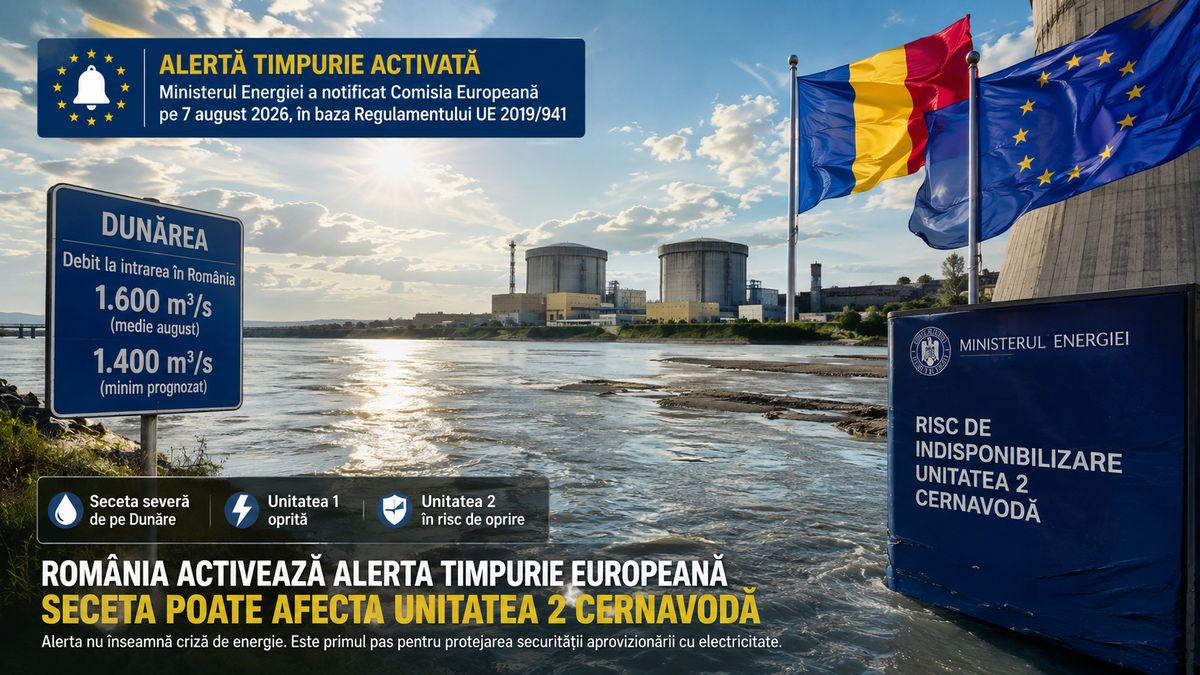
Romania has officially notified the European Commission and competent authorities in member states of the risk that deteriorating hydrological conditions on the Danube could further impact electricity generation. On August 7, 2026, the Ministry of Energy issued an early warning under Article 14(1) of EU Regulation 2019/941 on risk-preparedness in the electricity sector. The central reason for the notification is the situation at the Cernavodă Nuclear Power Plant. Unit 1 is already offline due to extremely low Danube water levels, and the Ministry warns that the persistence or worsening of unfavorable hydrological conditions could also lead to Unit 2 becoming unavailable . At the time the warning was issued, however, the Ministry of Energy specified that there was no negative impact on the domestic electricity market . The warning thus marks a formal escalation of the risk level, rather than the declaration of an active energy crisis. This distinction is explicitly provided for by European legislation. Article 14 of Regulation 2019/941 separates an "early warning"—issued when there is concrete, serious, and reliable information that an electricity crisis may occur —from the "declaration of an electricity crisis," which occurs when a member state is actually facing such a situation. The risk to Unit 2 shifts from a technical scenario to the European warning mechanism The situation at Cernavodă deteriorated rapidly in late July. On July 27, Nuclearelectrica announced that Unit 1 would undergo a controlled shutdown and be disconnected from the National Energy System on the morning of July 28. The company cited the extremely low level of the Danube, caused by severe drought, noting that the shutdown was being carried out in accordance with plant procedures applicable to such conditions. Two days later, Nuclearelectrica also announced its intention to perform a controlled shutdown of Unit 2, depending on the evolution of the Danube's water level. However, the situation changed during the night of July 29–30: an evaluation of operating parameters showed that the unit could continue to operate safely, and it remained connected to the National Energy System. This sequence is essential to understanding the current situation. Unit 2 is not currently scheduled for shutdown , but its operation depends on maintaining technical and hydrological parameters within the limits prescribed by the plant's procedures. The European warning issued on August 7 shows that the risk is no longer being treated solely as an operational issue for the plant. The potential loss of the second nuclear unit has become sufficiently relevant to the security of electricity supply for Romania to activate the formal mechanism provided by European Union legislation. The legal implications of an early warning The European regulation establishes a precise threshold for this procedure. A national authority must issue the warning without undue delay when a seasonal assessment or another qualified source provides concrete, serious, and reliable information that an electricity crisis may occur. The notification must include the causes of the potential crisis, the measures planned or already adopted to prevent it, any potential need for support from other member states, and the effects these measures might have on the European internal market. Declaring a crisis is a separate stage. According to paragraph (2) of the same article, when a member state is actually facing an electricity crisis, the competent authority, after consulting the transmission system operator, formally declares a crisis and informs the European Commission and relevant member states. Romania is currently in the first of these two situations. Therefore, the August 7 warning does not automatically mean halting exports, limiting industrial consumption, or rationing residential electricity. Indeed, the regulation stipulates that non-market-based measures can only be activated during a crisis as a last resort , after all market-based options have been exhausted or when it is clear that they are insufficient to prevent the situation from deteriorating. Such measures must be necessary, proportionate, non-discriminatory, and temporary. Cernavodă already has approximately 700 MW offline Each of the two nuclear units at Cernavodă has an electrical capacity of approximately 700 MW. Under normal conditions, the plant is one of the most important sources of baseload generation in the National Energy System. The shutdown of Unit 1 has already removed approximately 700 MW of available nuclear generation. Under these circumstances, keeping Unit 2 online becomes far more critical for system balance. Should the evolution of the Danube necessitate shutting down the second unit as well, Romania would have to temporarily replace Cernavodă's entire nuclear output through other domestic sources, imports, reserves, and demand-side management measures. This is the risk scenario the state is preparing for,…
Ioana Buzoaica — Independent Editorial Board
The NRG-IA newsroom continuously monitors Romanian energy markets, ANRE regulatory decisions, and national grid telemetry (SEN/SNT). We deliver independent intelligence anchored exclusively in official primary data.
Editorial Charter, Ethics & Verification Methodology →