Romania Delays Lignite Closures to 2028: NRRP and ACER — NRG-IA
Piața de Energie Author: Aurora AIRomania keeps Craiova and Turceni lignite units online, risking up to €100m in NRRP funds as delays in gas and wind projects threaten grid adequacy.
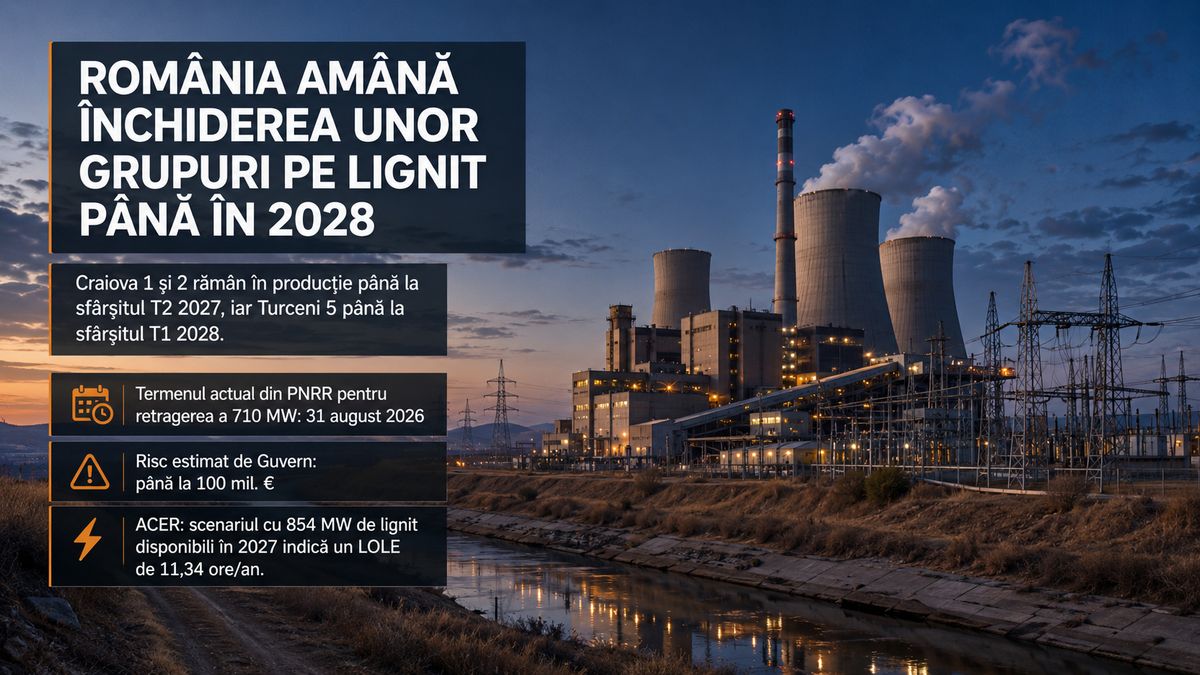
Romania will miss the August 31, 2026 deadline to decommission all the lignite capacities committed under its National Recovery and Resilience Plan (NRRP). On August 28, the Government decided that Craiova Units 1 and 2 will continue production until the end of Q2 2027, while Turceni Unit 5 will remain operational until the end of Q1 2028. This decision conflicts with the current NRRP schedule, which mandates the retirement of a cumulative 710 MW of lignite and hard coal capacity by August 31. The political and financial cost is already clear. Prime Minister Ilie Bolojan stated that Romania could lose up to €100 million in NRRP funding due to this delay, linking the situation to setbacks in the investments meant to replace the old coal-fired plants. For Craiova, the issue goes beyond electricity generation: the plant must be kept online to provide district heating for the upcoming winter, in the absence of the scheduled replacement solution. However, the decision is not merely a choice between coal and decarbonization. Romania has reached the NRRP deadline with some of its dispatchable replacement capacities delayed, and the European adequacy assessment confirms that this delay alters the system's security equation for 2027. The decommissioning schedule has outpaced replacement capacity In Opinion 14/2026 on the national adequacy assessment conducted by Transelectrica, the European Union Agency for the Cooperation of Energy Regulators (ACER) identifies the primary driver of adequacy risk for 2027 as the combination of slower-than-anticipated wind power development and a lack of thermal capacity, resulting from the early phase-out of lignite and delays at the 1.7 GW gas-fired plant in Mintia. The European document also confirms issues with the gas projects at Turceni and Ișalnița. ACER notes delays at the planned 460 MW combined-cycle plant in Turceni and the 825 MW project in Ișalnița, where the second construction tender was canceled on January 30, 2026, after no compliant bids were received. The original timeline for these new capacities has been pushed back from 2026 to 2029. At Mintia, the situation is different, but the impact on 2027 remains relevant. The Government has supported accelerating the project, and production could start in phases before the entire combined cycle is completed. However, ACER notes that the Ministry of Energy accepted an extension of the completion deadline to the end of 2027 and considers it justified to model a delayed entry of the new gas capacity. The result is a transition where old units must be retired before a significant portion of the capacity intended to take over their system function is actually available. ACER criticizes Transelectrica's study but does not validate the accelerated phase-out of lignite The dispute between Bucharest and Brussels becomes more complex when reading the ACER document in its entirety. The central scenario of Transelectrica's assessment indicates a LOLE of 143.55 hours per year for 2027, compared to the Romanian reliability standard of 13 hours per year . LOLE—"Loss of Load Expectation"—estimates the number of hours in a year when system resources would be insufficient to fully cover demand. The value of 143.55 hours is far above the reference threshold, but ACER considers that some of the assumptions producing this result are unjustified. The European agency criticizes, among other things, the incomplete assessment of economic viability, conservative assumptions regarding battery deployment, the lack of demand-side flexibility, and certain assumptions regarding new nuclear capacities. These discrepancies could lead to an incorrect estimation of the security of supply risk. However, ACER simultaneously formulates a key conclusion for the lignite dispute: the accelerated phase-out of coal is inconsistent with the slower development of gas and wind capacities . In Transelectrica's central scenario, only 155 MW of lignite would remain available in 2027, whereas the agency believes this retirement schedule does not sufficiently reflect the actual delays in Romania's energy transition. ACER points out that keeping additional lignite capacity online is compatible with a scenario that tracks the actual evolution of the system, rather than just the schedule planned on paper. 854 MW radically changes the outcome for 2027 The most significant difference appears in Transelectrica's sensitivity scenario SA1, explicitly analyzed by ACER. If 854 MW of available lignite capacity remains operational in 2027, the LOLE indicator drops from 143.55 hours to 11.34 hours per year . This result falls below the Romanian reliability standard of 13 hours per year. ACER states that this scenario better reflects the most likely outcome, as it aligns coal retirement with the actual, delayed pace of the energy transition. However, this 854 MW should not be confused with the Craiova Units 1 and 2 and Turceni Unit 5 specified in the Government's memorandum. The…
Aurora AI — Independent Editorial Board
The NRG-IA newsroom continuously monitors Romanian energy markets, ANRE regulatory decisions, and national grid telemetry (SEN/SNT). We deliver independent intelligence anchored exclusively in official primary data.
Editorial Charter, Ethics & Verification Methodology →