Cernavodă Unit 1 Returns to 700 MW After Outage — NRG-IA
Piața de Energie Author: Ioana BuzoaicaCernavodă Unit 1 returned to 700 MW on Nov 7, ending a 3-month nuclear outage and easing import pressure after spot power prices jumped 38%.
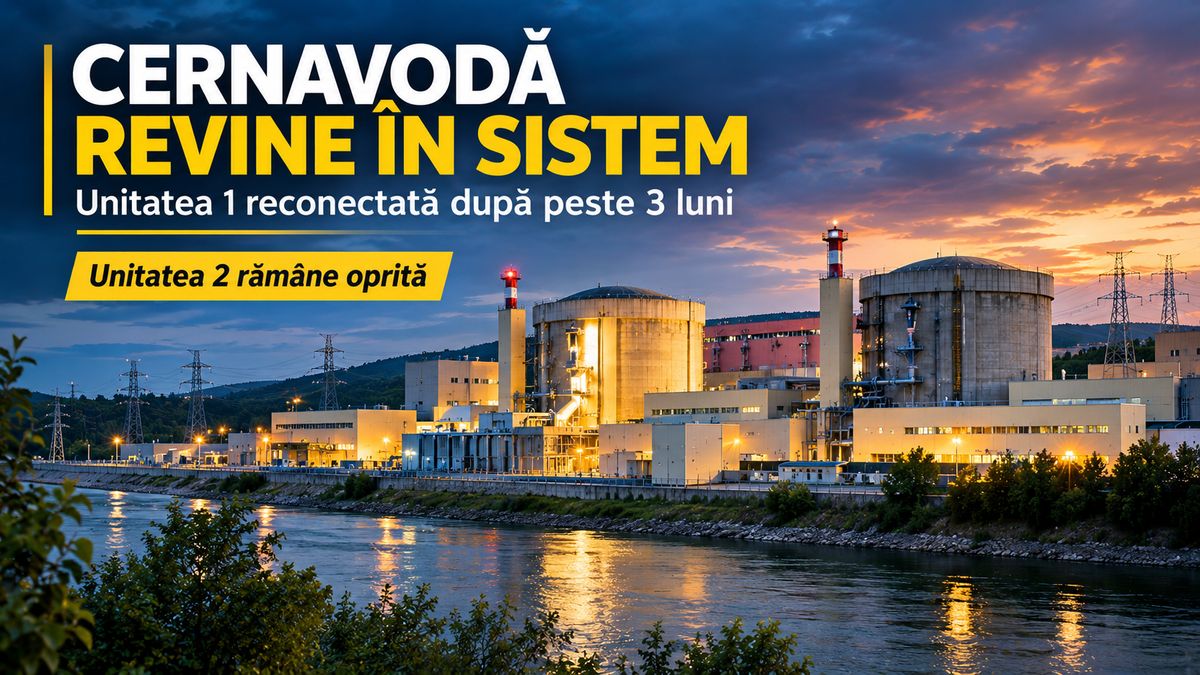
National operator Nuclearelectrica resynchronized Unit 1 of the Cernavodă Nuclear Power Plant to the National Power Grid on Friday afternoon, November 6, 2026, with the reactor expected to reach its nominal capacity of 700 MW on Saturday, November 7, at 22:00. This technical procedure ends a nearly three-month anomaly that began on August 13, 2026, during which Romania operated without a single megawatt of baseload nuclear power due to the plant's shutdown driven by historically low Danube water flow. The recovery of these 700 nuclear MW comes at a critical juncture for the physical and commercial balance of the national grid entering the cold season. The absence of output from Cernavodă, combined with a severe drought that curtailed Hidroelectrica's generation, forced domestic demand to be met through massive imports during peak hours, driving the weighted average price on the Day-Ahead Market up by 38% in October to 1,265.96 RON/MWh. The reactor's return to service contrasts sharply with the technical fragility of the coal-fired capacity authorities rely on for security of supply this winter. On the very same Friday, November 6, that Cernavodă Unit 1 was reconnected, a coal-fired unit in the National Power Grid suffered an unscheduled shutdown following a boiler tube burst—marking the third such failure in a single month among thermal plants kept operational beyond the deadlines originally set out in the National Recovery and Resilience Plan (NRRP). Nearly three months without nuclear power: the hydrotechnical mechanism behind Cernavodă's August 13 shutdown The complete absence of nuclear energy from Romania's generation mix between August 13 and November 6, 2026, demonstrated that climate change and regional hydrological patterns directly impact not only hydropower plants, but also baseload nuclear facilities. The Cernavodă plant utilizes CANDU technology and relies fundamentally on water drawn from the Danube to cool its condensers and auxiliary systems via a hydrotechnical circuit linked to the Danube–Black Sea Canal. The prolonged drought of summer 2026 dropped river levels toward the minimum safety thresholds required to operate cooling water pumps. Under these conditions, the controlled shutdown of Unit 1 in mid-August was a mandatory nuclear and mechanical safety measure designed to prevent cooling systems from operating outside design parameters and to allow technical maintenance work during the low-water period. The impact on the National Power Grid was swift and severe. Normally, Cernavodă supplies about one-fifth of national electricity consumption, delivering around-the-clock baseload power regardless of wind or solar weather conditions. The simultaneous loss of 700 MW of primary baseload generation left the system without its main anchor of stability throughout the autumn. Three boiler leaks in one month highlight physical limits of aging coal units In the absence of nuclear supply and with low water reserves in hydro reservoirs, the burden of balancing the system during evening peak hours fell on natural gas-fired plants and lignite units. Although Romania secured extensions for closing certain coal-fired capacities relative to the original NRRP timeline precisely to maintain installed capacity during emergencies, operational realities over the past month confirm that retaining capacity on paper does not guarantee physical availability. Friday's shutdown on November 6, caused by a boiler tube burst at a coal plant, represents the third identical technical failure in just thirty days. Utility boilers in lignite units operate under high temperatures and pressures; after decades of operation and repeated start-stop cycling, pressure system piping succumbs to thermal fatigue and ash-driven erosion. Each boiler failure abruptly removes 150 to 300 MW from the grid, requiring days of cooling, mechanical intervention, welding, and pressure testing before restart. For transmission system operator Transelectrica, these unpredictable outages mean coal power cannot offer the long-term reliability provided by a nuclear reactor, forcing reliance on the balancing market, where costs are the highest across the entire energy value chain. Why 700 MW of baseload matters for DAM prices that reached 1,265.96 RON/MWh The return of Cernavodă Unit 1 to its 700 MW nominal rating on the evening of November 7 fundamentally changes the commercial dynamics on the OPCOM power exchange. In October 2026, the weighted average price on the Day-Ahead Market surged by 38% over previous levels to 1,265.96 RON/MWh, driven by acute domestic supply deficits during peak consumption hours. In spot markets, the clearing price for each hourly interval is set according to marginal pricing principles—meaning by the most expensive production unit or import bid needed to satisfy the final megawatt-hour demanded. When 700 MW of low-marginal-cost nuclear energy is missing, the evening supply gap is filled by gas plants, coal units bearing…
Ioana Buzoaica — Independent Editorial Board
The NRG-IA newsroom continuously monitors Romanian energy markets, ANRE regulatory decisions, and national grid telemetry (SEN/SNT). We deliver independent intelligence anchored exclusively in official primary data.
Editorial Charter, Ethics & Verification Methodology →