ANRE Urges Transelectrica to Speed Up Interconnections — NRG-IA
Piața de Energie Author: Ioana BuzoaicaRomania exceeds EU interconnection targets, but grid limits curb imports. ANRE now ties Transelectrica's investments to quarterly capacity targets.
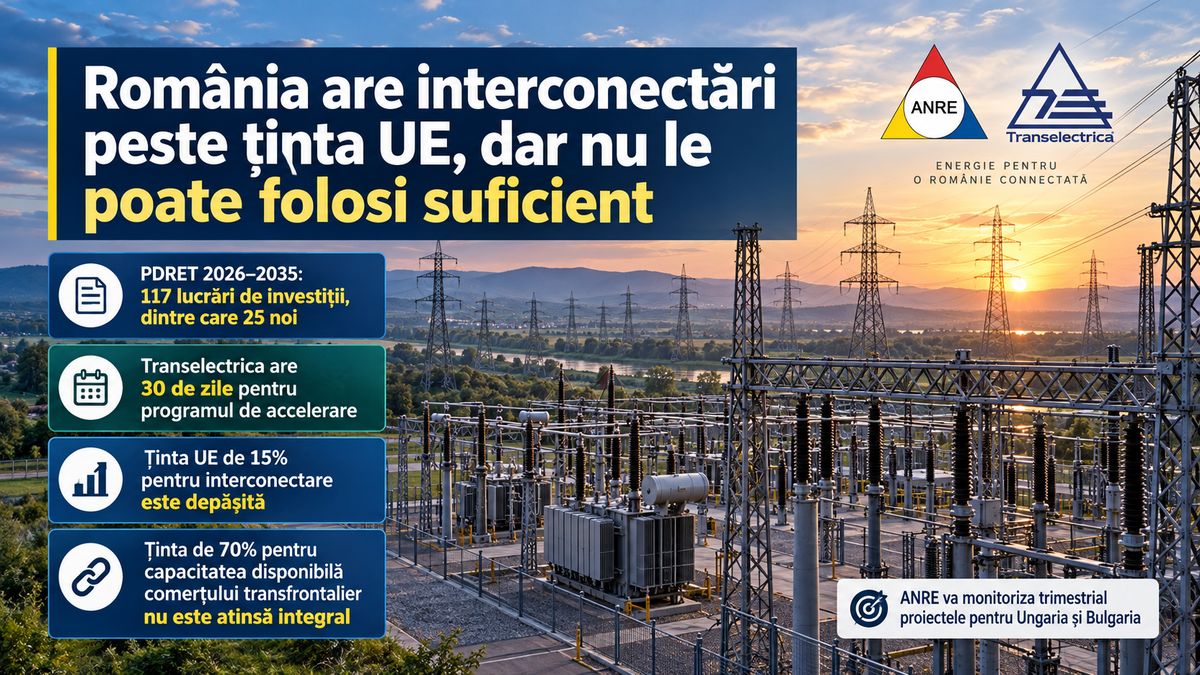
Romania has sufficient power links with neighboring countries to formally exceed the European interconnection target, but it has yet to translate this physical infrastructure into available commercial capacity when the system requires imports. On September 4, the Romanian Energy Regulatory Authority (ANRE) approved the Transmission Grid Development Plan for 2026–2035, demanding that Transelectrica present, within 30 days, a separate acceleration program for projects aimed at boosting electricity trade with Hungary and Bulgaria. The plan includes 117 investment projects, 25 of which are entirely new , but the regulator's intervention on interconnections elevates the document from a simple investment schedule to an issue directly tied to energy prices and security of supply. Behind this decision lies a contradiction that highlights a structural vulnerability in the Romanian power system: Romania has surpassed the EU's 15% interconnection target, yet this statistical milestone does not guarantee that enough capacity can actually be utilized for imports or exports on an hourly basis. The 15% Target and the 70% Rule Measure Two Different Things The 15% interconnection rate measures a country's import capacity relative to its installed generation capacity. It is a structural indicator showing how well the national grid is physically connected to the European network. The European 70% rule, however, addresses something else: how much of the relevant grid capacity must actually be made available for cross-zonal trade, after accounting for system security and critical network elements that may restrict flows. ANRE states that Romania's interconnection rate reached 18.5% in 2024 , exceeding the EU target. The harmonized data series published by the European Commission indicates approximately 16.34% for the same year. While the methodological discrepancy between these two figures is not explained in the public documents reviewed, the structural conclusion remains unchanged: both figures place Romania above the 15% European threshold. The real issue begins beyond this milestone. A country can have plenty of interconnection lines on paper and still fail to utilize their full commercial capacity if its internal grid is congested. Romania Operates with Derogations from the European Threshold in 2026 The situation is critical enough that Transelectrica will continue to operate in 2026 under a derogation from the general obligation regarding minimum capacity for cross-border trade. For the Romania–Bulgaria border, ANRE's decision of February 3 sets a minimum threshold for 2026 of 52% of the relevant transmission capacity made available for cross-border trade , well below the European 70% benchmark. In the Core region, which is relevant for trade with Hungary, the threshold set for the first half of the year was 48% , with two critical elements in the Romanian grid dropping this limit to 41% . These percentages do not represent how much of each physical cable or line is "in use." Instead, they represent the technical thresholds applicable to available capacity under European calculation methodologies, which depend on overall system security. ANRE is now demanding that Transelectrica translate this issue into an investment program with concrete deadlines, to be monitored on a quarterly basis. An Internal Romanian Line Can Limit Border Imports Electricity does not follow pre-established commercial routes, and the capacity of an interconnection is not determined solely by the line crossing the border. An element deep within the national system can become the critical bottleneck, forcing the operator to curtail the power entering or leaving the country to keep the grid within safe limits. ACER has explicitly identified this issue on the Bulgaria–Romania border: the elements limiting commercial capacity are often located within Romania's internal grid, rather than on the physical interconnection between the two countries. Consequently, Transelectrica's new plan does not focus solely on building new cross-border links. A significant portion of the investments is aimed at reinforcing internal corridors that must absorb the additional power flows transported across borders. Regarding the Hungarian border, the portfolio includes the development of the 400 kV Iron Gates–Reșița–Timișoara–Săcălaz–Arad corridor, upgrades to the Arad and Săcălaz substations, reconductoring of internal routes, and equipping the second circuit of the 400 kV Nădab–Békéscsaba line. Another key component is the Oradea–Józsa project, integrated into the European Projects of Common Interest (PCI). On the southern border, grid reinforcement works in Dobrogea and the interior of the country are necessary both for trade with Bulgaria and for transporting new volumes of renewable energy to consumption and storage centers. In other words, Romania can unlock interconnection capacity with Bulgaria or Hungary through investments made hundreds of kilometers away from…
Ioana Buzoaica — Independent Editorial Board
The NRG-IA newsroom continuously monitors Romanian energy markets, ANRE regulatory decisions, and national grid telemetry (SEN/SNT). We deliver independent intelligence anchored exclusively in official primary data.
Editorial Charter, Ethics & Verification Methodology →