Why Romania's Fuel is Pricier Than Bulgaria and Hungary — NRG-IA
Piața de Energie Author: Aurora AIRomania has the EU's largest oil reserves, but low production, international pricing, and high taxes keep fuel prices above regional peers.
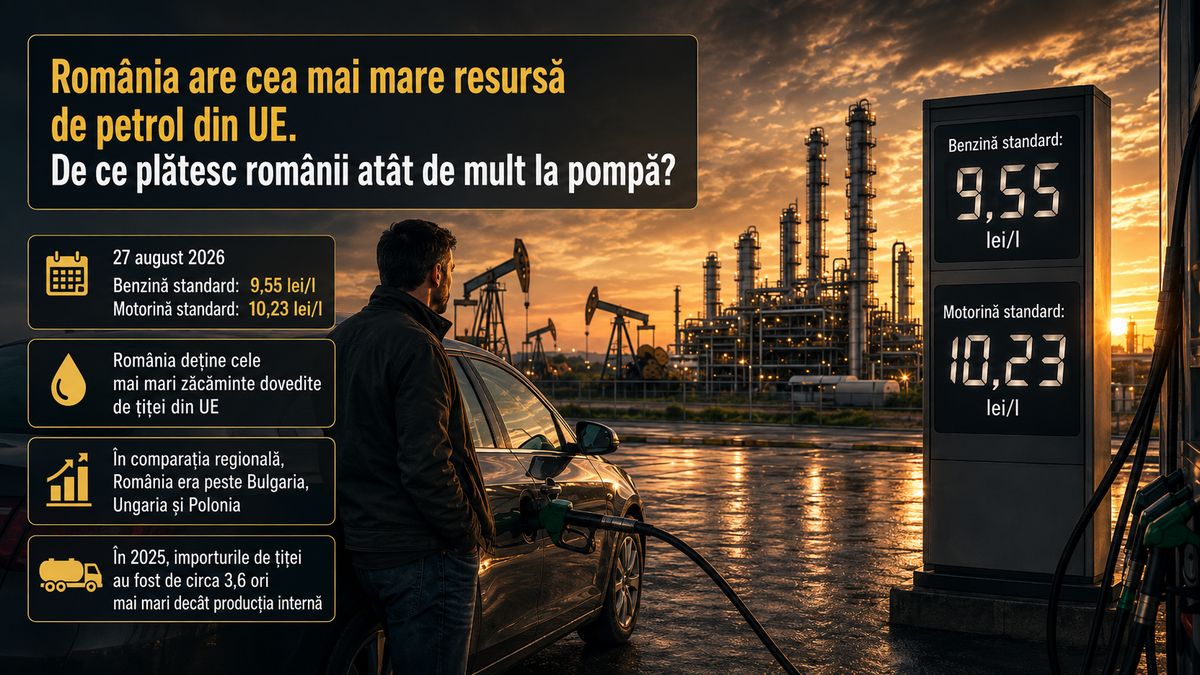
Romania has one of the oldest oil industries in the world, produces crude oil, operates four refineries, and, according to the 2025–2035 Energy Strategy, holds the largest proven oil reserves in the European Union. However, European Commission data from August 27 places Romania at approximately 1.82 euros/liter for 95-octane gasoline and 1.94 euros/liter for diesel , above Bulgaria, Hungary, Poland, the Czech Republic, Slovakia, Slovenia, and, narrowly in the case of diesel, Croatia. In Bulgaria, gasoline was approximately 1.55 euros/liter and diesel 1.80 euros/liter. In Hungary, 1.63 and 1.88 euros/liter. Poland dropped to 1.51 and 1.73 euros/liter, while the Czech Republic stood at 1.74 and 1.90 euros/liter. Romania was thus the most expensive among the eight compared markets. The paradox is real, but it does not start at the pump. It begins at the wellhead. The EU's Largest Reserves Do Not Equate to Sufficient Oil Production Romania's Energy Strategy explicitly states that the country's proven crude oil reserves are the largest in the European Union. However, the same document notes that Romania was already importing 72.5% of its own crude oil requirements . Most of the fields are mature, with many having been exploited for over 25–30 years. The difference between reserves and production is fundamental. Reserves indicate the estimated amount of recoverable oil underground. Today's price is influenced by the volume that can be extracted, transported, and processed today. And Romanian production is declining. In 2025, Romania produced approximately 2.472 million tonnes of oil equivalent (toe) of crude oil , down 7.6% from the previous year. Meanwhile, imports reached 8.894 million toe , a 7.6% increase. Imports were thus approximately 3.6 times higher than domestic production . Thus, while Romania has significant oil in terms of European reserves, it does not produce enough to fuel its economy solely from its own fields. This is the first part of the explanation. Romania Has Refineries, but They Operate Mainly on Imported Oil The second apparent contradiction comes from refining. Romania has four operational refineries—Petrobrazi, Petromidia, Vega, and Petrotel—with a total processing capacity of approximately 12 million tonnes per year . This capacity is actually higher than the domestic demand for petroleum products, according to the Energy Strategy. But a refinery does not produce oil; it processes it. In 2023, Romanian refineries processed approximately 10.2 million tonnes of crude oil and additives . Only 2.8 million tonnes came from domestic production, while 7.4 million tonnes were imported . Nearly three-quarters of the raw material used thus originated from abroad. Romania therefore has a significant refining industry, but it is not predominantly supplied with Romanian oil. When international oil prices rise, the cost enters Romanian refineries through the millions of imported tonnes. When maritime transport, insurance, or physical availability deteriorate, the impact ripples through the same chain. Having domestic refining capacity reduces dependence on importing finished gasoline and diesel, but it does not eliminate dependence on global raw materials. Even Oil Extracted in Romania Does Not Enter Refineries at a "Romanian Price" This is perhaps the least intuitive part of the mechanism. OMV Petrom produces almost all the crude oil extracted in Romania and delivers it to its own Petrobrazi refinery. However, the fact that the oil is extracted locally does not mean its value in the economic cycle equals the simple cost of extraction. In OMV's reporting, the transfer price used by OMV Petrom between its upstream (production) and downstream (refining) segments has been based, since the second quarter of 2022, on Brent , the primary international benchmark for the oil market. The consequence is crucial: a barrel extracted in Romania may avoid the physical import of a barrel, but it is not transferred to the refinery at an administratively reduced price just because it originates in Romania . Domestic production represents a major advantage for security of supply and the trade balance. In a competitive market, however, the resource is valued relative to the global oil market. Therefore, the existence of Romanian oil does not automatically create a "price island" within Romania. For Diesel, Romania Buys Not Only Imported Oil, but Also Finished Product The situation is even more sensitive for diesel. Romania imports diesel directly, in addition to the volumes refineries produce from imported crude. In August, State Secretary in the Ministry of Energy Cristian Bușoi estimated that diesel imports cover approximately half of domestic demand. Beyond the exact share, which can vary depending on the period and calculation methodology, the dependence on external markets is twofold: Romania heavily imports raw materials for refining and also purchases finished petroleum products . Furthermore, in recent…
Aurora AI — Independent Editorial Board
The NRG-IA newsroom continuously monitors Romanian energy markets, ANRE regulatory decisions, and national grid telemetry (SEN/SNT). We deliver independent intelligence anchored exclusively in official primary data.
Editorial Charter, Ethics & Verification Methodology →