Romania starts Rovinari 4 after 3,301 MW solar record — NRG-IA
Piața de Energie Author: Ioana BuzoaicaRomania faces daily extremes: midday solar surpluses and exports, followed by a need for dispatchable power during the evening peak.
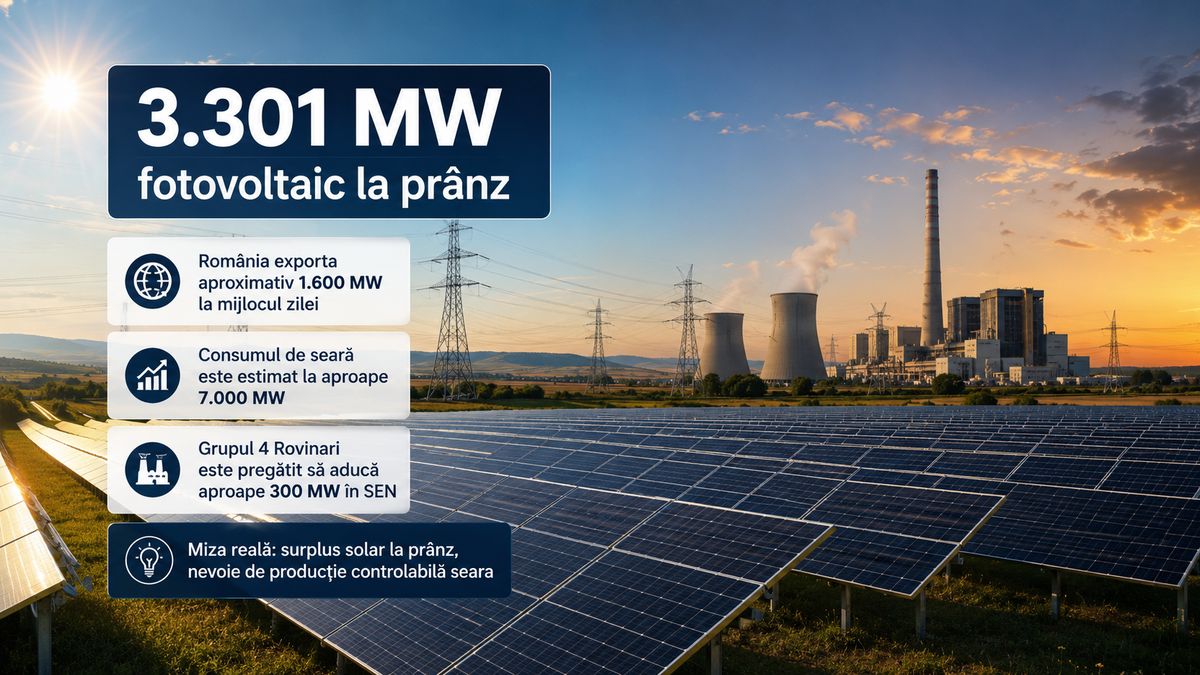
On Monday at noon, Romania generated a record 3,301 MW from dispatchable solar parks and was exporting around 1,600 MW . However, just a few hours later, the grid required nearly 300 MW of additional lignite-fired capacity to cover the evening peak. The Ministry of Energy announced that Unit 4 of the Rovinari Power Plant is ready to synchronize with the National Power System, at a time when consumption is projected to climb toward 7,000 MW . These two snapshots of the same day seem contradictory only if energy is viewed as a daily aggregate. Electricity must be generated or discharged from storage at the exact moment it is consumed. At noon, solar power drives generation up, enabling substantial exports. In the evening, solar output drops rapidly just as demand rebounds toward its peak, forcing the system to find other dispatchable sources that can be brought online and sustained. Under current conditions, this flexibility is further constrained by the unavailability of nuclear generation at Cernavodă and extremely poor hydrology. Rovinari Unit 4, with an installed capacity of 330 MW, is being deployed as a controllable reserve to narrow the gap that Romania would otherwise have to cover through imports and other available capacities. The midday solar record cannot be automatically shifted to the evening At 12:51 PM, dispatchable solar parks were producing 3,301 MW , according to Transelectrica data cited by Economica. This output accounted for approximately 55% of the electricity fed into the grid at that moment and was equivalent to about 70% of instantaneous consumption measured across the networks. During the same interval, Romania had a net export balance of approximately 1,600 MW . Prosumer generation adds a significant amount of solar energy, but this cannot be mechanically added to the 3,301 MW. Part of it is consumed directly by households and businesses, part may be stored locally, and only the surplus reaches the grid. For this reason, the relevant and directly measurable record for the system is that of dispatchable solar generation. The situation begins to shift as the sun goes down. Solar generation declines over a span of a few hours, while residential and industrial consumption climbs toward the evening peak. The excess energy available at noon cannot be preserved for 8:00 PM unless there is sufficient storage capacity or other flexibility mechanisms. Romania already has batteries and other forms of storage in its system, but the available volume is not yet at a scale capable of fully shifting a solar surplus of thousands of megawatts to the evening peak. Rovinari 4 brings controllable generation exactly when solar fades Rovinari Unit 4 has an installed capacity of 330 MW , and State Secretary Cristian Bușoi estimated that nearly 300 MW would actually reach the National Power System. The difference between the two figures is important: 330 MW represents the nominal capacity of the unit, while approximately 300 MW represents the estimated contribution for the operations announced during this period. The Ministry of Energy had been preparing this move since August 11, when it announced the removal of Unit 4 from the technical reserve to make it available to the grid. The decision is therefore not an improvised reaction to this evening's demand, but part of a set of measures established for this period of pressure on domestic generation. Government Decision (HG) 603/2026 allows Transelectrica, until August 31, to gradually implement additional measures to maintain the security of the SEN, ranging from increasing technological reserves and starting up units in technical reserve, to limiting exports and, in the final stage, restricting certain consumption. Starting up Rovinari 4 is thus a preventive step in the safety mechanism: the system brings controllable capacity to the market before the gap between generation and consumption becomes harder to bridge. At the time of writing, there was insufficient primary confirmation that the unit was already feeding the announced ~300 MW into the grid, so the relevant operational milestone remains the synchronization and actual power delivered by the unit during the evening peak. The 7,000 MW figure is not a consumption record The peak of nearly 7,000 MW projected for the evening of August 17 must be put into context. It is not a consumption record for Romania, nor is it an exceptional level compared to winter periods or other high-demand episodes. In January 2026, instantaneous consumption exceeded 9,200 MW , and the system has navigated other periods this year where demand was significantly above the level estimated for this evening. The current pressure comes from the other side of the balance: the structure of available generation . A system with both nuclear units online, normal hydro flows, and sufficient controllable generation would absorb a 7,000 MW peak much more easily. In the configuration of August 2026, covering this same demand domestically…
Ioana Buzoaica — Independent Editorial Board
The NRG-IA newsroom continuously monitors Romanian energy markets, ANRE regulatory decisions, and national grid telemetry (SEN/SNT). We deliver independent intelligence anchored exclusively in official primary data.
Editorial Charter, Ethics & Verification Methodology →