Day-Ahead Power Hits RON 1,838/MWh with Cernavodă Offline — NRG-IA
Piața de Energie Author: Ioana BuzoaicaRomania enters a new week with 1,300 MW offline at Cernavodă nuclear plant, driving day-ahead power prices up to RON 1,838/MWh amid severe drought.
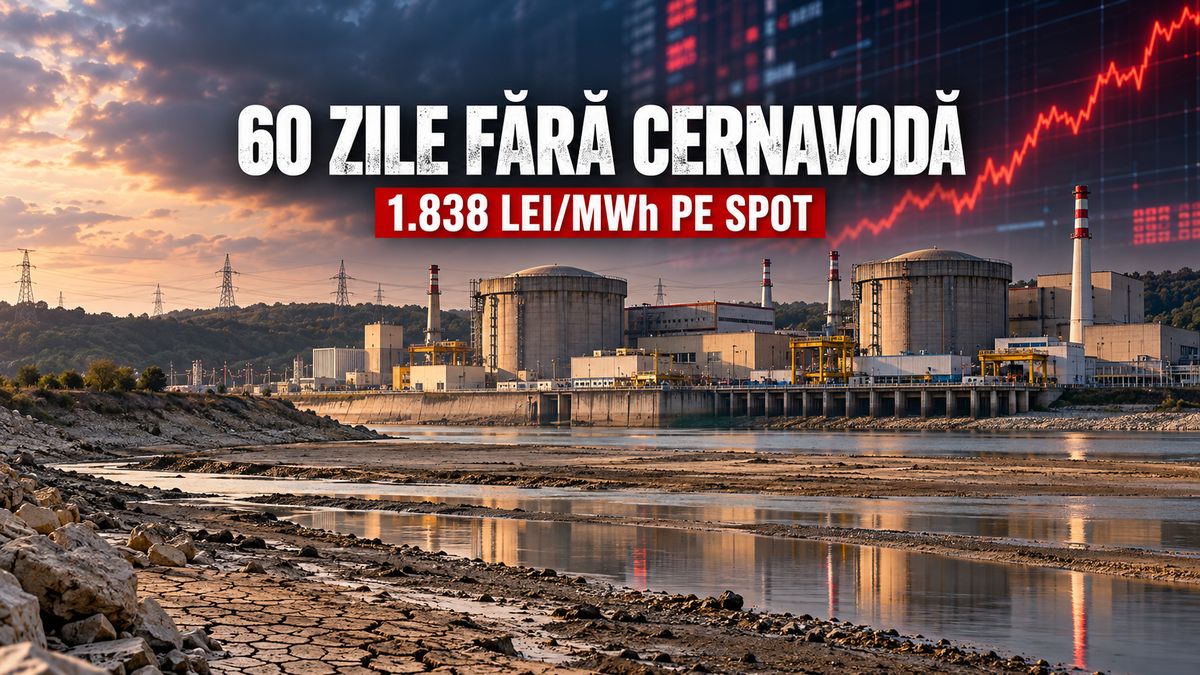
Romania begins a new week on Monday, October 12, 2026, with its entire nuclear generation capacity offline and an average electricity price of RON 1,256.76/MWh on the Day-Ahead Market (DAM/PZU). Official OPCOM data shows that during the 08:00–08:15 Romanian time delivery interval, prices spiked to RON 1,838.02/MWh, one of the highest levels of the day. This comes as both reactors at Cernavodă Nuclear Power Plant have been shut down for 60 days, with their restart contingent on the recovery of hydrological conditions along the Danube. Behind these figures lies a nationwide energy challenge. Romania has temporarily lost access to approximately 1,300 MW net of nuclear capacity, which under normal conditions provides a continuous baseload supply to the power grid. Missing this volume requires compensation from fossil fuel and renewable sources, alongside power flows with neighboring countries, within a market priced dynamically by supply and demand equilibrium. Pressure is compounded by a prolonged drought affecting both cooling conditions at Cernavodă NPP and hydro generation availability. To secure cooling water supply for the nuclear plant, authorities have implemented emergency measures, including deploying a system of barges and high-capacity pumps, with potential temporary restrictions on river navigation in the affected sectors. Electricity prices surge 33.6% compared to Sunday According to market operator OPCOM, the baseload average price for power delivery on October 12 stands at RON 1,256.76/MWh, while peakload power—defined in the operator's report for the 06:00–22:00 CET window—reached RON 1,303.63/MWh. Peak pricing is concentrated across several delivery windows, particularly during the morning demand ramp. The intraday peak of RON 1,838.02/MWh was recorded during a single 15-minute settlement period, while the daily low dropped to RON 893.27/MWh. The spread of nearly RON 945/MWh underscores extreme intraday price volatility driven by delivery timing. Compared to Sunday, October 11, when the average baseload price was RON 940.42/MWh, Monday’s clearing price rose by RON 316.34/MWh, or 33.6%. The spike coincides with the typical post-weekend rebound in industrial and commercial power demand. However, elevated prices were not confined to Monday. On Friday, October 9, the average price hit RON 1,365.34/MWh, exceeding Monday's level. Market data depicts a prolonged period of elevated clearing prices, marked by pronounced weekday-weekend cyclicality. A total volume of approximately 37,503 MWh was traded on the Day-Ahead Market for October 12. This volume reflects energy cleared through the spot market for that specific delivery day, rather than Romania's total power consumption, which is also covered via bilateral contracts and other commercial mechanisms. Cernavodă lost total nuclear output in August; reactors remain offline The shutdown at Cernavodă began nearly two and a half months prior to the current trading day. According to the National Commission for Nuclear Activities Control (CNCAN), Unit 1 underwent a controlled shutdown on July 28, 2026, followed by Unit 2 on August 13, 2026, due to exceptional hydrological conditions along the Danube River. Since August 13, Romania has operated without its two nuclear units, which represent roughly 1,300 MW of net nominal capacity. Running continuously at full output, this capacity would theoretically generate approximately 31.2 GWh per day—a critical baseload contribution for a national grid requiring real-time power balancing. In an October 11 statement, operator Nuclearelectrica confirmed that both units remain in a safe shutdown state, adding that nuclear safety functions are fully maintained via existing cooling, safety, and emergency systems. While generation remains halted, the operator has not announced a target date for grid reconnection. The prolonged outage fundamentally alters grid supply dynamics. Nuclear energy provides high capacity factors independent of daily solar radiation or wind variations. Without it, the power system is increasingly reliant on alternative generation technologies and regional market integration to maintain supply adequacy during peak periods. This structural vulnerability is further magnified in a year when low rainfall restricts water availability, placing severe operational constraints on hydro power generation. Danube river flow drops to 31% of normal October levels Data from the National Institute of Hydrology and Water Management illustrates the severity of the hydrological deficit. On October 10–11, Danube river flow at the entry point into Romania (Baziaș) recorded 1,200 m³/s, compared to the multi-year October average of 3,900 m³/s. In other words, the water discharge is at roughly 31% of its historical monthly average—a reduction of nearly 69%. This severe low-water status impacts river navigation, freight transport, hydroelectric plant operation, and industrial water abstraction along the river basin. At…
Ioana Buzoaica — Independent Editorial Board
The NRG-IA newsroom continuously monitors Romanian energy markets, ANRE regulatory decisions, and national grid telemetry (SEN/SNT). We deliver independent intelligence anchored exclusively in official primary data.
Editorial Charter, Ethics & Verification Methodology →