Romania Tops 2.7 GWh Battery Storage: E-INFRA Adds 401 MWh — NRG-IA
Piața de Energie Author: Ioana BuzoaicaRomania's battery storage reached 1,262 MW / 2,713 MWh as E-INFRA completed a 401 MWh system at Câmpia Turzii, boosting fast reserves during peak hours.
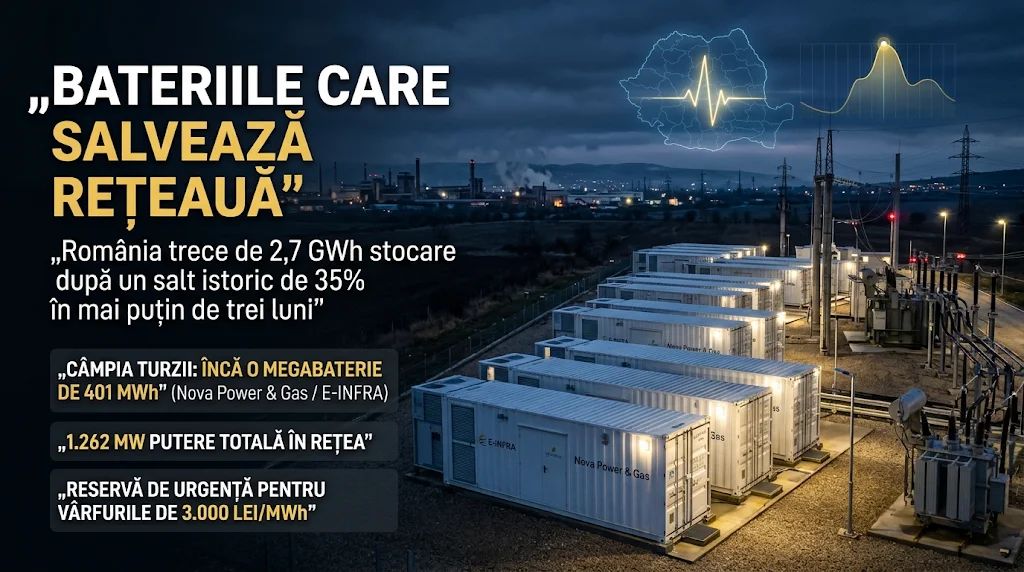
Romania has surpassed the 2.7 gigawatt-hour milestone in battery energy storage capacity, reaching a cumulative installed power of 1,262 MW and an energy capacity of 2,713 MWh as of November 1, 2026, according to operational data centralized by Transelectrica. The current level represents an expansion of approximately 35% in less than three months compared to the roughly 2 GWh threshold recorded in August. This growth is anchored by Nova Power & Gas, part of the Romanian entrepreneurial group E-INFRA, which has completed installation and moved a second battery unit of 200 MW power and 401 MWh capacity into technical certification at Câmpia Turzii. The new facility in Cluj County duplicates, with identical specifications, the largest battery unit previously commissioned in Romania by the same developer. Once certification with the transmission system operator is concluded for this second tranche, the energy hub developed with domestic capital at Câmpia Turzii will feature twin systems with a combined power output of 400 MW and 802 MWh of storage capacity, cementing the Cluj-based group’s standing as the largest utility-scale storage operator in the local market. An injection capacity rivaling two nuclear reactors during the evening peak The true significance of the 1,262 MW national fleet becomes clear when measured against the country's main generation assets and the severe deficit experienced by the National Power System this week. In terms of instantaneous grid injection capacity, Romania's installed batteries have reached 90% of the combined output (~1,400 MW) of the two nuclear units at Cernavodă. The structural difference lies in discharge duration: the ratio of 2,713 MWh energy capacity to 1,262 MW power output yields an average full-load autonomy of two hours and nine minutes. This positions these installations as a virtual peaking plant designed to bridge the critical supply gap between 17:00 and 21:00, whereas nuclear units provide continuous baseload generation around the clock. The economic and security value of this fast-response reserve was highlighted on Tuesday, November 10, when an unplanned outage at Cernavodă Unit 1 coincided with the unavailability of Unit 2 and hydro reservoir levels dipping below 50%. With morning domestic generation at just 5,400 MW against demand of 7,500 MW, average Day-Ahead Market power prices on OPCOM surged on Tuesday to €411.41/MWh, hitting hourly peaks of 3,000 RON/MWh, before declining on Wednesday, November 11, to €227.74/MWh following the reconnection of Unit 2 at 07:56, market data and system reports show. Day-Ahead Market arbitrage and fast grid balancing drive private investment The rapid pace at which private developers are deploying hundreds of megawatt-hours on the ground is backed by highly compelling economics across Romanian and Southeast European electricity markets. Battery systems like those at Câmpia Turzii charge during midday solar surplus periods or overnight off-peak hours with high wind output, when spot prices are low, and discharge during the two evening hours when solar absence and surging residential demand drive prices to regional highs. Every megawatt injected from storage during that window directly displaces expensive imports or the ramping up of high-marginal-cost thermal plants. Beyond intraday price spreads, the second major revenue pillar comes from the balancing market and ancillary services procured by Transelectrica. Unlike conventional gas or coal turbines, which require tens of minutes to ramp up, storage system inverters respond in fractions of a second to stabilize grid frequency at 50 Hz during unplanned generation trips. The ongoing certification process for Nova Power & Gas’s second 401 MWh battery focuses specifically on verifying these technical parameters for transmission grid compliance. This technical reality has fundamentally altered bankability criteria for new wind and solar assets in Romania, where grid injection without co-located storage is becoming increasingly challenging and less profitable. Further evidence of this shift emerged on Tuesday, November 10, when Greek energy group HELLENiQ ENERGY officially launched its local subsidiary with a €1 billion-plus investment plan through 2030—where its 1,000 MW renewable target is mandatorily paired with at least 500 MW of battery storage, according to Energynomics. Meanwhile, on the low-voltage distribution grid, the National Energy Regulatory Authority (ANRE) reported on November 10 that 151,000 of the country's 400,000 prosumers already own behind-the-meter storage systems. New grant scheme 13.4x oversubscribed as 3 GWh milestone nears Investor appetite for the sector is highlighted by the €150 million competitive call managed by the Ministry of Energy for standalone storage systems, closing on November 15, 2026. Submitted project values have reached RON 10.57 billion—oversubscribing the allocated budget by 13.4 times—and driving some developers to bid down…
Ioana Buzoaica — Independent Editorial Board
The NRG-IA newsroom continuously monitors Romanian energy markets, ANRE regulatory decisions, and national grid telemetry (SEN/SNT). We deliver independent intelligence anchored exclusively in official primary data.
Editorial Charter, Ethics & Verification Methodology →