Romania's green speed: grid and storage decide energy value — NRG-IA
Energie Regenerabilă Author: Ioana BuzoaicaRomania is rapidly building large-scale renewables. This advantage can only become regional if grids, batteries, and flexible demand keep pace.
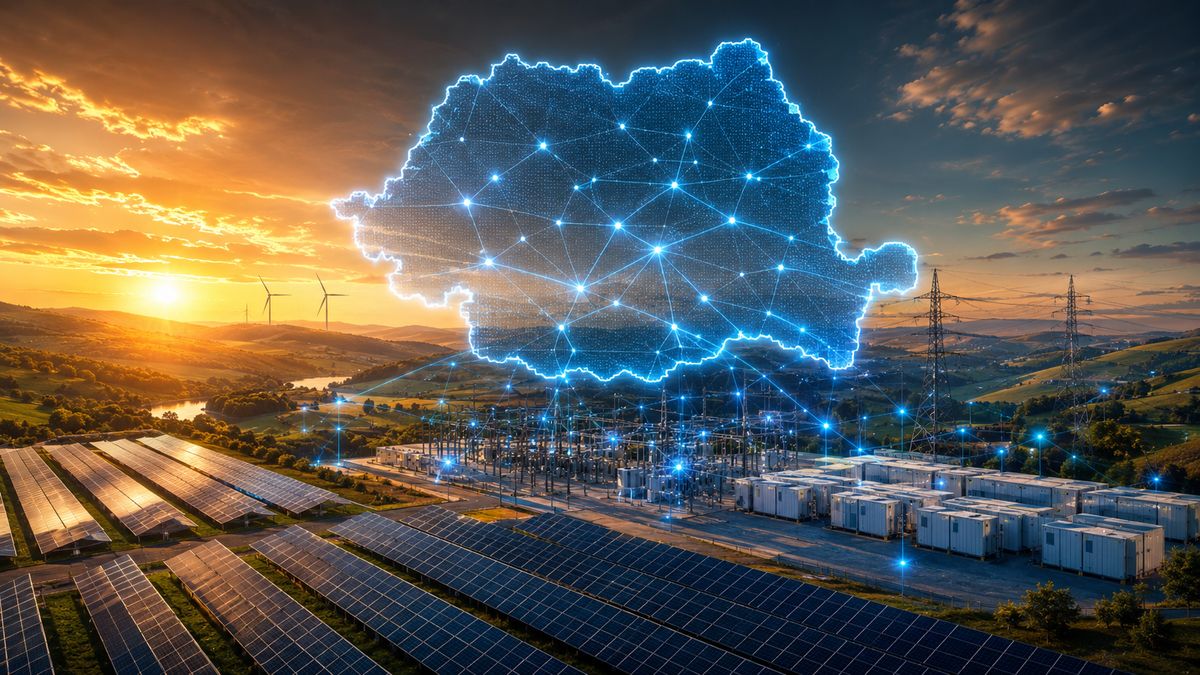
Romania does not have Germany's installed capacity, the UK's flexibility market, the Benelux interconnections, or Spain's industrial maturity. But it has an advantage that many European economies are looking for: the speed with which large-scale renewable projects can move from planning to construction. This is the core idea behind the statement made by Cristian Pîrvulescu, CEO and co-founder of Enevo Group, who noted that Romania and Balkan markets can commission hundreds of MW in months—a pace that many Western economies find much harder to achieve. The statement is an assessment by an active player in energy project construction, not an official European ranking. However, it describes a real shift: Romania is no longer a market of small, sporadic projects, but one where capacities on the scale of hundreds of MW are entering construction. The stakes are higher than just the number of panels installed in a field. In the coming years, the country can turn this speed into a regional economic advantage: cheaper midday power, direct contracts for industry, new investments, and a stronger position in the Central and Southeastern European energy market. But speed can also become a problem if green energy is built faster than the infrastructure can absorb it. Romania enters the era of hundreds-of-MW projects The Ogrezeni project illustrates the scale of this new market. In January, Enevo Group announced the launch of a 761 MWp photovoltaic project, equivalent to 534 MWac, along with a 400 kV grid connection substation. It is one of the largest hybrid PV investments developed in Europe and a benchmark for the scale the local market has reached. The difference between these two values must be properly understood. MWp represents the nominal capacity of the panels under standard test conditions. MWac represents the alternating current power deliverable to the grid. For the power system, the relevant value is primarily the capacity at the grid connection point and the actual production profile for each hour of the day. A 761 MWp project does not mean Romania permanently receives 761 MW into the grid. It means that during hours of high solar irradiance, the plant can produce large amounts of energy, within the limits of conversion capacity, grid connection, and system conditions. Yet even with this nuance, the scale of the project is significant. Romania has transitioned from parks of a few dozen MW to investments comparable to the output of a large power plant during certain hours of the day. Enevo claims to have a cumulative portfolio under construction of over 1.5 GW in renewable projects, over 1 GWh in storage projects, and ten high-voltage substations (110 kV, 220 kV, and 400 kV). This shows that developers are no longer just building power plants, but are also starting to build the integration infrastructure required for them. Speed is not system maturity Romania can build quickly for a few simple reasons. Land is available. There is investment pressure from funds and developers. Funding is available through the Modernisation Fund, the NRRP (National Recovery and Resilience Plan), and other European mechanisms. There is demand from companies looking to secure their energy through long-term direct contracts. There is another important factor: the market is starting from a lower base than Western European economies. In Germany, the Netherlands, or Belgium, new projects more frequently run into congested grids, fragmented administrative procedures, local opposition, and lack of space. Romania still has areas where large-scale projects can be developed more easily. But a rapidly built solar park does not automatically become an economic advantage. The energy must be transmitted to the consumer. It must be stored when production exceeds local demand. It must be sold during intervals when it has value. It must be integrated into a grid that can manage production variations without pushing the market toward imbalances and extreme prices. This is where the real test begins. Solar produces cheap power at noon. The system needs energy in the evening Romania is already seeing the contrast between abundant midday energy and tension during evening hours. On sunny days, photovoltaics can massively reduce the need for conventional generation and push prices down. But after sunset, that energy quickly disappears. If demand remains high, the system must find other sources: available hydropower, gas-fired plants, imports, batteries, or reserve capacities. This is the flexibility challenge. A solar plant is excellent for daytime power generation. It cannot cover the evening peak demand on its own. A battery can shift some of the midday energy to the evening. A new transmission line can transport the surplus to another area. A flexible consumer can shift industrial activities to hours with cheap energy. Without these three mechanisms—storage, grid, and flexible consumption—renewable energy loses part of its value precisely when the…
Ioana Buzoaica — Independent Editorial Board
The NRG-IA newsroom continuously monitors Romanian energy markets, ANRE regulatory decisions, and national grid telemetry (SEN/SNT). We deliver independent intelligence anchored exclusively in official primary data.
Editorial Charter, Ethics & Verification Methodology →