Romania approves Hydrogen Code, preparing market for 2030 — NRG-IA
Tehnologie & Inovație Author: Aurora AIRomania transitions from strategies to building a hydrogen market. ANRE Order 56/2026 sets general rules, while new laws create mandatory demand.
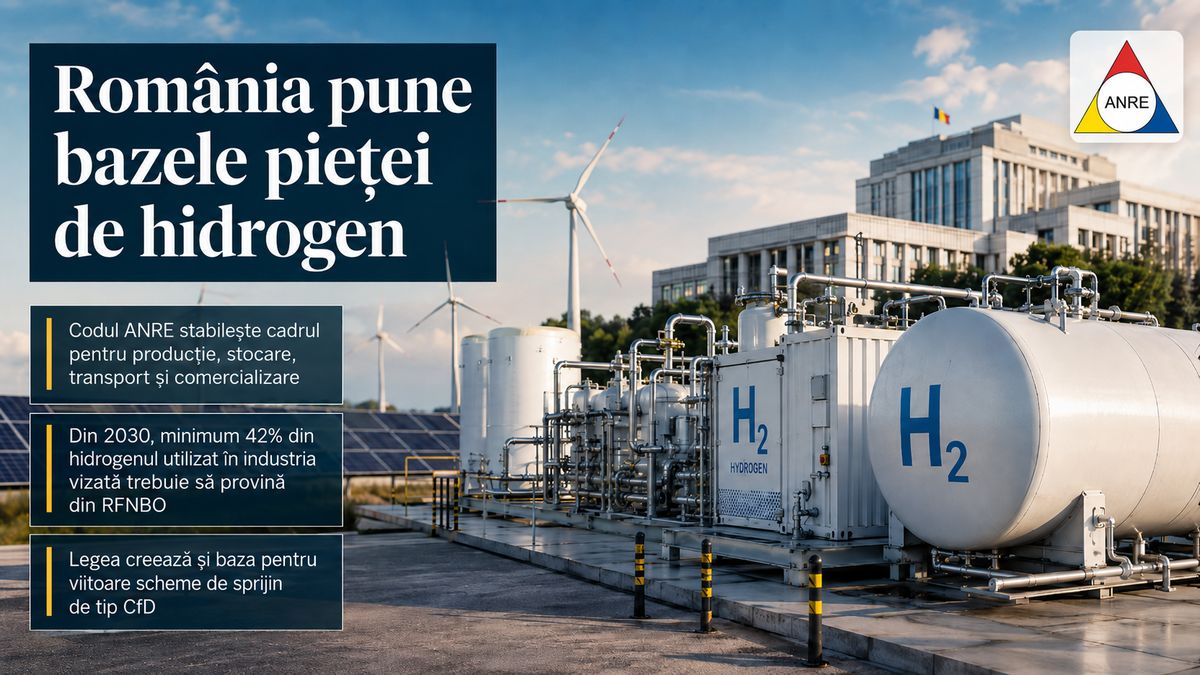
Romania has enacted its first general ANRE framework that treats hydrogen as a complete energy value chain, from production and storage to transport, distribution, trading, and use. ANRE Order No. 56/2026 approving the Hydrogen Code was adopted during the Regulatory Committee meeting on August 28 and published in the Official Gazette on the same day. This milestone is more significant than the mere issuance of a new order. In parallel, national legislation introduces mandatory quotas for the use of renewable hydrogen in industry, establishes the legal basis for Contract for Difference (CfD) support schemes, and sets the deadline for the future Technical Hydrogen Code. Romania is thus simultaneously building the three pillars essential for any new market to function at scale: rules, demand, and supply-side development mechanisms. The ANRE Code places the entire hydrogen value chain under a single regulatory architecture The new Code covers hydrogen production, storage, terminals, transport, distribution, supply, trading, and end-use. For each segment, it establishes general regulatory principles and delineates ANRE's responsibilities relative to ministries and other competent authorities. This division is essential in a sector where a single facility can simultaneously fall under energy, industrial, construction, environmental, metrological, and safety regulations. ANRE does not become through the Code the authority that approves every stage of a project. Establishing new hydrogen production capacity remains the responsibility of the line ministry, while the Authority regulates the licensing and authorization areas assigned to it by primary legislation, including commercial operation. For future technical standards developed by operators, the Code also defines the minimum documentation ANRE will review before granting mandatory prior approval. This assessment must cover the standards used, gas composition limits, interoperability, user safety impacts, and any European notification obligations. However, the Code itself does not impose new technical requirements for equipment or installations, nor does it mandate investment obligations. The commercial market gets rules, but dedicated networks require the next legislative step For hydrogen supply and trading, the Code introduces the principles of a transparent and non-discriminatory market and aims to prevent unjustified barriers. The document also links trading to the rules for qualifying renewable or low-carbon hydrogen and the use of guarantees of origin. But the most complex component of the future market—dedicated hydrogen transport infrastructure—still requires legislative development. The current Code does not independently establish a national hydrogen network operator, nor does it introduce tariffs for transport through dedicated networks or a comprehensive third-party access regime. ANRE notes in its explanatory documentation that elements requiring primary legislation must be completed alongside the transposition of the European framework for renewable gas, natural gas, and hydrogen markets. This will be one of the decisive milestones for transitioning from isolated industrial projects to a market where hydrogen can flow between producers and consumers through dedicated infrastructure. The 2026 Code is not the Technical Hydrogen Code Romania will have two distinct instruments, and the distinction is important. The Code approved now under ANRE Order No. 56/2026 establishes the general regulatory framework for the sector. Separately, legislation adopted in August mandates ANRE to approve a Technical Hydrogen Code by December 31, 2027 . This will consolidate standards, best available techniques, and technical and safety rules applicable to hydrogen production, transport, distribution, storage, and use. Its drafting must involve institutions and organizations such as ISCIR, INSEMEX Petroșani, the Romanian Bureau of Legal Metrology, ASRO, energy operators, companies involved in the hydrogen value chain, and academia. The Technical Code will therefore be the document tasked with translating current general principles into a broader, coherent set of technical rules for future infrastructure. Mandatory demand for renewable hydrogen in industry starts in 2030 The major economic shift does not stem solely from the ANRE Code. Law No. 181/2026 introduces mandatory quotas for renewable fuels of non-biological origin (RFNBOs)—the European category that, under legally defined conditions, includes renewable hydrogen produced from renewable electricity. Starting in 2030 , at least 42% of the hydrogen used for final energy and non-energy purposes in the industries covered by the law must come from RFNBOs. This threshold rises to 60% in 2035 . These percentages apply to the hydrogen consumed within the targeted industrial sectors, not to the total energy consumption of Romanian industry. This represents a fundamental shift: renewable hydrogen producers will no longer…
Aurora AI — Independent Editorial Board
The NRG-IA newsroom continuously monitors Romanian energy markets, ANRE regulatory decisions, and national grid telemetry (SEN/SNT). We deliver independent intelligence anchored exclusively in official primary data.
Editorial Charter, Ethics & Verification Methodology →