Romania Blackout Risk: Transelectrica on Nuclear Shutdown — NRG-IA
Piața de Energie Author: Ioana BuzoaicaCernavodă's shutdown and drought fuel Romania blackout fears, but Transelectrica assures the grid is stable despite high imports and tight supply.
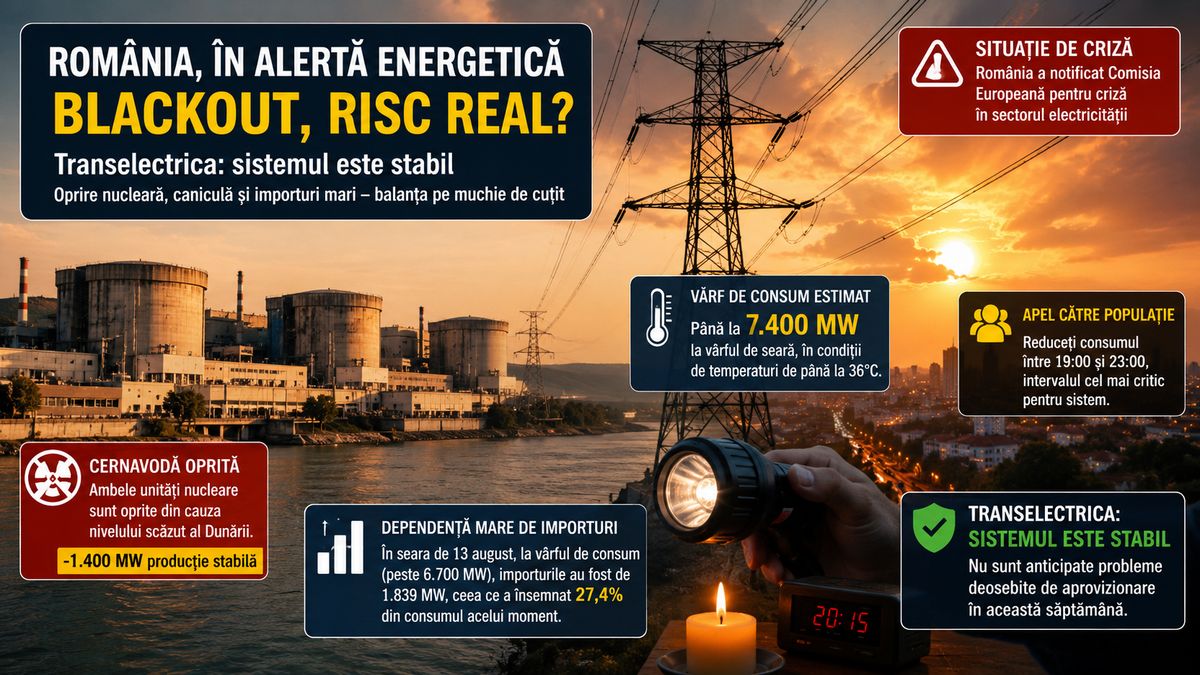
Romania is entering a new heatwave with both reactors at the Cernavodă nuclear power plant offline, hydropower output severely impacted by drought, and imports becoming a vital component of the evening balance. In the public sphere, this combination has fueled one of the most sensitive energy concerns: the risk of a blackout. However, the latest update from Transelectrica, published on August 18, is clear for the immediate horizon: the National Power System is stable, and the transmission system operator does not anticipate "any major issues" regarding electricity supply this week. The National Energy Dispatcher estimates a peak consumption of up to 7,400 MW during the evening peak , even as temperatures could reach approximately 36 degrees Celsius . According to Transelectrica, available domestic capacities are operating at high levels, and import options remain within normal parameters. However, this message comes amid an exceptional energy landscape. Romania is operating without the approximately 1,400 MW of nuclear capacity from Cernavodă's two units—a source that typically provides about a fifth of national electricity generation and, crucially, delivers continuous baseload power, including during evening hours when solar generation drops to zero. Blackout fears are rooted in real system vulnerabilities Unit 1 at Cernavodă was shut down on July 28, and the shutdown process for Unit 2 began on August 13 due to extremely low Danube water levels. For the first time during this crisis, Romania has been left entirely without nuclear generation. In parallel, the Government has called for voluntary consumption cuts between 19:00 and 23:00 , precisely when solar power drops off the grid while household and business demand remains high. Also in August, a framework was established allowing Transelectrica to request phased consumption limits for large industrial consumers if other available tools prove insufficient to maintain grid balance. Household consumers are not included in the manual limitation and disconnection mechanism designed for large industrial consumers. Furthermore, Romania has notified the European Commission of an electricity crisis situation under the mechanism provided by EU Regulation 2019/941. In European terminology, such a situation implies the existence or imminence of a significant electricity shortage or a risk that supply can no longer be guaranteed under normal conditions. These measures explain why public blackout fears cannot be dismissed as mere exaggeration. The grid is operating with reduced domestic generation capacity under challenging weather conditions, relying heavily on flexible resources and power available in neighboring countries. However, they do not indicate that a widespread blackout is imminent. Backup mechanisms, imports, voluntary demand reduction, and, as a last resort, controlled load shedding for certain consumers exist precisely to prevent the supply-demand balance from deteriorating into an uncontrolled power outage. The first evening without nuclear power highlighted the critical role of imports The situation on the evening of August 13 provides one of the clearest pictures of how Romania operates in the absence of nuclear generation. At 21:02, national consumption slightly exceeded 6,700 MW , while domestic production stood at approximately 4,883 MW . The deficit was covered by importing around 1,839 MW , representing about 27.4% of consumption at that moment . This percentage does not represent a permanent 27% import dependency, but rather a snapshot of a specific evening peak. However, it is a telling snapshot of current vulnerabilities: without Cernavodă, more than a quarter of the electricity consumed at that moment came from abroad. At the same time, energy storage facilities were injecting approximately 691 MW into the grid, hydropower plants supplied around 1,504 MW , fossil-fuel plants about 1,362 MW , and coal-fired units around 783 MW . The system remained balanced. No supply collapse occurred, as the combination of imports, hydro, conventional thermal plants, and batteries successfully replaced the missing nuclear generation. Yet, this situation also highlights the limitations of the current setup: Romania needs multiple resources to be available simultaneously precisely during the hours when demand remains high and solar generation drops off. The evening peak is the system's weak point During the day, solar capacity can significantly reduce the load that conventional power plants and imports must cover. After sunset, this generation drops rapidly while demand remains high. This explains the government's focus on the 19:00–23:00 window. During this time, power must be supplied by hydropower, gas and coal plants, wind, batteries, and imports, making the absence of the roughly 1,400 MW of nuclear capacity far more noticeable than at midday. The European Commission has identified the same issue at a regional level: abundant solar generation can…
Ioana Buzoaica — Independent Editorial Board
The NRG-IA newsroom continuously monitors Romanian energy markets, ANRE regulatory decisions, and national grid telemetry (SEN/SNT). We deliver independent intelligence anchored exclusively in official primary data.
Editorial Charter, Ethics & Verification Methodology →