Romania's €22bn Energy Corridor: Türkiye Seeks to Join — NRG-IA
Geopolitică & Energie Author: Ioana BuzoaicaTürkiye seeks to join the €22.1bn Caspian-EU power corridor. With dual subsea and overland routes, Romania could become a key South-Eastern European hub.
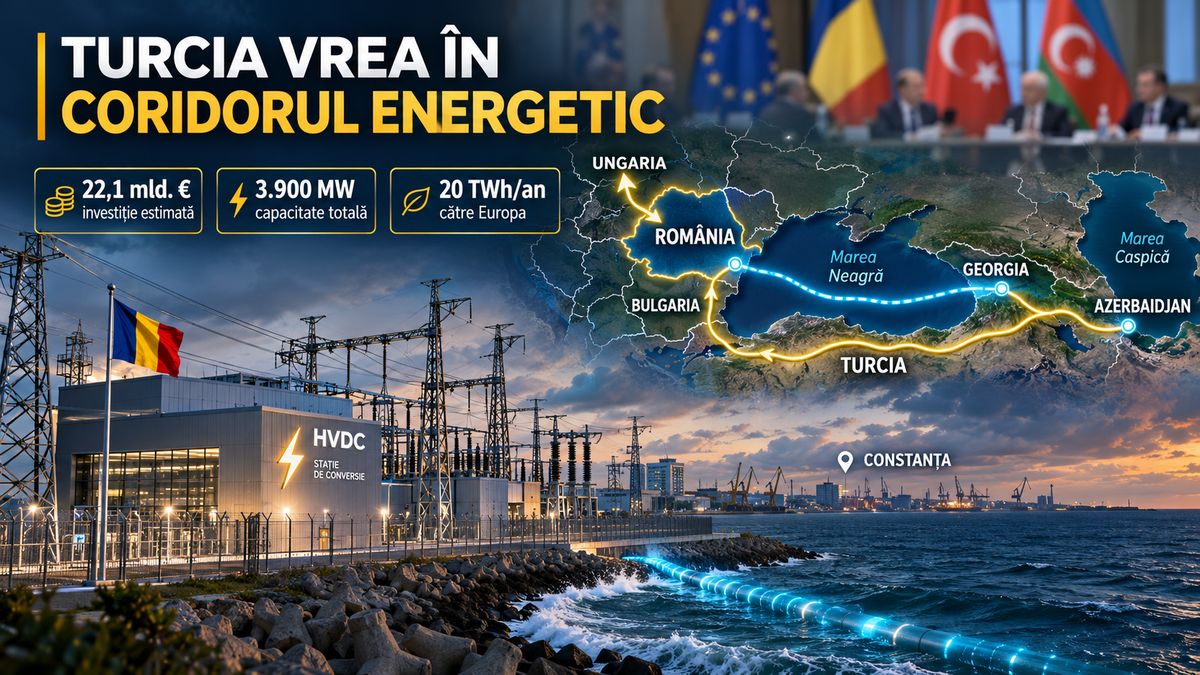
Romania could become one of the European Union's primary entry points for electricity generated in the Caspian Sea region, driven by a transcontinental energy project estimated at €22.1 billion. At the ministerial meeting held in Bucharest on November 23, 2026, Türkiye expressed its interest in joining the Green Energy Corridor—an initiative developed by Azerbaijan, Georgia, Romania, and Hungary that entails constructing three subsea power interconnectors across the Black Sea. Azerbaijan’s Minister of Energy, Parviz Shahbazov, announced the completion of the preparatory stage and the confirmation of the project's feasibility. The timeline presented by developers targets a Final Investment Decision (FID) in 2029, the commencement of power deliveries in 2032, and reaching a total transmission capacity of 3,900 MW by 2040. However, the Bucharest meeting highlighted a broader strategic outlook. Parallel to Türkiye’s interest in the subsea corridor, Romania is exploring potential participation in a second power transmission project linking Azerbaijan to the European Union via Georgia, Türkiye, and Bulgaria. These dual routes could significantly reshape the energy landscape of South-Eastern Europe, granting Romania access to new power sources and bolstering its role in regional energy trade. Romania and Türkiye could participate in dual energy corridors linking Asia and Europe The Green Energy Corridor project stems from a strategic partnership agreement signed in Bucharest in December 2022 by Azerbaijan, Georgia, Romania, and Hungary. The initiative aims to harness the Caspian region's renewable energy potential and transmit green power to European markets via high-capacity electrical infrastructure. Nearly four years after the original agreement, regional energy cooperation is gaining an added dimension. On November 10, 2026, Azerbaijan, Georgia, Türkiye, and Bulgaria signed a strategic clean energy partnership in Antalya, establishing a framework for an overland power corridor toward the European Union. According to Azerbaijan’s Ministry of Energy, Romania’s prospective involvement in this second route was discussed during a bilateral meeting on November 23 between officials from both nations. Concurrently, Türkiye’s interest in the subsea project opens up prospects for synergy between the two initiatives. Developing distinct routes—one crossing the Black Sea and the other traversing Türkiye and Bulgaria—would diversify Europe’s energy supply infrastructure. For Romania, involvement in both projects presents an opportunity to serve as a convergence point for electricity flows between the Caspian basin, the Balkans, and Central Europe. The €22.1 billion investment encompasses transmission infrastructure and new generation capacity The financial scale of the Green Energy Corridor reflects a scope far exceeding the deployment of a single subsea cable. According to estimates by Green Energy Corridor Power Company, the entity tasked with project development, approximately €14.3 billion is earmarked for power transmission infrastructure, with an additional €7.8 billion dedicated to developing targeted renewable generation capacities. The infrastructure plan includes three subsea interconnectors—each with a transmission capacity of 1,300 MW—converter stations, onshore power lines, and grid interconnections with participating nations. Each subsea cable is projected to span approximately 1,120 kilometers, traversing Black Sea depths exceeding 2,000 meters. The first 1,300 MW interconnector is scheduled for completion in 2032. A second phase is set to expand cumulative capacity to 2,600 MW by 2036, with the third link pushing total capacity to 3,900 MW in 2040. The technical architecture also features a 2,000 MW onshore transmission link connecting Constanța South in Romania to Albertirsa in Hungary. This phased development model allows capital expenditure to be spread over a longer horizon while enabling infrastructure adjustments based on evolving generation capacities, European electricity demand, and financing conditions. The overall figure of €22.1 billion represents the total estimated investment for the entire multinational endeavor. Annual transit through Romania could match 40% of national power consumption According to a feasibility study conducted by Italian engineering consultancy CESI, the Green Energy Corridor could facilitate annual exports of roughly 8 TWh to the EU in its initial phase. Once all three interconnectors are fully operational, annual transmitted energy could reach 20 TWh. The magnitude of these flows is striking when placed alongside Romania’s domestic energy metrics. Data from the National Institute of Statistics shows Romania’s final electricity consumption stood at around 50 TWh in 2025, while nuclear generation totaled roughly 11 TWh. At full capacity targeted for 2040, the corridor could channel an annual electricity volume through Romania equal to nearly 40% of the country’s 2025…
Ioana Buzoaica — Independent Editorial Board
The NRG-IA newsroom continuously monitors Romanian energy markets, ANRE regulatory decisions, and national grid telemetry (SEN/SNT). We deliver independent intelligence anchored exclusively in official primary data.
Editorial Charter, Ethics & Verification Methodology →