Sept DAM Hits 927 RON/MWh: Romania Among Costliest in EU — NRG-IA
Piața de Energie Author: Ioana BuzoaicaRomania's September day-ahead price averaged 927 RON/MWh, up 17% MoM and 88% YoY, making it the fourth most expensive spot market in the EU.
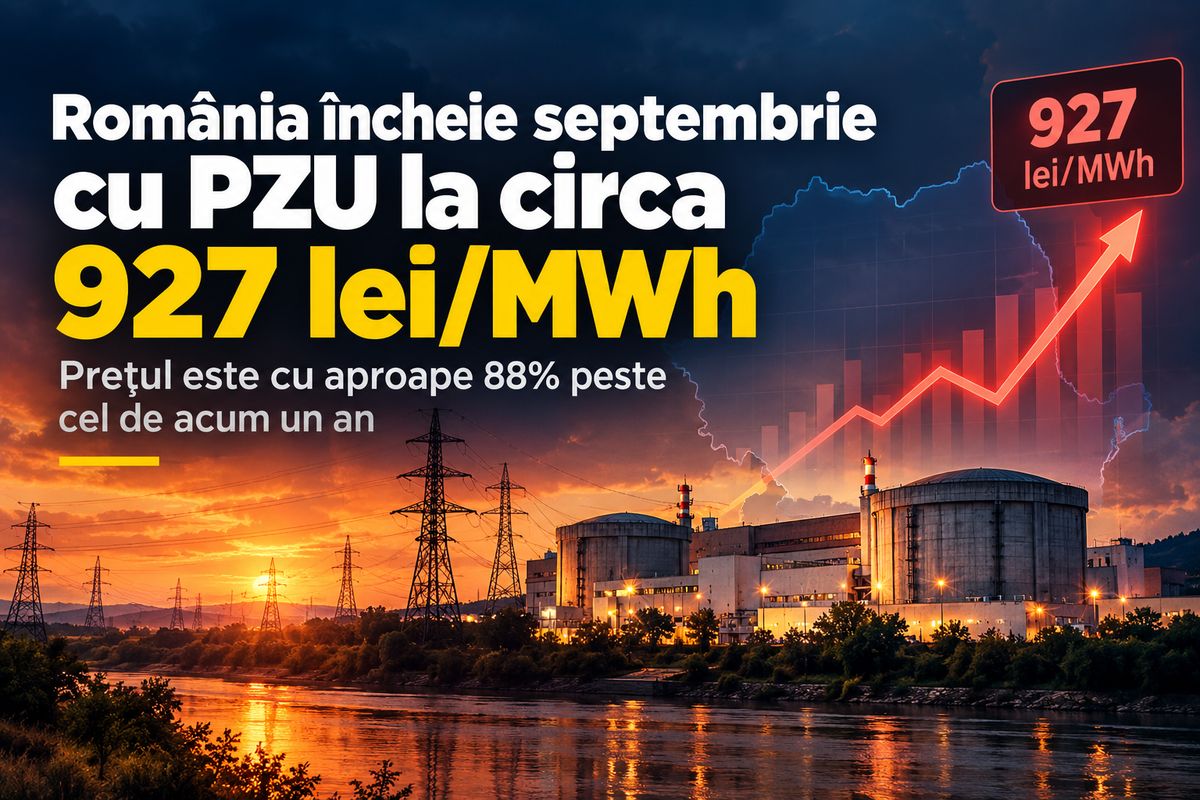
September Pushes DAM to Around 927 RON/MWh Romania ends September with one of the most expensive months of the past year on the spot electricity market. The average Day-Ahead Market (DAM) price is calculated at approximately 927 RON/MWh , according to data published by Economica.net. In August, the price stood at 793 RON/MWh , and in July at around 629 RON/MWh . This represents an increase of approximately 17% in a single month , after August had already brought a roughly 26% advance compared to July. The difference becomes even more pronounced on a year-on-year basis. In September 2025, the average price was around 492 RON/MWh . At approximately 927 RON/MWh in September 2026, the year-on-year increase is nearly 88% . The official final weighted average price for September had not yet been published by OPCOM at the time of writing. The market operator displays a weighted average price of 793.19 RON/MWh for August. Romania Ranks Among the Most Expensive Spot Markets in the EU The increase is not only relative to Romania's own historical data. Profit.ro calculates an average price of approximately EUR 176.14/MWh for September, placing Romania fourth among the most expensive spot markets in the European Union , behind Italy, Ireland, and Hungary. In August, the value calculated in euros was approximately EUR 151.16/MWh , and in September 2025 it was EUR 97.95/MWh . However, the Romanian market does not operate in isolation. The DAM is integrated into the European single day-ahead coupling mechanism, and price pressures were also felt across other regional markets in September. Yet, Romania simultaneously faced its own severe deficit in available generation. Cernavodă Was Completely Offline in September One of the most significant departures from a normal month was the complete absence of nuclear generation. Unit 1 of the Cernavodă NPP underwent a controlled shutdown on July 28 due to the extremely low flow rate of the Danube River. On August 13, Nuclearelectrica initiated a controlled shutdown of Unit 2 as well, citing the continuous and significant decline in the river's water levels. The two reactors have a capacity of approximately 700 MW each, representing a combined 1,400 MW of nuclear capacity . In September, neither unit was available. The impact on the generation mix is major: under normal conditions, Cernavodă provides a large and relatively constant volume of baseload power, independent of daily variations in wind or solar radiation. The absence of nuclear power forced the system to cover this deficit through other domestic sources and imports, during a period when hydropower generation was also unable to compensate for the loss. Drought Hit Both Nuclear and Hydropower Simultaneously The Danube's low flow issues were not limited to Cernavodă. Severely weak hydrological conditions also curtailed hydropower generation. During certain intervals in September, hydro output fell below 200 MW , according to data analyzed by Economica.net. Romania thus faced a highly unfavorable combination: approximately 1,400 MW of unavailable nuclear capacity and a hydro contribution far below its potential. On certain days, this was compounded by low wind generation and outages at several thermal power plants. On September 24, for instance, the average DAM price surged to approximately 1,224 RON/MWh , equivalent to around EUR 233/MWh , giving Romania one of the highest spot prices in Europe at the time. Solar Lowers Daytime Prices but Fails to Solve the Evening Peak September also highlighted another increasingly critical feature of the Romanian power system: the massive price spread between hours with solar generation and those without. During intervals favorable to solar generation, photovoltaic supply can drive DAM prices down significantly. After sunset, this generation drops off rapidly while demand remains high. Without steady baseload generation from Cernavodă, with limited hydro, and with storage capacity still low relative to the system's size, Romania becomes heavily dependent on thermal power plants and imports during these peak hours. The result is extreme intra-day volatility. OPCOM data for September 30 illustrates this disconnect: 15-minute interval prices dropped as low as 50–60 RON/MWh , yet exceeded 1,300 RON/MWh during other intervals. Consequently, it is no longer enough to look solely at the volume of energy generated in a day. The timing of when that energy is available has become critical for pricing. The DAM Has Come to Handle Very Large Volumes The pressure on the spot market is also evident in the sheer volume of traded power. For the delivery day of September 28 , OPCOM reported 62,552 MWh traded on the DAM , the highest level in 2026 after the winter peaks recorded in February. The average price for that day was EUR 154.34/MWh , below the European average of approximately EUR 171/MWh. However, the volume demonstrates how vital the DAM has become to the daily operation of the market. In…
Ioana Buzoaica — Independent Editorial Board
The NRG-IA newsroom continuously monitors Romanian energy markets, ANRE regulatory decisions, and national grid telemetry (SEN/SNT). We deliver independent intelligence anchored exclusively in official primary data.
Editorial Charter, Ethics & Verification Methodology →