Romania Power Prices Double Amid Nuclear and Hydro Deficits — NRG-IA
Piața de Energie Author: Ioana BuzoaicaRomania faces its toughest winter start in a decade as drought halts Cernavodă's reactors and drains hydro reservoirs, doubling spot power prices.
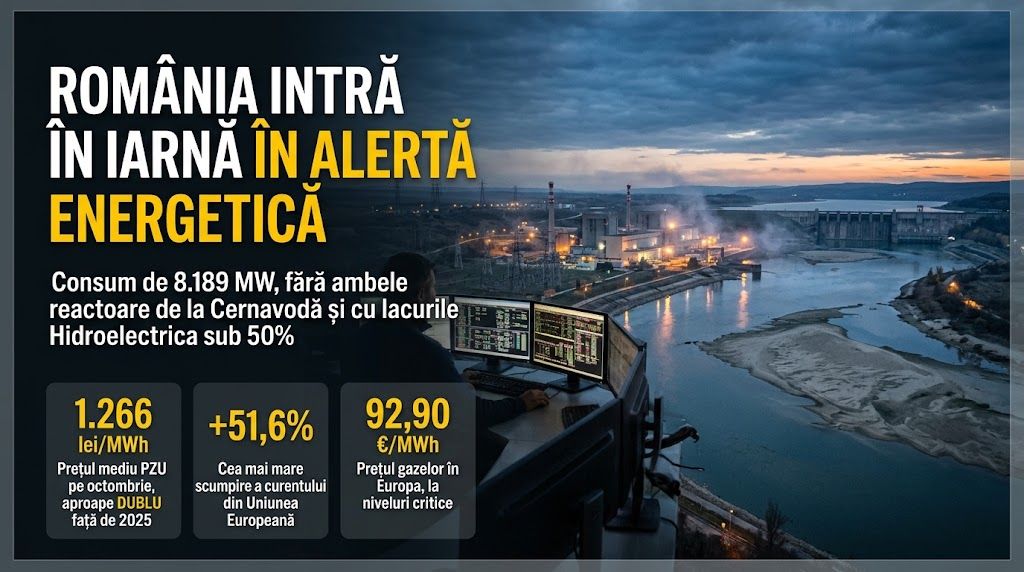
Romania’s National Energy System entered the cold season in November 2026 under the most severe capacity and price pressures seen in a decade, forced to cover a domestic peak demand of 8,189 MW without a single megawatt from the Cernavodă nuclear power plant and with Hidroelectrica’s reservoir levels dropping below 50%. The simultaneous outage of the country's primary low-cost generation assets immediately shifted system balancing onto natural gas-fired plants and expensive imports, doubling wholesale electricity prices compared to last autumn and cementing Romania’s position as the EU leader in household power price inflation. Official data released by energy exchange operator OPCOM show that the weighted average price on the Day-Ahead Market (DAM) reached RON 1,265.96/MWh in October 2026, up 38% from September 2026 (RON 917.36/MWh) and 97.5% higher than the RON 641.00/MWh recorded in October 2025. Market strain intensified in early November as colder weather pushed electricity consumption to 8,189 MW on November 2, driving the average daily spot price on November 3 to RON 1,586/MWh—more than triple the April average of RON 514/MWh. These market developments unfold under an official state of alert in the energy sector, extended by authorities in Bucharest until November 30, 2026, via legislation published in Official Gazette Part I No. 902/2026. This administrative measure underscores an unprecedented physical constraint: Romania must navigate the first month of meteorological winter with the temporary removal of the very power assets that traditionally provide baseload stability and evening peak flexibility. Danube drought forces full November shutdown of both Cernavodă reactors The direct cause behind the unavailability of both units at the Cernavodă Nuclear Power Plant, which represent roughly 1,400 MW of installed capacity, is not a technical fault on the nuclear side, but a drastic drop in the Danube's water levels and flow rates caused by prolonged drought across the European river basin. In early November, hydrological readings at Cernavodă recorded a river level of minus 267 centimeters and a flow rate of just 215 cubic meters per second. Meanwhile, at Baziaș, where the river enters Romania, Danube flow dropped to 1,550 cubic meters per second on November 4—nearly one-third of the historical November average. Although the CANDU 6 reactors operated by Nuclearelectrica use heavy water in a closed primary circuit for core moderation and cooling, their safe operation relies on drawing massive volumes of water from the Danube via an intake canal to cool secondary-circuit condensers and auxiliary systems. When river levels fall below the technical suction threshold of the cooling water pumps, power generation becomes impossible. Consequently, both Unit 1 and Unit 2 underwent controlled shutdowns and are scheduled to remain offline throughout November 2026. The absence of 1,400 MW of nuclear output removes approximately 18% to 20% of the power needed to meet national consumption exceeding 8,000 MW. Unlike intermittent renewable sources, nuclear power provides round-the-clock baseload generation at some of the lowest marginal costs in the market. The loss of this baseload capacity creates a structural deficit that transmission system operator Transelectrica must continuously balance. Hidroelectrica reservoir levels fall below 50%, among the lowest in three decades Under normal circumstances, a temporary outage of a nuclear or thermal unit is swiftly offset by ramping up generation at major hydropower facilities along inland rivers and at the Iron Gates. In November 2026, however, this safety buffer is severely constrained, as state-controlled Hidroelectrica enters the cold season with reservoir filling levels below 50%—one of the lowest early-winter marks recorded in the past thirty years. The November 2026 hydrological forecast issued by the National Institute of Hydrology and Water Management confirms persistent nationwide water deficits, with river flows estimated at 30% to 50% of monthly historical averages. Under these conditions, the country's largest power producer—holding over 6,300 MW of installed capacity—is forced to preserve strategic water reserves in major reservoirs for peak winter months in January and February, when severe cold spells could push national demand toward 9,000 MW. This dual hydrological constraint—affecting both the Danube at Cernavodă and Iron Gates and inland mountain reservoirs—deprives Romania's power market of its primary price-dampening tool. When Hidroelectrica scales back evening supply to conserve water, the system loses the flexible generation that typically prevents high-cost fossil fuel plants from setting clearing prices during peak hours. Behind the RON 1,586/MWh spot price: How EUR 92/MWh gas sets electricity bills The financial impact of losing nuclear generation alongside significant hydropower availability is reflected directly in the marginal pricing…
Ioana Buzoaica — Independent Editorial Board
The NRG-IA newsroom continuously monitors Romanian energy markets, ANRE regulatory decisions, and national grid telemetry (SEN/SNT). We deliver independent intelligence anchored exclusively in official primary data.
Editorial Charter, Ethics & Verification Methodology →