Romania Negotiates US LNG via Greece with Atlantic–SEE — NRG-IA
Gaze Naturale Author: Ioana BuzoaicaRomania could join the regional US LNG supply chain via Greece if talks with Atlantic–SEE close by late summer, linking Greek terminals to Central Europe.
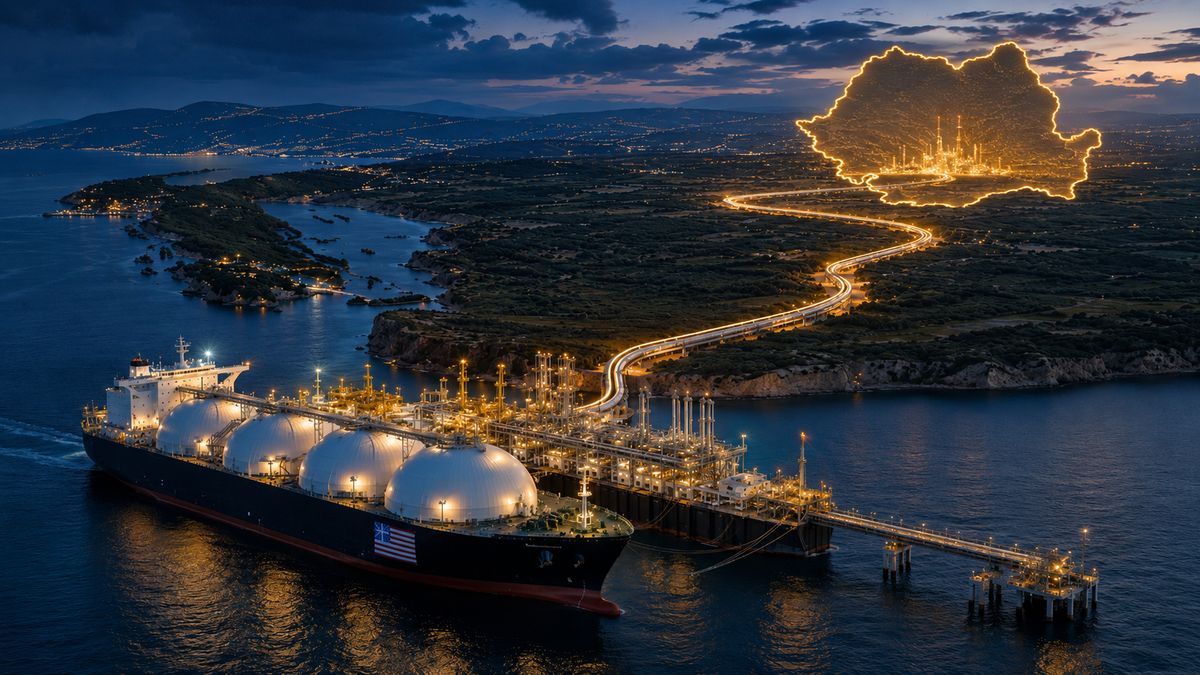
Atlantic–SEE LNG Trade aims to finalize negotiations with Romania by the end of the summer, at a time when Greece is consolidating its role as the southern gateway for US liquefied natural gas destined for Eastern Europe and the Balkans. The Greek company, controlled by AKTOR Group and DEPA Commercial, already has a long-term agreement with Venture Global for US LNG, and Romania is emerging as one of the target markets for the volumes to be brought into the region. The stakes go beyond purchasing additional gas volumes. The contract would connect Romania more clearly to an emerging regional energy infrastructure: LNG arrives by sea in Greece, is regasified at Greek terminals, and can then be transported through the gas networks of Greece, Bulgaria, Romania, Moldova, and Ukraine. In practical terms, Romania does not receive LNG as a liquid cargo, but rather natural gas resulting from regasification, transported via regional pipelines. Atlantic–SEE is building a regional portfolio, not just a bilateral contract Atlantic–SEE LNG Trade is a Greek joint venture in which AKTOR Group holds 60% and DEPA Commercial holds 40%. The company was established to import LNG into Greece and market gas in Southeast and Eastern Europe, utilizing the Vertical Corridor as transport infrastructure to the north. Venture Global and Atlantic–SEE announced on June 11, 2026, the expansion of their existing LNG sales and purchase agreement. The minimum contracted volume doubles from 0.5 million tonnes per annum (MTPA) to 1 MTPA for a 20-year period starting in 2030. The agreement is backed by Venture Global's investment in regasification capacity at the Alexandroupolis terminal, where the US company holds approximately 25% of the total capacity. This structure explains why negotiations with Romania are of strategic importance. Atlantic–SEE is attempting to link US suppliers, Greek infrastructure, and regional buyers into a predictable commercial chain. For the US supplier, the agreement means access to Eastern European markets. For Greece, it cements its role as an energy hub. For Romania, it provides access to an additional supply option at a time when gas remains a tool for economic security. The actual route runs through LNG terminals, regasification, and regional pipelines The physical entry point is Greece. The Alexandroupolis LNG terminal, operated by Gastrade, has an annual regasification capacity of 5.5 billion cubic meters (bcm) and is connected to the Greek system via a 28-kilometer pipeline. The terminal was designed to deliver gas not only to the Greek market but also to Bulgaria, Romania, Serbia, Hungary, and Ukraine. The Vertical Corridor is the infrastructure that transforms Greek LNG terminals into a regional route. It links Greece, Bulgaria, Romania, Moldova, and Ukraine, and transmission system operators (TSOs) have agreed with the European Commission on a tariff structure designed to make the route more competitive. Starting in October 2026, operators are expected to offer daily, monthly, quarterly, and annual capacity products for the 2026–2027 gas year. For Romania, this element matters almost as much as the price of LNG. US gas can only be competitive if the entire chain operates economically: purchase price, regasification costs, transmission tariffs through Greece and Bulgaria, available capacity at interconnectors, and the final cost at the entry point into the Romanian system. A favorable contract at the source can lose its advantage if transport becomes expensive or if capacity access is bottlenecked during periods of high demand. Romania gains options, but cannot escape the price calculation Romania has significant domestic gas production and is awaiting the start of gas flows from Neptun Deep. This is precisely why an agreement for regasified gas in Greece must be viewed through the lens of portfolio diversification, rather than as a sole supply solution. Commercial value arises when imports from the south can cover peak demand, increase competition among sources, and support regional deliveries to markets under pressure. There is also a harsher price calculation. Long-term US LNG offers predictability but does not automatically guarantee cheap energy. The final price depends on the contractual formula, transport costs, competition with Asia, spot market developments, and the actual capacity of terminals and pipelines. Atlantic–SEE notes that 20-year agreements are harder to secure than they were six months ago, as US suppliers become more price-sensitive and cautious about volume commitments in a tight market. The essential distinction lies between security and price. A new source can enhance security of supply without immediately lowering bills. It can mitigate deficit risks, help suppliers build more robust portfolios, and reduce dependence on vulnerable routes, but the consumer price is shaped by a longer chain of commercial costs, tariffs, taxes, and market conditions. Europe shifts its gas gravity…