Romania Commits to 2,496 MW of Storage by 2028 in EU Pact — NRG-IA
Energie Regenerabilă Author: Ioana BuzoaicaRomania targets 2,496 MW of new storage in the EU's first tripartite pact, but success depends on grid connection, financing, and merchant revenues.
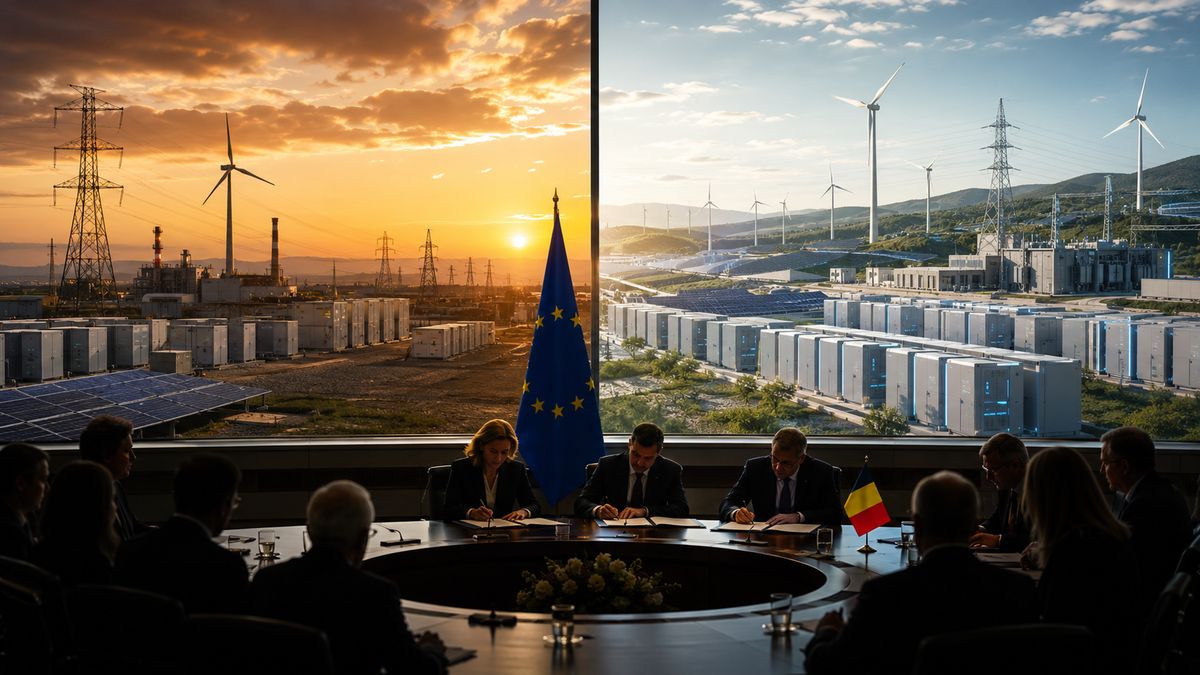
Romania has committed to developing 2,496 MW of additional energy storage capacity between 2026 and 2028 , under the European Union's first tripartite agreement dedicated to this sector. The target appears in the official list published by the European Commission following the signing of the document in Luxembourg, on the sidelines of the Energy Ministers' meeting on June 26. This figure does not automatically mean 2,496 MW of batteries are already funded, contracted, or under construction. Instead, it represents Romania's estimated commitment for storage capacity to be added by the end of 2028. The Commission has not published a breakdown for Romania in terms of MWh, technologies, projects, or commissioning years. The distinction is essential. MW represents the maximum power at which a facility can charge or inject energy into the grid at any given moment. MWh indicates the volume of energy that can be stored and the potential duration of operation. Two facilities can have the same capacity of 100 MW but very different storage volumes: one might deliver energy for one hour, while another could do so for two or four hours. The first European agreement to treat storage as a market priority The tripartite agreement is built around three categories of stakeholders: public authorities and financial institutions, storage and renewables developers, and energy-intensive industries. The mechanism aims to de-risk investments through a clearer pipeline of projects, grid rules more favorable to flexibility, and support for financing storage assets. The 22 participating member states agreed to accelerate the deployment of storage, and 17 of them have already submitted concrete targets formulated in either MW or MWh. Another five states are expected to publish their commitments by the end of the year. Romania is listed in the document with a target of 2,496 MW, one of the largest pledges published for the 2026–2028 period. The agreement does not impose a mandatory quota and does not automatically transfer EU funding to Romanian projects. The Commission specifies that these commitments do not create legal obligations for the signatories. Instead, they serve as a political and investment signal: member states must demonstrate they have the projects, regulations, grids, and mechanisms capable of supporting storage expansion. Grid tariffs and commercial revenues become the real test Signatory states have committed to removing barriers that slow down storage development and to enabling regulatory authorities to set or approve non-discriminatory, cost-reflective grid tariffs that incentivize flexibility. For Romania, this component is more important than the mere figure of 2,496 MW. A storage facility must be able to buy energy, charge, discharge, and participate in balancing and ancillary services without being penalized by disproportionate grid costs or rules that treat the battery simultaneously as a simple consumer and a simple producer. The agreement also calls on storage and renewables developers to provide annual estimates of new projects and associated capacities. Industry is urged to develop co-located storage and provide clearer information on consumption profiles. For financiers, this visibility is directly critical: projects become easier to evaluate when there is data on grid capacity, consumption, potential revenues, and implementation timelines. The European Commission will monitor progress annually until 2028 and support member states in developing financing mechanisms. The EIB Group is exploring the expansion of existing instruments to include storage, including in corporate power purchase agreements (PPAs), the European manufacturing supply chain, and project finance. Romania already has approved funding and major projects under development The European target comes at a time when Romania already has an established financial framework and a growing pipeline of projects. In March, the European Commission approved a €150 million Romanian state aid scheme for utility-scale, standalone electricity storage facilities. Funded through the Modernisation Fund, the scheme aims to install at least 2,174 MWh of new storage capacity. In parallel, commercial projects are beginning to reach a scale relevant to the Romanian market. The EBRD is financing with up to €44 million the storage system in Scornicești, Olt County, developed by R.Power and Eiffel Investment Group. The facility is designed for 127 MW and 254 MWh and is expected to participate in the ancillary services and balancing markets, relying primarily on merchant revenues. This type of project highlights the difference between a political target and a functional asset. For the 2,496 MW to become actual capacity, developers must navigate grid connection, permitting, equipment procurement, financing, and operational contracting. The market needs projects that can demonstrate not just that they have batteries and land, but that they can generate stable revenues…
Ioana Buzoaica — Independent Editorial Board
The NRG-IA newsroom continuously monitors Romanian energy markets, ANRE regulatory decisions, and national grid telemetry (SEN/SNT). We deliver independent intelligence anchored exclusively in official primary data.
Editorial Charter, Ethics & Verification Methodology →