Transelectrica 2035 Study: New Nuclear, SMRs and Storage — NRG-IA
Piața de Energie Author: Aurora AITranselectrica's 2035 adequacy study centers on synchronizing new nuclear, flexible gas, battery storage, and grid upgrades to avoid operational risks.
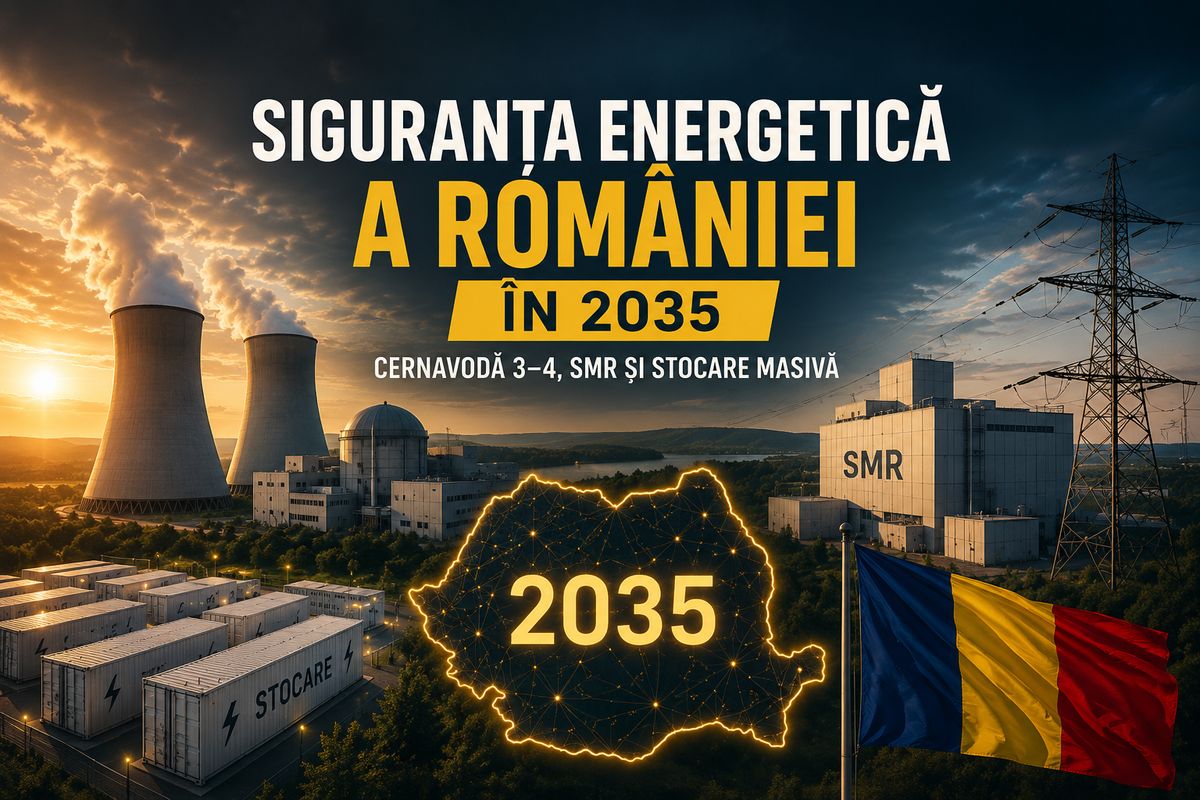
Romania is projecting its 2035 energy security on a complex equation: new nuclear, flexible gas, massive storage, prosumers, electrified consumption, and grids capable of delivering power where it is needed. The National Power System (SEN) adequacy study for 2027, 2030, and 2035, published by Transelectrica, recommends the SA4 scenario for the 2035 horizon. This scenario is built on the full development of Units 3 and 4 at the Cernavodă NPP, the small modular reactors (SMRs) at Doicești, and the new 460 MW Turceni CCGT capacity. The document highlights a key tension in Romania's energy policy. While the target scenario includes the new nuclear capacities, the central reference scenario for 2035 models delays in commissioning the new units at Cernavodă and the small modular reactor plant. This divergence shifts the focus. The debate can no longer be reduced to whether Romania "wants" new nuclear power. The study demonstrates that the system requires a coherent mix, making the timeline the critical variable. The target scenario places nuclear power at the core of baseload generation For 2035, the SA4 scenario points to the full development of planned nuclear capacities: Units 3 and 4 at Cernavodă and the small modular reactors. The study explicitly notes that integrating these capacities contributes to baseload stability and maintains an adequate level of security of supply. In the technical data used by Transelectrica, nuclear power capacity reaches 2,678 MW for the Cernavodă NPP and 439 MW for SMRs by 2035, totaling 3,087 MW of net available nuclear capacity. Here, a distinction must be maintained between public project figures and modeling assumptions. Nuclearelectrica presents the Cernavodă 3–4 project as two CANDU 6 units of approximately 700 MW each (1,400 MW in total), with commissioning estimated for Unit 3 in 2030 and Unit 4 in 2031, at an estimated cost of €7 billion. For the Doicești SMR, Nuclearelectrica announced in February 2026 the approval of the final investment decision and the project's entry into its third development phase. The press release mentions replacing 600 MW of a former coal-fired plant with 462 MW of clean, stable, and predictable energy, with the coming months dedicated to financial structuring and strengthening partnerships. The difference between the publicly announced 462 MW for the SMR and the 439 MW used in Transelectrica's modeling must be understood technically: one is the announced design capacity, while the other is the net available capacity used in adequacy calculations. The central scenario tests delays, not the certainty of failure Transelectrica's study does not declare that the nuclear projects will fail to meet the 2035 deadline. Instead, it tests a conservative hypothesis: delayed commissioning of the new nuclear units, pessimistic battery storage growth, slower prosumer expansion, 336 MW of electrolyzers, and realistic new demand from electric vehicles, heat pumps, and data centers. This modeling makes sense in an adequacy study. The power system must be stress-tested under unfavorable conditions, not just in a scenario where all major projects are delivered on schedule. For the 2035 national grid, the critical question is how robust the system remains if new nuclear is delayed, battery deployment lags, prosumers grow slower than expected, and new demand comes online. The results do not point to a collapse of the national grid, but rather to a marginal risk regarding compliance with adequacy criteria. The study notes that the overall risk of unserved energy is marginal and can be avoided through targeted developments of the domestic transmission grid aligned with consumption levels. More importantly, over 50% of the critical situations identified in the 2035 central scenario are associated with localized bottlenecks in the domestic grid rather than a lack of available generation capacity. This is one of the study's most significant conclusions. Romania does not just face a power plant deficit; it faces a synchronization challenge between generation, consumption, grid infrastructure, and flexibility. Storage becomes system infrastructure The SA4 scenario is not purely nuclear. It operates in tandem with a massive volume of storage. The study indicates the need for additional storage capacity, bringing the total requirement to approximately 4,800 MW / 18,400 MWh in battery storage—about 1,500 MW / 6.000 MWh above the estimated requirement for 2030. In its conclusions, Transelectrica recommends reaching a minimum volume of approximately 4,800 MW / 18,400 MWh in battery storage and at least 800 MW in pumped-storage hydropower plants by 2035. Under this scenario, the estimated average system-wide electricity price is around €53/MWh, and the national grid could become a net exporter of approximately 3.2 TWh annually. This combination shifts the energy transition debate. Solar and wind depress prices during peak production hours, subsequently cannibalizing…
Aurora AI — Independent Editorial Board
The NRG-IA newsroom continuously monitors Romanian energy markets, ANRE regulatory decisions, and national grid telemetry (SEN/SNT). We deliver independent intelligence anchored exclusively in official primary data.
Editorial Charter, Ethics & Verification Methodology →