Romania Risks Needing 3,500 MW Power Imports This Winter — NRG-IA
Piața de Energie Author: Ioana BuzoaicaRomania enters winter 2026–2027 with depleted hydro reserves. Severe cold and zero solar/wind could drive power imports to 3,500 MW, raising market risks.
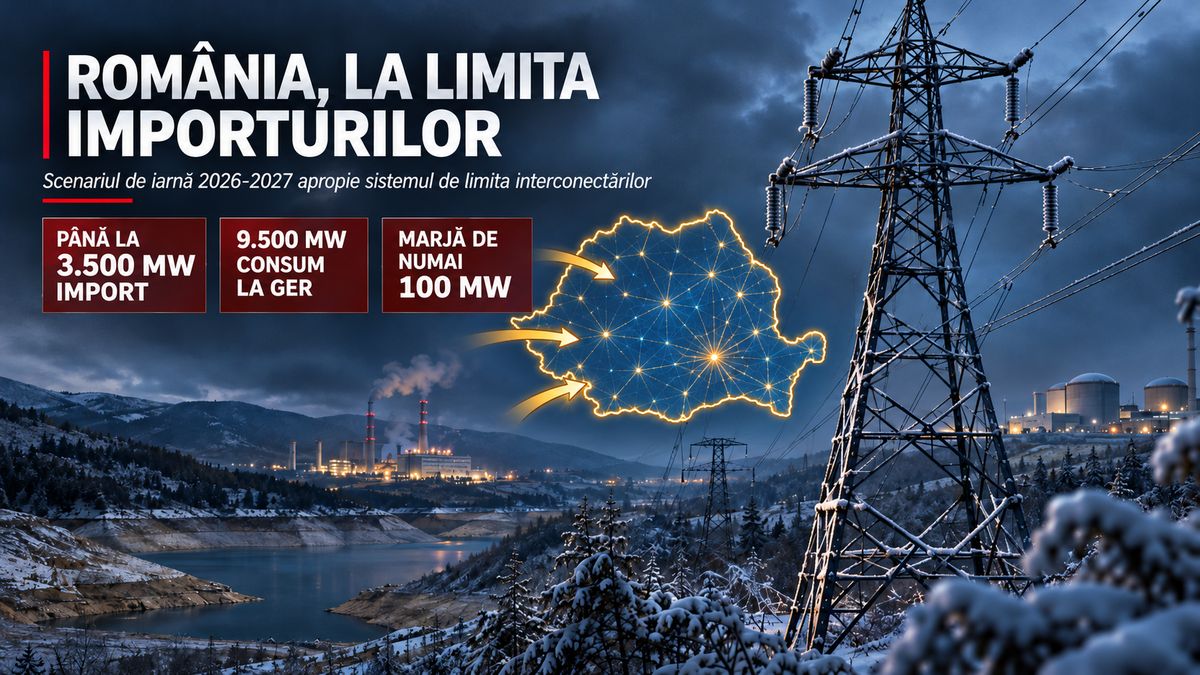
Romania could end up importing over a third of its required electricity on a freezing evening this winter. Calculations attributed to Transelectrica in the 2026–2027 Winter Outlook, reported by Economedia and cited by TVR on November 24, indicate import requirements of up to 3,500 MW under a stress scenario where low temperatures drive up consumption while wind and solar generation are entirely unavailable. The scale of this vulnerability becomes clear when compared against transmission grid capacity. For November, Romania's maximum import capacity is estimated at 3,600–4,100 MW, depending on the configuration and operational availability of grid infrastructure domestically and in neighboring systems. Under conditions corresponding to the lower bound, the margin between import capacity and the stress scenario requirement would narrow to just 100 MW. Romania's structural challenge lies in the simultaneous availability of energy resources during peak demand hours. A country adding new installed capacity can remain heavily reliant on imports if those assets fail to generate sufficient power precisely during the intervals when the system needs it most. Import Requirements Could Increase 2.7-Fold Between the Two Winter Scenarios In the baseline scenario attributed to Transelectrica, Romania would record peak demand of 9,100 MW, met by a mix of 2,000 MW from hydropower, 2,070 MW from natural gas-fired plants, 1,400 MW from nuclear energy, 930 MW from coal power plants, 700 MW from wind power, and 700 MW supplied by storage assets. Required imports would stand at 1,300 MW. In the downside scenario, consumption rises to 9,500 MW, while output from hydro drops to 1,500 MW, gas-fired generation falls to 1,920 MW, and coal output drops to 680 MW. Nuclear power remains constant at 1,400 MW, battery storage provides 500 MW, while wind and solar output is assumed to be zero. The discrepancy between the two scenarios is stark. While consumption rises by only 400 MW, power supplied from domestic resources and storage declines by 1,800 MW. Combined, these shifts generate an additional import requirement of 2,200 MW. Consequently, the share of imports needed to cover demand escalates from approximately 14.3% to 36.8%. This gap underscores that the primary challenge stems not solely from temperature-driven demand spikes, but primarily from the simultaneous contraction in output across multiple generation categories. Depleted Hydro Reserves Constrain One of Romania’s Most Critical Assets Hydroelectric power plays a strategic role in operating the National Power System (SEN). Unlike wind and solar assets, storage-based hydro facilities can adjust output to meet system demand, stepping in rapidly during power deficits or sharp demand fluctuations. According to financial media reports, as of November 8, 2026, hydro reservoir storage levels stood at approximately 40%. Prolonged drought conditions and intensive hydro dispatch during periods of reduced nuclear output depleted available reserves ahead of the cold season. The European Winter Outlook 2026–2027 assessment, published by ENTSO-E on November 13, confirms this vulnerability. Depleted hydro reserves limit Romania’s ability to leverage stored water to shave demand peaks throughout the entire winter season. In this context, water management becomes a key strategic issue. Heavy hydro dispatch in December and January could deplete energy available for cold snaps in February and March. While installed hydro capacity remains unchanged, the total energy volume these facilities can deliver across the season depends directly on available water stocks. Gas, Coal, and Nuclear Assets Become Decisive on Freezing Evenings Under the downside scenario, natural gas-fired plants would serve as the single largest source of domestic generation at 1,920 MW, followed by hydro assets and the two nuclear reactors at Cernavodă. Combined, gas, coal, and nuclear facilities would deliver 4,000 MW, equivalent to roughly 42% of estimated national peak demand under freezing conditions. Operational availability of these dispatchable units is essential for maintaining system balance. An unplanned outage at a Cernavodă nuclear unit or a major power plant like Brazi could significantly surge import needs. ENTSO-E explicitly identifies potential outages among dispatchable units as a key risk factor straining Romania’s security of supply. Gas-fired generation also faces a unique economic and operational dynamic. During severe cold snaps, gas consumption spikes simultaneously for space heating and power generation. Operational coordination between the national gas TSO and power TSO becomes essential to ensure the stability of both energy infrastructures. Thousands of Installed Renewable Megawatts Do Not Guarantee Evening Peak Output The rapid expansion of solar and wind capacity is fundamentally reshaping Romania's power generation profile. Under favorable weather conditions, these technologies can cover a…
Ioana Buzoaica — Independent Editorial Board
The NRG-IA newsroom continuously monitors Romanian energy markets, ANRE regulatory decisions, and national grid telemetry (SEN/SNT). We deliver independent intelligence anchored exclusively in official primary data.
Editorial Charter, Ethics & Verification Methodology →