Romania Tops EU Electricity Hikes (+51.6%): Eurostat Data — NRG-IA
Piața de Energie Author: Ioana BuzoaicaRomania leads EU household energy price increases (+51.6% electricity, +9.3% gas). Purchasing power burden is the EU's highest as winter risks mount.
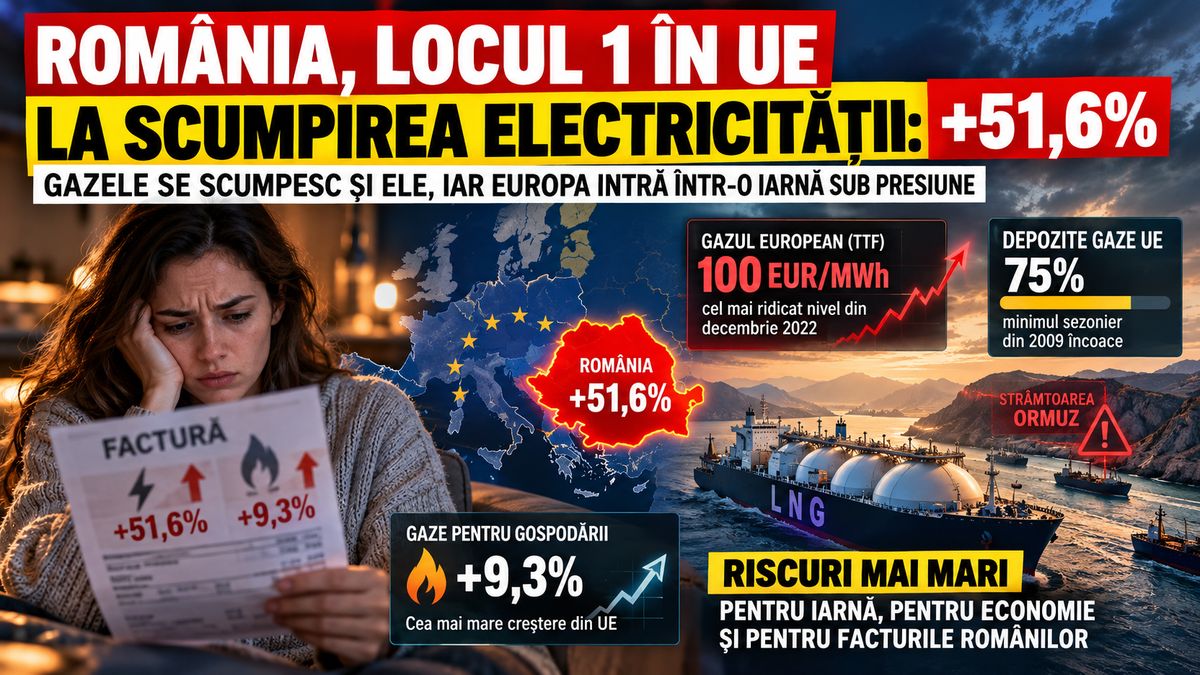
Romania recorded the largest annual surge in household electricity prices across the entire European Union, according to data published on Friday, October 30, 2026, by Eurostat. Prices jumped by 51.6% in the first half of 2026 compared to the same period of the previous year—a rate more than two and a half times higher than in Ireland, the second-ranked country. Romania also ranks first among EU states with comparable data for household natural gas price increases, which rose by 9.3%. The statistics reveal a situation with direct implications for living standards: while Romania's nominal electricity price is close to the European average, it is the highest in the EU when adjusted for purchasing power. In other words, electricity represents a heavier economic burden on Romanian households than on those in any other member state, according to Eurostat's benchmark indicator. The figures come as Europe faces a fresh rally in natural gas prices. On October 28, the European benchmark TTF price briefly hit €100/MWh for the first time since December 2022. Concurrently, EU gas storage facilities were approximately 75% full—below seasonal norms—following a summer marked by supply bottlenecks and disruptions to Persian Gulf LNG exports. Romania: Electricity 51.6% More Expensive in a Europe Where Prices Have Begun to Fall The 51.6% annual increase reported by Eurostat puts Romania comfortably in first place across the European Union. Ireland follows with 19.8%, and Finland recorded an 18.4% rise. The gap of nearly 32 percentage points between Romania and Ireland underscores the extraordinary magnitude of the price shift in the country. The contrast is even more pronounced when examining broader European trends. In the first half of 2026, the average household electricity price in the EU dropped to around €0.28/kWh, down 2.2% from the second half of 2025. Although this represents a half-year comparison—distinct from the year-on-year increase reported for Romania—it highlights that the European market did not evolve uniformly. While many member states experienced price stabilization or decline, Romanian consumers bore the brunt of a major regulatory shift. A central factor behind this increase was the phase-out of the general electricity price cap scheme on July 1, 2025. The first half of 2025 reflected government-subsidized rates, whereas H1 2026 reflected market dynamics under the new commercial framework. The statistical discrepancy thus captures the shift from capped tariffs to free-market price offers from suppliers. For end-users, this transition altered effective energy costs, with the actual impact depending on household consumption, contractual terms, and baseline rates. The 51.6% jump represents Eurostat’s calculated national average, rather than a uniform increase across all utility bills or a price hike occurring specifically in October. Romanians Bear Highest Electricity Cost Burden Adjusted for Purchasing Power Beyond the rankings of price surges, the critical takeaway concerns energy affordability. Eurostat also calculates electricity prices in Purchasing Power Standards (PPS), a metric that compares costs across countries while accounting for relative price levels and economic output. Romania ranks first in the EU under this metric, at 46.9 PPS per 100 kWh of electricity. Poland follows at 41.1 PPS, and the Czech Republic at 34.3 PPS. This divergence highlights the severe strain on Romanian households, even though nominal tariffs expressed directly in euros are not among Europe's highest. In nominal terms, Romania’s average household electricity price stood at approximately €0.284/kWh, close to the EU average. By comparison, Ireland recorded around €0.39/kWh, while Germany and Belgium stood near €0.36/kWh. Consequently, Romania leads the purchasing-power-adjusted burden ranking despite other member states having higher nominal rates. This distinction is vital for assessing the social impact of energy price increases. Electricity is an essential service, and a household’s ability to absorb price hikes depends on disposable income and essential living expenses. A tariff close to the European average becomes disproportionately burdensome in an economy with lower purchasing power. The picture for natural gas reveals a different dynamic. Romania posted a 9.3% annual price increase for households—the highest among reporting member states—yet nominal gas prices remained among the lowest in the Union. National price mitigation measures for gas continued to buffer end-consumers from full wholesale market volatility. European Gas Hits €100/MWh as Storage Levels Sit at Just 75% While Eurostat data outlines household price trends from the first half of the year, European wholesale markets are signaling renewed tightness ahead of winter. The benchmark TTF month-ahead contract briefly touched €100/MWh on October 28, reaching its highest level in nearly four years. Although prices subsequently eased below this…
Ioana Buzoaica — Independent Editorial Board
The NRG-IA newsroom continuously monitors Romanian energy markets, ANRE regulatory decisions, and national grid telemetry (SEN/SNT). We deliver independent intelligence anchored exclusively in official primary data.
Editorial Charter, Ethics & Verification Methodology →