Romania's Gas Plants Under Pressure: ENTSO-E CCGT Warning — NRG-IA
Gaze Naturale Author: Ioana BuzoaicaRomania needs dispatchable power post-coal, but its gas-heavy plan faces economic pressure. The key is how much gas is built and at what cost.
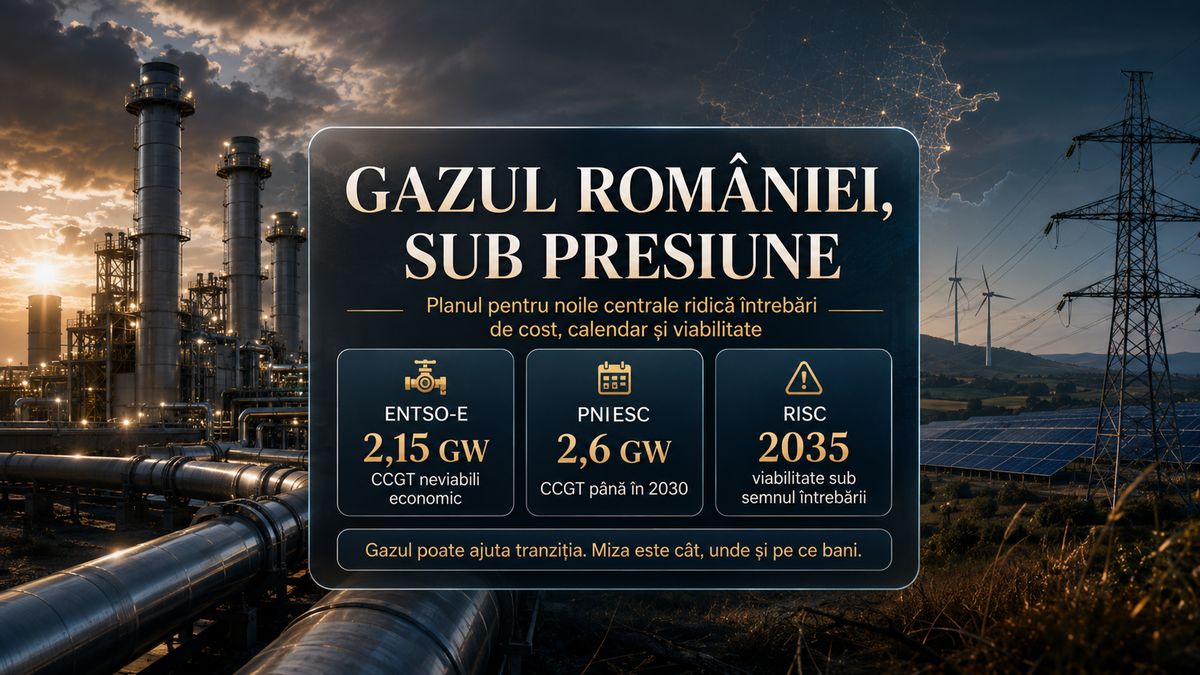
Romania is entering a challenging phase of its energy transition: it must phase out coal, integrate more solar and wind, maintain security of supply, and avoid building expensive assets that may run too infrequently to recover their investment. At the heart of this dilemma lie the new gas-fired power plants. Romania's energy plan includes developing new natural gas capacities, specifically CCGT (combined cycle gas turbine) plants. These plants use a gas turbine and recover waste heat to generate additional electricity through a steam turbine, achieving higher efficiency than open-cycle turbines. They can provide dispatchable power to a system with increasingly variable generation, but their economics depend on running hours, gas prices, CO₂ allowance costs, contracts, and market revenues. The warning sign comes from European adequacy assessments. In ERAA 2024, ENTSO-E shows that Romania's reference scenario reflects the coal phase-out and the replacement of decommissioned capacities primarily with CCGT gas plants. The same document warns that commissioning these CCGTs is "highly uncertain," and delays could affect Romania and, potentially, the region. More importantly, the economic viability assessment results indicate that 2.15 GW of gas CCGT capacity would not be economically viable by 2035 and should be removed from the model for that horizon; since these capacities do not yet exist and are assumed for the 2026–2030 period, there is a risk that these investments may not materialize at all. Gas can help the system, but not every megawatt of gas plays the same role For the public, this distinction is essential. A gas-fired power plant can be useful to the system even if it operates only a few hours a year. It can cover peak demand, step in when solar and wind generation drops, support balancing, and reduce the risk of deficits during critical hours. The problem arises when the investment is too high for the actual role the market can afford to pay for. A CCGT plant makes better economic sense when it operates for a sufficient number of hours. If it ends up being used only rarely, as a backup for peak situations, its revenues become highly uncertain. In an energy-only market, an asset operating for just a few hundred hours a year must either capture very high prices during those hours or receive additional revenue through contracts or capacity mechanisms. Without these, the investor may delay or abandon the project. EPG highlights precisely this tension for Romania. The think tank points out that Romania's NECP (National Energy and Climate Plan) targets a total gas-fired power generation capacity of 5.8 GW by 2030, of which 4.4 GW is CCGT and 1.4 GW is CHP. This target is to be met through new plants, including 2.615 GW CCGT and around 900 MW CHP , initially fueled by natural gas and, prospectively, by hydrogen after 2036. This does not mean all projects are flawed. It means that each project must answer a simple question: will it operate as a significant market producer or as a safety reserve? If the answer is the latter, it must be clarified who pays for availability. 2.15 GW of economically unviable capacity does not mean Romania can abandon dispatchable capacity The risk of misinterpretation is high. The ENTSO-E warning does not state that Romania does not need gas during the transition. It states that a significant portion of the CCGT capacities assumed in the modeling may not be economically viable under the analyzed conditions. This is where the gap between technical necessity and economic modeling appears. The system may need a plant during a few high-stress hours, but the market may not provide sufficient revenue to build and maintain it. In this case, the problem does not disappear. It shifts to support mechanisms, long-term contracts, capacity markets, or costs indirectly passed on to consumers. ERAA 2025 reinforces this concern. In the country comments for Romania, the document shows that the results indicate heightened adequacy concerns, reflecting changes in NECP data, the status of new projects, and scenarios regarding investor risk aversion. For Romania, ERAA 2025 identifies a high adequacy risk in the short and medium term, driven by the market exit—due to economic unviability—of certain lignite and gas thermal capacities, on top of the planned retirement of Cernavodă Unit 1 for refurbishment. The data is telling: ERAA 2025 indicates a risk peak for Romania in 2028, when LOLE reaches an average of 7.59–13.30 hours/year , and in extreme scenarios can climb to 49.05–57.05 hours/year . LOLE stands for Loss of Load Expectation, representing the statistical number of hours in which the system may fail to fully cover demand. The document also highlights uncertainties regarding the economic unviability of the expected new gas units. Concrete projects show that the gas plan is not progressing easily Romania is not discussing abstract power plants. The project pipeline is well known: Iernut,…
Ioana Buzoaica — Independent Editorial Board
The NRG-IA newsroom continuously monitors Romanian energy markets, ANRE regulatory decisions, and national grid telemetry (SEN/SNT). We deliver independent intelligence anchored exclusively in official primary data.
Editorial Charter, Ethics & Verification Methodology →