Romania Power Price Hits €323.76/MWh on Day-Ahead Market — NRG-IA
Piața de Energie Author: Ioana BuzoaicaElectricity trades near €324/MWh in Romania for Oct 29, while Finland and northern Sweden stay under €20/MWh, highlighting deep regional grid disparities.
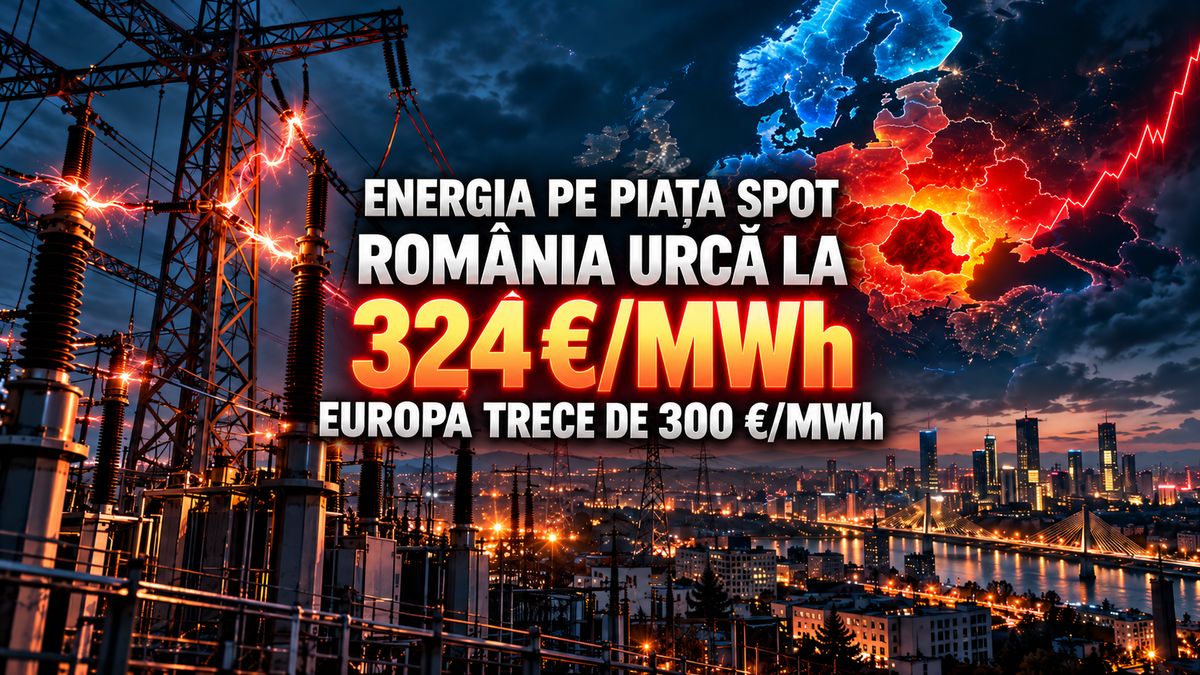
Romania recorded an average price of €323.76/MWh on October 29, 2026, on the Day-Ahead Market (DAM), according to results published by market operator OPCOM. Power for this delivery date traded at an average price of RON 1,731.68/MWh, one of the highest levels in Europe. This price spike comes at a time when the Romanian energy system is operating without output from the two nuclear reactors at Cernavodă. However, the pressure extends beyond Romania’s borders. In Germany, the average price for the same delivery day stands around €315/MWh, in Austria it exceeds €310/MWh, and in Hungary it reaches approximately €325/MWh. Serbia records a level close to €330/MWh. Several markets across Central and Southeastern Europe are thus simultaneously facing wholesale power prices above €300/MWh. The contrast with Northern Europe is striking. Finland has an average price of around €17/MWh, while some bidding zones in northern Sweden drop below €20/MWh. For the same delivery day, power trades in Romania at nearly 19 times the price in Finland. The disparity highlights the vulnerabilities of an interconnected European market where generation availability and grid capacity continue to drive vast price divides. Romania feels the dual impact of lost nuclear capacity and reduced hydro output The primary domestic vulnerability is the absence of nuclear power from Cernavodă. Unit 1 underwent a controlled shutdown on July 28, 2026, followed by Unit 2 on August 13, due to low water levels on the Danube River. Both shutdowns were carried out in accordance with nuclear safety procedures, and operator Nuclearelectrica confirmed in October that the reactors remain in a safe shutdown state. Under normal operating conditions, the two units provide a combined capacity of approximately 1,400 MW, serving as a critical cornerstone of national power generation. Their outage forces the grid operator to cover a larger share of demand from other domestic sources and imports. The impact becomes particularly pronounced when cheap energy is scarce across neighboring countries as well. Drought conditions are also curtailing hydroelectric generation. Low river flows limit output from key hydro facilities, including those along the Danube, just as the system requires additional capacity to meet demand. Concurrently, shorter daylight hours and the onset of colder weather reduce solar power contributions during evening peak demand periods. These supply headwinds are regional. Energy trade press reported outages affecting nuclear capacity in Bulgaria and reduced output from Hungary’s nuclear plant. These developments further constrain available supply across a region where multiple countries are vying to cover their power demand during the exact same peak hours. Why power is surging past €300/MWh across multiple markets These elevated prices reflect the core mechanics of wholesale power markets. For each trading interval, generators and buyers submit bids, with the market clearing price set by the marginal cost of the last generating unit needed to meet demand. When low-marginal-cost renewable or baseload energy is insufficient, the system relies on higher-cost thermal generation to bridge the gap. Natural gas-fired plants thus set the clearing price during numerous settlement periods. Fuel costs, coupled with carbon emission allowances and operational expenses, dictate the bids submitted by gas generators. During periods of elevated natural gas prices, heavier reliance on gas-fired capacity pushes up prices across the entire wholesale market. In Romania, OPCOM market data reveals that the average peak-load price climbed to €359.97/MWh, well above the daily baseload average of €323.76/MWh. Off-peak hours averaged €287.55/MWh. This spread highlights the intense pressure exerted on the power system during peak demand hours, when tight supply forces expensive marginal generators online. The upward trajectory is also clear day-over-day. For October 28, the Romanian market cleared at an average of roughly €311/MWh. For October 29, the baseload index published by OPCOM rose to €323.76/MWh, a 3.98% increase. Persistent high prices, particularly if sustained over several weeks, could significantly increase procurement costs for energy suppliers and end-users exposed to spot prices. Why Finland and northern Sweden enjoy prices nearly 19 times lower Widespread price divergence across Europe underscores physical bottlenecks in moving cheap power to demand centers. Europe operates an integrated market coupling system designed to enable cross-border power trading based on supply bids and net transfer capacities. While market coupling promotes price convergence, it cannot eliminate spreads when cross-border transmission corridors hit maximum capacity constraint. Finland and Sweden’s northern bidding zones benefit from a vastly different generation mix, anchored by abundant hydro, nuclear, and wind power. On days when generation comfortably exceeds regional demand,…
Ioana Buzoaica — Independent Editorial Board
The NRG-IA newsroom continuously monitors Romanian energy markets, ANRE regulatory decisions, and national grid telemetry (SEN/SNT). We deliver independent intelligence anchored exclusively in official primary data.
Editorial Charter, Ethics & Verification Methodology →