Dama Solar: 1.2 GW Solar Park with 1,043.7 MW Connection — NRG-IA
Energie Regenerabilă Author: Ioana BuzoaicaDama Solar clears key hurdle. The 1.2 GW project could become the EU's largest solar park, testing Romania's grid with over 1 GW of injected power.
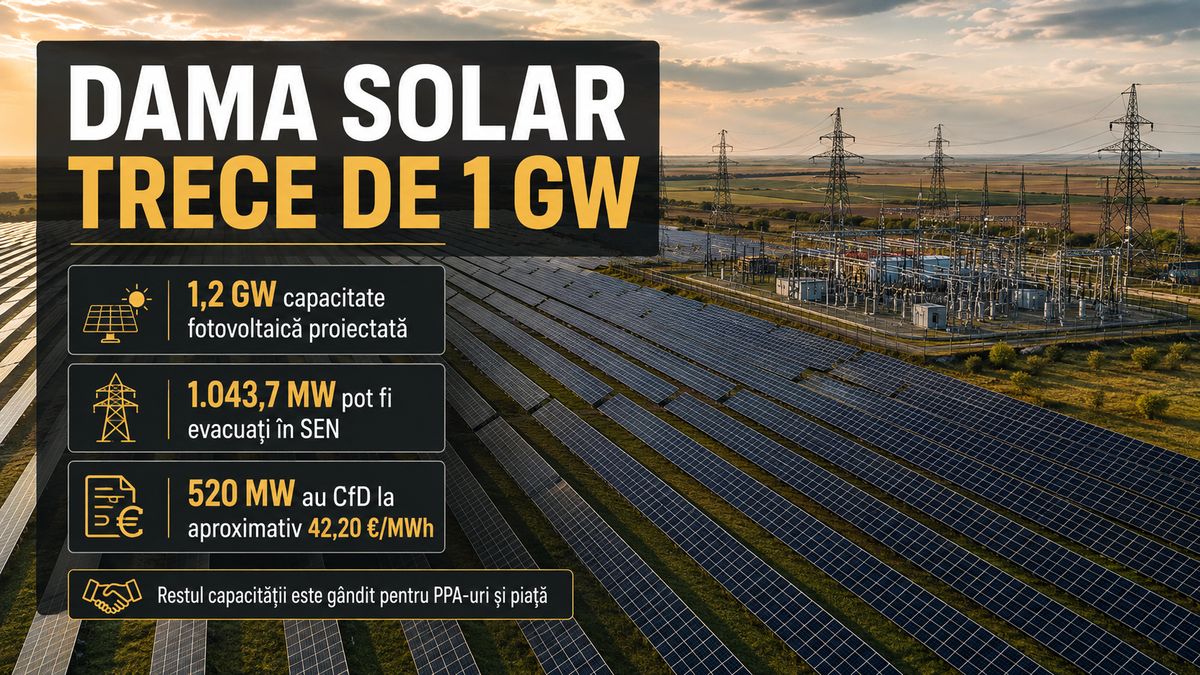
Romania is moving closer to the construction of a solar park of a scale that redefines renewable energy projects in the national energy system. Dama Solar, developed by Rezolv Energy through West Power Investments in Arad County, has received its establishment authorization from ANRE and is designed for approximately 1.2 GW of installed capacity, with a maximum grid injection capacity of 1,043.7 MW . The project will span over 1,000 hectares in the communes of Grăniceri and Pilu, near the Hungarian border. Rezolv pitches it as the future largest solar park in the European Union, with commissioning planned for 2028. Compared to currently operational projects, its size is sufficient to support this claim, provided Dama goes online in its announced configuration and is not surpassed by another project in the meantime. The ANRE authorization moves the project into a much more advanced stage, but actual construction depends on the next financial milestone. On August 20, Rezolv stated that financing and procurement procedures are underway, with financial close expected very soon, after which construction works are set to begin. Over 1 GW can be injected from a single park The figure of approximately 1.2 GW describes the installed solar capacity announced in the project's current configuration. Technical and lender documentation indicates values of around 1.25–1.3 GWp on the DC side, while the maximum injection capacity into the grid is lower. Transelectrica includes the project in its investment program under the name CEF Arad 1, with a connection capacity of 1,043.70 MW . This distinction is important. The total capacity of the panels and the power that can be simultaneously injected into the grid are different metrics. For the NES, the 1,043.7 MW figure represents the actual size of the new generation asset from a grid perspective. The connection is planned via 400 kV infrastructure in the Grăniceri area, linking to the existing Nădab–Békéscsaba line. The project documentation includes an interconnection substation and approximately 3.5 kilometers of high-voltage underground cabling. This component sets Dama Solar apart from numerous renewable projects in various stages of development. A park exceeding 1 GW only has systemic relevance if its energy can actually be injected, and Dama's capacity is already included in the transmission system operator's investment planning. Estimated production exceeds 2 TWh per year The size of the facility should not be translated into annual production simply by multiplying the nominal capacity by all 8,760 hours of the year. A solar park does not produce at maximum capacity continuously. The International Finance Corporation estimates an annual output of over 2 TWh for Dama Solar. Rezolv expresses this same scale through consumption equivalence: the annual energy would cover the needs of over 280,000 households , or nearly one million people. This is an energy comparison, not the physical destination of the electricity. The generated power will enter the grid and be commercialized through market and contractual mechanisms, including to industrial and commercial consumers. However, at over 2 TWh annually, Dama would become a producer large enough for its impact to be felt across the market and the operation of the NES, not just in statistics on installed solar capacity. 520 MW already have a contract price of approximately €42.20/MWh The project's scale is matched by an unusually significant commercial structure. West Power Investments secured two contracts of 260 MW each under the Romanian Contracts for Difference (CfD) scheme, totaling 520 MW . The strike prices are €42.1969/MWh and €42.1970/MWh . The CfD scheme stabilizes revenues for this portion of the capacity against market prices, reducing long-term commercial risk and supporting the project's bankability. The target commissioning date stipulated in the contracts is September 15, 2028 , in line with the developer's timeline. The date of September 15, 2030, appears as a contractual deadline, not the current project completion target. The remaining capacity is not covered by these two CfD contracts. IFC documentation shows that this component is designed for merchant revenues, including through private power purchase agreements (PPAs) and market exposure. Dama thus combines two revenue models in a single asset: one part benefits from the stability of the CfD scheme, while the other must find its value directly in the market. Financial close separates the authorized project from the construction site The ANRE authorization is a major step, but it does not equate to financial close. Rezolv Energy has indicated that it is working on the financing structure with international financial institutions and commercial banks. The IFC is considering its own financing of up to €107 million, while the European Investment Bank is evaluating a loan of up to €100 million. However, public documents from the lenders offer different…
Ioana Buzoaica — Independent Editorial Board
The NRG-IA newsroom continuously monitors Romanian energy markets, ANRE regulatory decisions, and national grid telemetry (SEN/SNT). We deliver independent intelligence anchored exclusively in official primary data.
Editorial Charter, Ethics & Verification Methodology →