EU Probes €52M+ Solar Award Claim Against Romania — NRG-IA
Legislație & Reglementări Author: Ioana BuzoaicaRomania faces a final arbitral award, US enforcement, and an EU probe over solar compensation, testing the limits of investment protection and EU law.
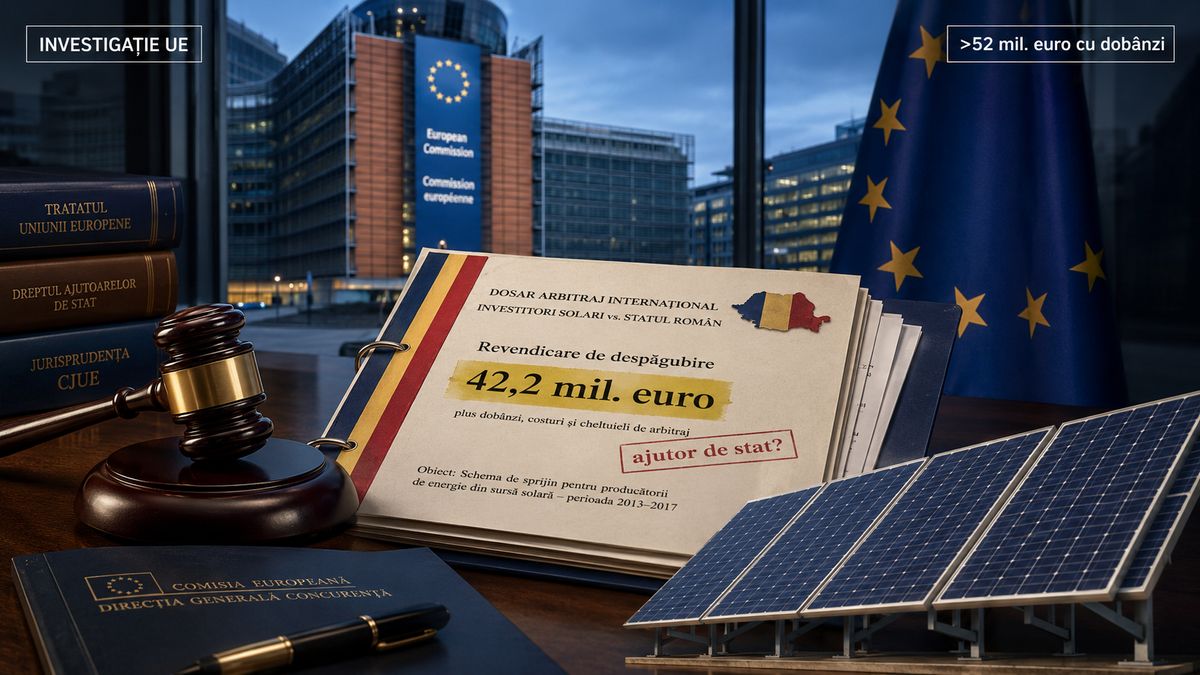
The European Commission has opened an in-depth investigation into an arbitral award ordering Romania to compensate ten solar energy investors, as well as the potential enforcement of this ruling. In its preliminary assessment, Brussels considers that the compensation may constitute state aid and that its payment could be incompatible with the internal market. However, the case does not begin with the European investigation. The arbitral tribunal issued its award on February 20, 2024, awarding the investors €42.2 million, plus interest, arbitration costs, and legal fees. The investors had originally claimed approximately €142.7 million. Romania sought to annul the award, but its application was fully dismissed on February 18, 2026, by an ad hoc committee constituted under the International Centre for Settlement of Investment Disputes (ICSID). The state was also ordered to bear $855,000 in annulment proceeding costs. The award can no longer be set aside through the arbitral center's internal mechanisms. Consequently, the conflict has shifted toward the recognition and enforcement of the compensation, as well as the compatibility of the payment with European Union law. Investments made during the solar energy boom The dispute was initiated by ten companies that invested between 2010 and 2013 in five photovoltaic plants located in Giurgiu and Călărași counties. The projects had installed capacities of approximately 50, 45, 20, 9.5, and 5.4 megawatts. The investors hail from several European countries, including Austria, Germany, the Netherlands, and Cyprus. The dispute is therefore an intra-EU matter, pitting European Union investors against a member state. The projects were built during a period when Romania was seeking to rapidly attract renewable energy investments through its green certificates scheme. Producers received certificates for every megawatt-hour delivered to the grid, which suppliers were mandated to purchase, passing the costs on to end consumers. For solar energy, the scheme had scaled up to grant six green certificates per megawatt-hour produced over a 15-year period. This high level of support attracted massive investments but also increased pressure on consumer bills and large industrial energy users. Regulatory changes slashed project revenues Starting in 2013, Romanian authorities modified the mechanism to limit the financial burden on consumers. Contested measures included deferring the trading of a portion of the certificates allocated to PV plants, lowering the minimum trading value, and altering purchase obligations. While the scheme was not entirely dismantled, the investors' projected revenues plummeted, altering the financial viability of already-built projects. The companies argued that the measures were applied retroactively, undermining the legitimate expectations on which they had based their investments. The arbitral tribunal found that certain amendments to the scheme breached Romania's obligation to accord fair and equitable treatment to the investments. The arbitrators ruled that the state had significantly altered the economic framework under which the plants had been developed. The compensation does not represent the full value of the support originally projected. Instead, it stems from an assessment of the damages attributed to measures deemed incompatible with Romania's international obligations. Commission examines whether the compensation constitutes a selective advantage In principle, EU state aid rules prohibit selective economic advantages granted to specific companies from public resources when they threaten to distort competition and affect trade within the internal market. The Commission is analyzing whether the payment of the compensation meets these criteria. In its preliminary assessment, Brussels considers that the arbitral award and its enforcement could confer a selective economic advantage on the investors, funded by the Romanian budget. Opening an in-depth investigation does not constitute a final decision. Romania, the investors, and other interested parties can submit comments and arguments before the European executive determines whether the measure constitutes state aid and if it can be authorized. The outcome could confirm that the compensation does not constitute aid, that it represents compatible aid, or that it is incompatible aid that cannot be paid out to the beneficiaries. If incompatible funds have already reached the companies, the Commission may order their recovery. Brussels challenges arbitration between EU investors and member states The investigation goes beyond the narrow issue of state aid. The Commission also challenges the use of international arbitration in disputes between EU investors and member states. Through its Achmea and Komstroy rulings, the Court of Justice of the European Union established that arbitration mechanisms cannot remove such disputes from the oversight of national courts and the European judicial system. In…