Romania Funds 2,174 MWh of Batteries & 800k Smart Meters — NRG-IA
Piața de Energie Author: Ioana BuzoaicaRomania launches €250m for standalone batteries and smart meters. Success hinges on shifting energy to peak hours and ensuring reliable data transmission.
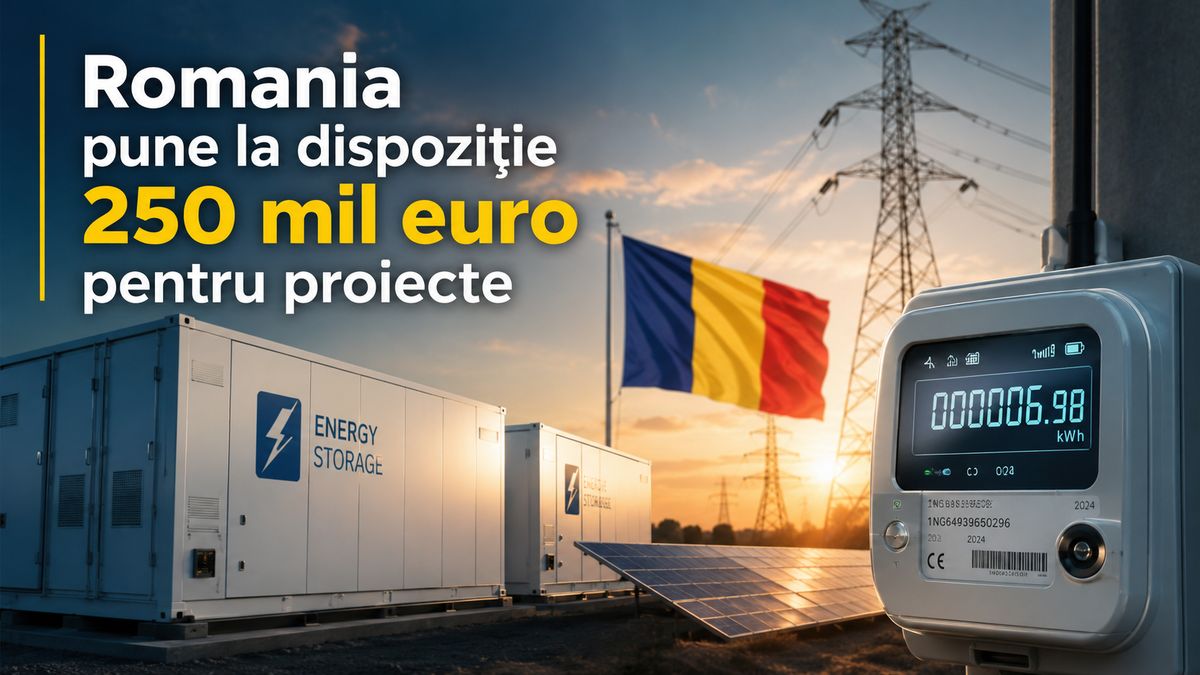
Romania is launching two funding programs totaling €250 million to develop energy storage capacity and expand smart metering. Of this amount, €150 million will fund standalone battery installations with a cumulative capacity of at least 2,174 MWh , while €100 million is earmarked for the installation of over 800,000 smart meters . The funds are sourced from the Modernisation Fund, a European instrument financed by revenues from the EU Emissions Trading System (ETS). Although the two programs target different beneficiaries and use distinct allocation mechanisms, they share the same goal: a power system capable of responding more effectively to fluctuations in generation and consumption. Batteries can absorb electricity when supply is abundant and feed it back when the grid needs it. Smart meters can replace estimated billing with real-time data, automate distribution processes, and eventually enable the development of time-of-use tariffs. €150 million for standalone storage The call for storage projects is competitive. Projects will be ranked based on the requested aid per installed MWh, capped at €69,000/MWh , with a maximum of €15 million per company . The announced timeline schedules the call to open on September 1, 2026, close on October 30, and target investment completion by December 31, 2030. The scheme was not designed overnight. The European Commission approved it on March 5, 2026, following a notification from Romania. The EU executive determined that the measure could support at least 2,174 MWh of new, standalone battery storage installations and that beneficiaries must be selected through a competitive bidding process. Subsequently, on May 21, the Ministry of Energy published the draft applicant guidelines for public consultation. The 2,174 MWh figure represents the minimum threshold resulting from full budget utilization at the maximum cap of €69,000 per MWh. Competition could drive funding requests below this ceiling. In such a scenario, the same budget could finance a larger total capacity, provided there are mature, bankable projects. Compared to the situation at the beginning of the year, the scale of the program is massive. As of January 1, 2026, Transelectrica recorded storage installations with a total capacity of 494 MW and an energy capacity of 913.68 MWh . The target of the new scheme alone is approximately 2.4 times larger than the entire energy storage capacity reported at that time. This comparison highlights the scale of the program rather than the final 2030 landscape, as other projects funded by different sources may also be completed by then. Batteries shift energy between hours, not seasons The primary value of batteries emerges in a system with rapidly growing solar generation. During midday intervals, abundant power supply can drive wholesale prices down significantly, whereas in the evening, as solar output drops and demand remains high, the system relies on other sources, imports, or more expensive balancing energy. A storage facility can buy or absorb energy during low-price hours and deliver it during high-price hours. Additionally, batteries can respond rapidly to deviations between forecasted and actual generation, provide frequency containment reserves, and limit the curtailment of renewable generation when the grid cannot absorb the full available output. While these functions can ease price pressure during certain intervals and lower balancing costs, they do not automatically guarantee lower bills. The outcome depends on where the batteries are connected, how they participate in the markets, competition among operators, and the pass-through of savings to the final cost of energy. Battery storage is not a substitute for grid investments or long-duration power generation assets. It is primarily suited for intra-day variations and rapid interventions. It cannot single-handedly cover consecutive days of low wind and solar output, seasonal deficits, or structural transmission line congestion. 800,000 meters for an unevenly digitized grid The second program has an allocation of €100 million and targets the four concessionaire distribution system operators (DSOs): Distribuție Energie Electrică România, Delgaz Grid, Rețele Electrice România, and Distribuție Energie Oltenia. The call is non-competitive, with each operator eligible for a maximum of €25 million. Project submission is scheduled between August 3 and December 2, 2026, with investments to be completed by December 31, 2029. The budget relative to the 800,000-unit target averages approximately €125 per meter. This amount should not be interpreted as the price of the device itself: projects encompass installation, communications, data collection and management systems, billing integration, and the IT infrastructure required to operate the entire system. At the end of 2025, Romania had nearly 3.58 million users integrated into smart metering systems, representing 34.5% of total consumption points. Coverage had…
Ioana Buzoaica — Independent Editorial Board
The NRG-IA newsroom continuously monitors Romanian energy markets, ANRE regulatory decisions, and national grid telemetry (SEN/SNT). We deliver independent intelligence anchored exclusively in official primary data.
Editorial Charter, Ethics & Verification Methodology →