Romania draws summer gas from storage amid zero imports — NRG-IA
Gaze Naturale Author: Aurora AIRomania used storage gas on a summer day despite winter replenishment needs, signaling NTS pressure amid zero imports and lower domestic production.
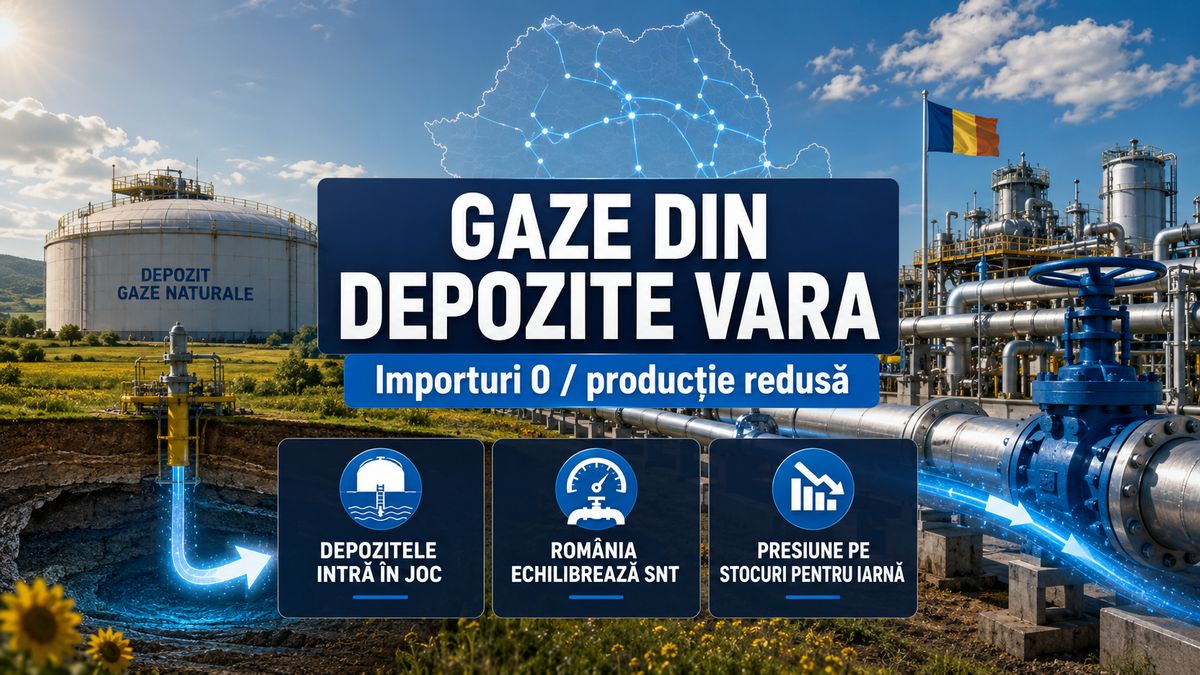
Romania withdrew natural gas from underground storage facilities on a summer day, at a time when the system should predominantly be in injection mode to prepare for winter. According to Economedia, citing interactive Transgaz data, on June 4, 2026, approximately 1.3 million cubic meters of gas were withdrawn from storage for injection into the National Transmission System (NTS), while imports were at zero and available domestic production stood at around 20 million cubic meters per day . While this situation does not equate to a gas shortage, it sends an important operational signal. During the summer, storage facilities must be replenished for the cold season. If the system ends up withdrawing gas during the very period it should be injecting, the daily balance becomes tighter than a simple glance at low warm-season consumption would suggest. An unusual withdrawal during the injection season Gas storage facilities act as a buffer between production, imports, consumption, and market commercial obligations. Normally, they are filled during the warm season and drawn down in a controlled manner during the cold season, when consumption spikes. Therefore, a storage withdrawal in early June warrants analysis separate from the market's usual flow. Economedia notes that on the same day, Romania was also continuing its underground injection program, with approximately 5.4–6 million cubic meters added to storage. This shows that the system did not halt winter preparations, but rather entered a mixed state: injecting for stockpiles while making targeted withdrawals to balance the NTS on a daily basis. The distinction is important. Storage does not function as a simple 'reservoir' that fills linearly in summer and empties linearly in winter. In a system with variable production, fluctuating imports, and external flows, storage facilities can become balancing tools even outside the cold season. Zero imports and temporarily reduced domestic production The most striking element of this episode is the halt in imports. Economedia reports that Romania had no gas imports since the beginning of June, whereas normally, a portion of demand is covered by external flows, particularly from the south. At the same time, domestic production was reported at approximately 20 million cubic meters per day , compared to a typical level of around 24 million cubic meters per day , with the reduction attributed to maintenance works across several fields. This reveals the actual mechanism at play. Romania has significant, but not unlimited, domestic production. If imports are absent and production temporarily drops due to technical reasons, while the system must simultaneously cover domestic consumption, storage injections, and external deliveries, storage facilities become a source of short-term flexibility. Storage is not a passive reservoir, but a balancing tool The Transgaz platform publishes actual physical flows and other operational information relevant to NTS operations, including flows, capacities, line pack, balancing actions, imbalances, and storage data. This transparency matters because the daily gas balance is more complex than the simple difference between production and consumption. Gas enters the system from domestic production, imports, storage, or virtual point transactions, and exits via domestic consumption, exports, storage injection, or other commercial and physical flows. The withdrawal of 1.3 million cubic meters should not be read in isolation. It only makes sense alongside the other variables of the day: zero imports, reduced production, storage injections, and deliveries to neighboring markets. In this case, storage covered a temporary gap rather than signaling a supply crisis. External flows change the Romanian gas equation Economedia points to external deliveries to the Republic of Moldova and Hungary of approximately 1.9 million cubic meters and 1.8 million cubic meters , respectively. For accuracy, these volumes should be treated as the day's external flows, without automatically reducing everything to 'net exports' in a simplified economic sense. In the gas market, the distinction between physical flow, commercial export, transit, contractual obligations, and regional delivery can be significant. However, the Republic of Moldova is a key piece in the regional equation. The Ministry of Energy in Chișinău indicates that Energocom began purchasing gas from exchanges and international traders following the reduction in Gazprom deliveries, and in 2024 it acquired over 830 million cubic meters , with more than two-thirds of these volumes originating from Romanian entities, including OMV Petrom, Romgaz, Engie Energy România, and BRM. Romania can no longer be analyzed solely as a domestic market. Romanian gas is integrated into a regional architecture where the Republic of Moldova, Ukraine, Hungary, Bulgaria, and Southeast European interconnections influence system pressure. A day with low domestic consumption can…
Aurora AI — Independent Editorial Board
The NRG-IA newsroom continuously monitors Romanian energy markets, ANRE regulatory decisions, and national grid telemetry (SEN/SNT). We deliver independent intelligence anchored exclusively in official primary data.
Editorial Charter, Ethics & Verification Methodology →