Romania Battery Storage: 1,975 MWh Installed, 1+ GWh Slated — NRG-IA
Piața de Energie Author: Ioana BuzoaicaRomania doubled its battery storage capacity in early 2026. Next, 200–500 MWh projects are becoming common, with a 1+ GWh facility scheduled for 2027.
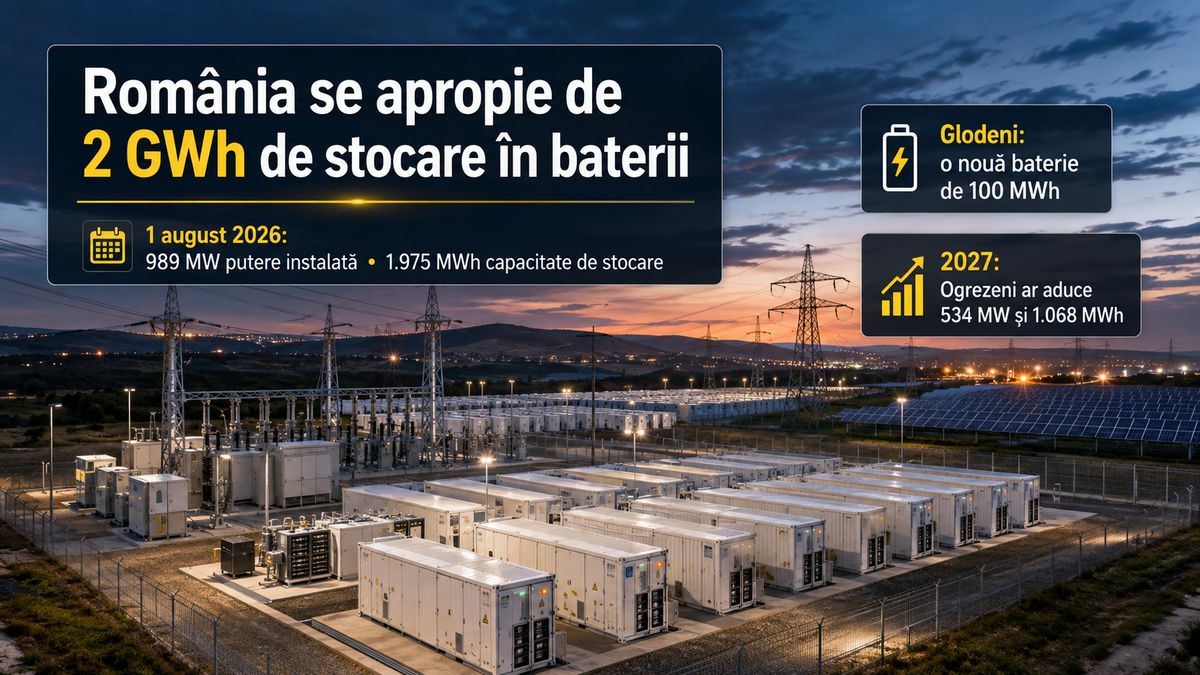
Romania reached 989 MW of installed capacity and 1,975 MWh of energy storage capacity as of August 1, 2026, after starting the year with 494 MW and 913.68 MWh. In just seven months, the system's battery capacity practically doubled, and the amount of energy they can store increased more than twofold. This shift in scale is more significant than any individual project. The Romanian market has transitioned from installations in the tens of MWh to units of hundreds of MWh, and projects with public timelines for 2027 are already introducing a new category: individual battery systems approaching or even exceeding 1 GWh . The most recent commissioning confirms this pace. On August 14, Winners Holding Investments and Finas Group announced a 100 MWh battery in Glodeni, Mureș County , representing an investment of over €25 million. The installation's power output, expressed in MW, was not specified in verified public disclosures, meaning the 100 MWh figure describes the storable energy capacity rather than the battery's power output. However, Glodeni is just one of the installations now entering a much larger market. Romania already has 300–400 MWh batteries in operation The largest individual operational benchmark is Nova Power & Gas's project in Florești, Cluj County. The 200 MW / 400 MWh facility entered commercial operation at the end of 2025, setting a new scale for the Romanian storage market. In June 2026, Aukera completed the first phase of the Gura Ialomiței project, totaling 150 MW / 300 MWh . The company is already preparing the second phase, which will add 100 MW / 200 MWh, bringing the entire complex to 250 MW of power and 500 MWh of energy capacity . In Caraș-Severin, the project built by Simtel for Energy Capital Group features 100 MW and approximately 200 MWh , making it one of the largest standalone assets to enter the market. These installations demonstrate how quickly the benchmark for what constitutes a "large battery" in Romania has shifted. A capacity of 100 MWh, such as the one recently commissioned in Glodeni, remains significant but is no longer the market leader. The next generation is already two, four, or even ten times larger. Glodeni paves the way for another 200 MWh in Jibou The Glodeni project is the second investment made by Winners Holding Investments and Finas Group in this segment, following their 10 MWh battery in Aghireșu. However, the two companies have a much larger project in the pipeline in Jibou, totaling 200 MWh , with the announced timeline pointing to November 2026. If this deadline is met, their portfolio will have scaled in a single year from an initial 10 MWh installation to cumulative assets exceeding 300 MWh. This evolution is representative of the entire market. Developers who tested the business model with smaller projects are rapidly scaling up to units in the hundreds of MWh, while major energy producers and suppliers are beginning to integrate batteries into much broader portfolios. The end of 2026 and early 2027 could bring another 854 MWh from three major projects Three projects in advanced stages of development could collectively add 854 MWh around the turn of 2026 and 2027. Premier Energy is constructing a 200 MW / 400 MWh facility near Iași, with an estimated investment of approximately €75 million. The company's public timeline schedules commissioning for late 2026 or early 2027. Aukera has secured financing for the second phase of Gura Ialomiței, a 100 MW / 200 MWh expansion of the already operational complex. The announced timeline also targets completion around late 2026 or early 2027. In Scornicești, R.Power and Eiffel Investment Group are developing a 127 MW / 254 MWh battery project, which is currently under construction and backed by EBRD financing. Commercial operation is also estimated for the end of this year or early 2027. These timelines explain why the final tally for 2026 remains difficult to pin down precisely. A difference of just a few weeks in commissioning a single project can shift hundreds of MWh from one year's statistics to the next. ANRE (the energy regulatory authority) estimated that Romania could exceed 2,000 MW of installed capacity in dispatchable storage units by the end of 2026 . Reaching this level from the 989 MW reported on August 1 requires commissioning approximately another 1 GW in just a few months. While the pipeline exists, the actual commissioning schedule will determine whether this threshold is reached in December or pushed into 2027. 2027 brings the first battery exceeding 1 GWh Projects scheduled for 2027 are set to redefine the market's scale once again. Enery is developing a project in Ogrezeni, Giurgiu County, that combines a large-scale solar PV plant with a 534 MW / 1,068 MWh battery. The public timeline targets the fourth quarter of 2027 for commercial operations. A single 1,068 MWh installation would represent more than half of the entire energy storage capacity Romania had installed as of August 1,…
Ioana Buzoaica — Independent Editorial Board
The NRG-IA newsroom continuously monitors Romanian energy markets, ANRE regulatory decisions, and national grid telemetry (SEN/SNT). We deliver independent intelligence anchored exclusively in official primary data.
Editorial Charter, Ethics & Verification Methodology →