Romania: 385k Prosumers, 151k Battery Systems in 2026 — NRG-IA
Prosumatori & Eficiență Author: Ioana BuzoaicaRomania reached 385,791 prosumers in August 2026, with battery-equipped users surging 378% year-on-year, reshaping solar energy use across the country.
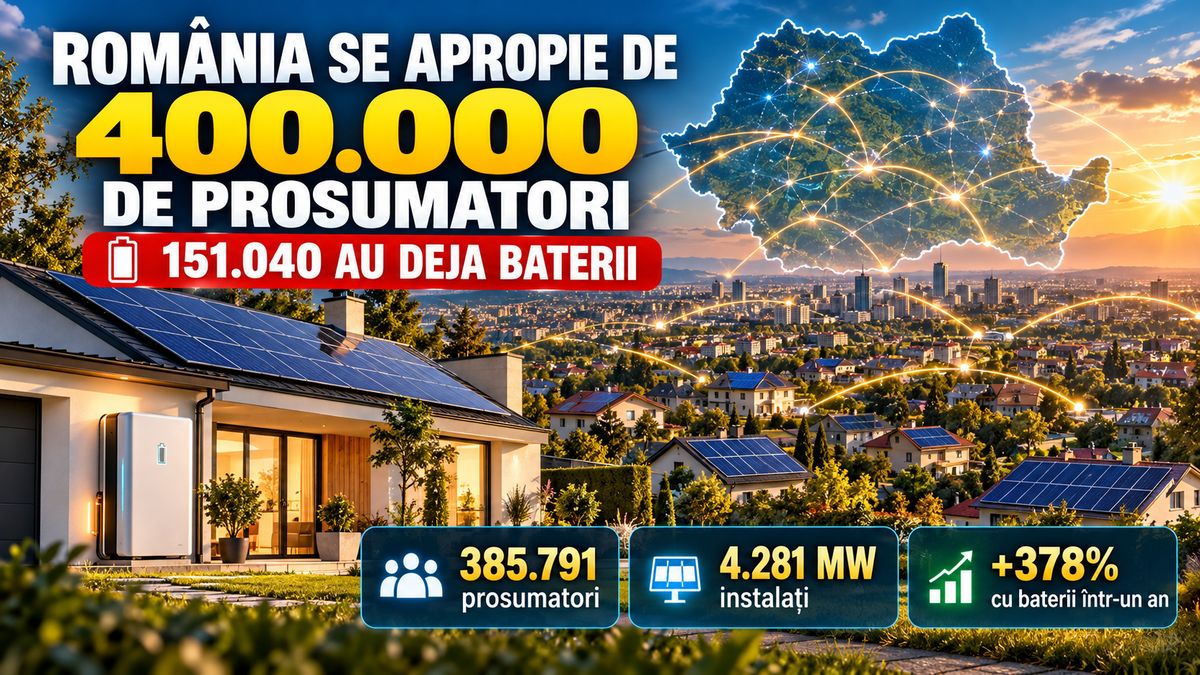
Romania is approaching the 400,000 prosumer threshold, but the most significant shift in the distributed energy sector is the accelerated expansion of storage capacity. According to the latest data released by the National Energy Regulatory Authority (ANRE), 385,791 prosumers were registered as of August 31, 2026, with a combined installed generation capacity of 4,281.86 MW. Among them, 151,040 also owned energy storage systems—nearly five times as many as in the same period last year. The scale of this transformation becomes evident through year-on-year comparison. In August 2025, only 31,595 prosumers had installed batteries, accounting for 12.27% of the total. A year later, their share reached 39.15%, representing a 378% increase in battery-equipped users. Over the same period, total prosumer numbers grew by nearly 50%, rising from 257,451 to 385,791. Storage is thus expanding far faster than the user base itself, with nearly two out of five prosumers now capable of storing self-generated electricity for later use. This trend marks a major shift for the Romanian power system. Solar PV panels previously allowed households and businesses to generate part of their electricity and feed surplus energy into the grid. The addition of batteries enables power consumption after sunset, when solar generation drops while electricity demand remains high. For consumers, this translates to higher self-consumption rates and lower energy bills; for the broader power system, it offers a growing source of flexibility that could prove increasingly valuable. Prosumers with battery storage grew by 119,445 in a single year ANRE data shows sustained acceleration in the deployment and registration of storage systems. At the end of 2025, there were 65,175 prosumers with batteries, representing roughly 22% of the 295,476 prosumers registered at the time. By July 2026, that number reached 139,967, and in August it crossed the 150,000 mark for the first time, reaching 151,040. Compared to the end of last year, reported battery installations increased by approximately 132% in just eight months. Monthly figures confirm this momentum. Between July 31 and August 31, 2026, Romania added a net total of 12,542 prosumers, while those with storage systems increased by 11,073. These net changes reflect updated reporting from distribution system operators (DSOs) and include both new installations and database updates. Concurrently, total installed prosumer generation capacity grew by 133 MW in a single month, rising from 4,148.86 MW to 4,281.86 MW. On an annual basis, prosumer generation capacity expanded by 1,261.21 MW, a 41.75% increase. Over this period, total installed capacity climbed from 3,020.65 MW to over 4,280 MW. An increasingly vital share of solar generation is now located on residential, commercial, and industrial rooftops, where power can be consumed directly at the point of origin without straining transmission grids. The growing adoption of battery storage is particularly relevant for the evolution of distributed generation. Storage systems can mitigate daytime feed-in surges, supply local demand during non-sunlight hours, and enable commercial dispatch during higher-priced time slots. As the share of battery-backed installations grows, prosumers gain the ability to actively manage both their internal consumption and grid feed-in. Businesses account for under 10% of prosumers, but hold nearly half of installed capacity The prosumer segment displays two distinct economic profiles. Residential users numerically dominate the sector, totaling 349,099 prosumers at the end of August 2026—accounting for 90.49% of all users—with an installed capacity of 2,214.26 MW. In contrast, the 36,692 corporate entities registered as prosumers held 2,067.60 MW, or 48.29% of total capacity, despite representing only 9.51% of the total user count. This disparity reflects system sizing. The average installed capacity for a residential prosumer stood at approximately 6.34 kW, compared to 56.35 kW for commercial and industrial users. For businesses, self-generation holds significant economic value, particularly for daytime-intensive operations. Offsetting grid electricity through solar panels reduces reliance on suppliers and mitigates exposure to volatile commercial market prices. However, battery deployment shows a reversed distribution. Of the 151,040 prosumers equipped with storage, 146,347 were residential users—representing nearly 97% of the storage total. Approximately 41.92% of residential prosumers had installed storage, compared to just 12.79% among corporate users. This indicates that battery adoption is far more widespread in the residential sector, despite businesses owning significantly larger generation capacities. For households, the key benefit of storage lies in bridging the gap between generation times and demand peaks. A rooftop PV system generates peak surplus at midday when home consumption is typically low, but demand peaks in…
Ioana Buzoaica — Independent Editorial Board
The NRG-IA newsroom continuously monitors Romanian energy markets, ANRE regulatory decisions, and national grid telemetry (SEN/SNT). We deliver independent intelligence anchored exclusively in official primary data.
Editorial Charter, Ethics & Verification Methodology →