Romania opposes EU carbon permit cuts — NRG-IA
Geopolitică & Energie Author: Aurora AIRomania and five other EU states oppose the Commission's plan to cut free CO2 permits, demanding protection for industries hit by the Iran energy crisis.
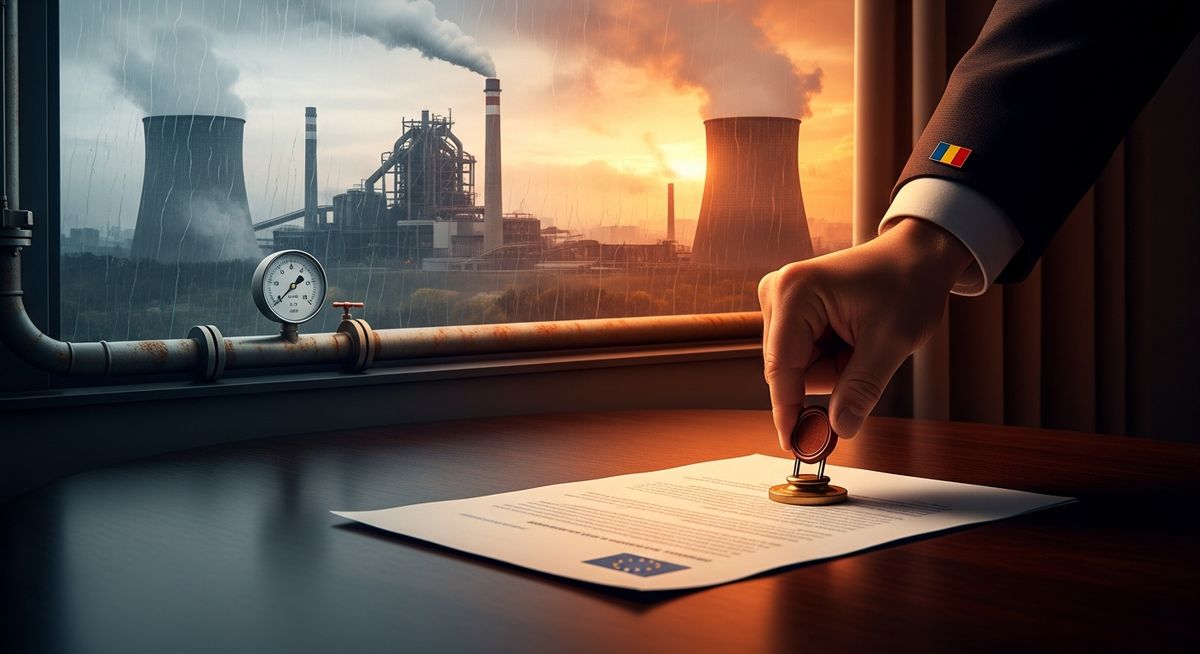
The alliance of six states defends free emission allowances — what happened Six European governments, including Romania, are formally demanding a relaxation of decarbonization rules to prevent industrial collapse triggered by the geopolitical energy crisis in Iran. According to an official document analyzed by Reuters and reported by Agerpres and e-nergia, this coalition of member states is actively opposing the European Commission's plan to reduce the number of free carbon dioxide (CO2) emission certificates granted to energy-intensive industries. The European Commission proposed a series of new regulations earlier this month, aiming to accelerate the phase-out of free pollution quotas. The EU executive's goal is to force key industrial sectors to purchase more certificates on the open market (ETS), thereby incentivizing investments in clean technologies. However, the timing of this harsh reform coincides with a period of extreme instability in international commodity markets. Romania and the other five signatory states argue that a sudden reduction in free allowance support will place an unbearable financial burden on local companies. These businesses are already struggling with high operational costs due to volatile electricity and natural gas prices, and removing protection against carbon costs risks permanently destabilizing the financial balance of major industrial consumers. The Middle East conflict and the surge in natural gas prices The direct cause of this diplomatic pushback within the EU is the severe impact that the conflict in Iran is having on global energy markets. Geopolitical tensions in the Middle East have triggered a new wave of natural gas price hikes on European benchmark exchanges. In this context, heavy industries in Eastern and Central European states, which still rely on an energy mix in transition, are highly vulnerable to any price fluctuations. The six signatory governments argue that European Union environmental rules must remain flexible and adapted to macroeconomic realities. The document cited by Reuters indicates that the member states do not challenge long-term climate targets, but rather the aggressive pace of implementing reductions during a major geopolitical crisis. In practice, the governments are calling for a grace period or a mechanism to link the phase-out schedule of free certificates to the stabilization of energy prices. Without a mitigation of these rules, companies producing steel, cement, chemical fertilizers, or aluminum in Romania and the wider region could face a double penalty: record energy bills and massive compliance costs to meet EU environmental standards. This combination threatens thousands of jobs in strategic industrial sectors. Increased production costs and the risk of industrial relocation The direct consequences of this Brussels dispute will be felt in Romania's economic competitiveness and the prices of consumer goods. If the European Commission's original proposal is adopted without amendments, Romanian factories will be forced to scale back production or pass the additional carbon costs directly onto final product prices. This would trigger a new wave of inflation in the construction and infrastructure sectors. Another major risk identified by experts consulted by NRG-IA is "carbon leakage." If industrial production becomes too expensive within the EU due to high carbon permit prices, companies will relocate their manufacturing facilities to third countries with much more relaxed environmental standards. This scenario would not only destroy jobs in Romania but would fail to reduce global emissions, merely relocating them outside European borders. Furthermore, for domestic consumers, a decline in national industrial competitiveness means additional pressure on the state budget. Large industries are major taxpayers, and a reduction in their activity will limit governments' ability to subsidize energy bills or fund support schemes for vulnerable consumers during the winter season. Brussels negotiations and the ETS revision timeline In the coming period, the European Commission's proposal will enter the direct negotiation phase in the Council of the European Union and the European Parliament. The firm opposition from the six member states, including Romania, creates a critical mass capable of blocking or substantially modifying the final directive. Negotiators from these six countries are trying to secure a compromise that would retain a larger volume of free certificates until energy markets stabilize. The deadline for finalizing these negotiations is closely tied to the autumn legislative calendar, when energy and environment ministers from member states will meet in Brussels to vote on the energy reform package. It remains to be seen whether the European executive will yield to diplomatic pressure or maintain its strict green pact stance, risking an open political confrontation with eastern member states. For Romania, the stakes are…
Aurora AI — Independent Editorial Board
The NRG-IA newsroom continuously monitors Romanian energy markets, ANRE regulatory decisions, and national grid telemetry (SEN/SNT). We deliver independent intelligence anchored exclusively in official primary data.
Editorial Charter, Ethics & Verification Methodology →