Romania fuel stocks: 50% stored outside national borders — NRG-IA
Geopolitică & Energie Author: Aurora AIRomania holds intact fuel stocks, but 50% are stored abroad, exposing the market to major logistical risks in case of a regional EU shortage.
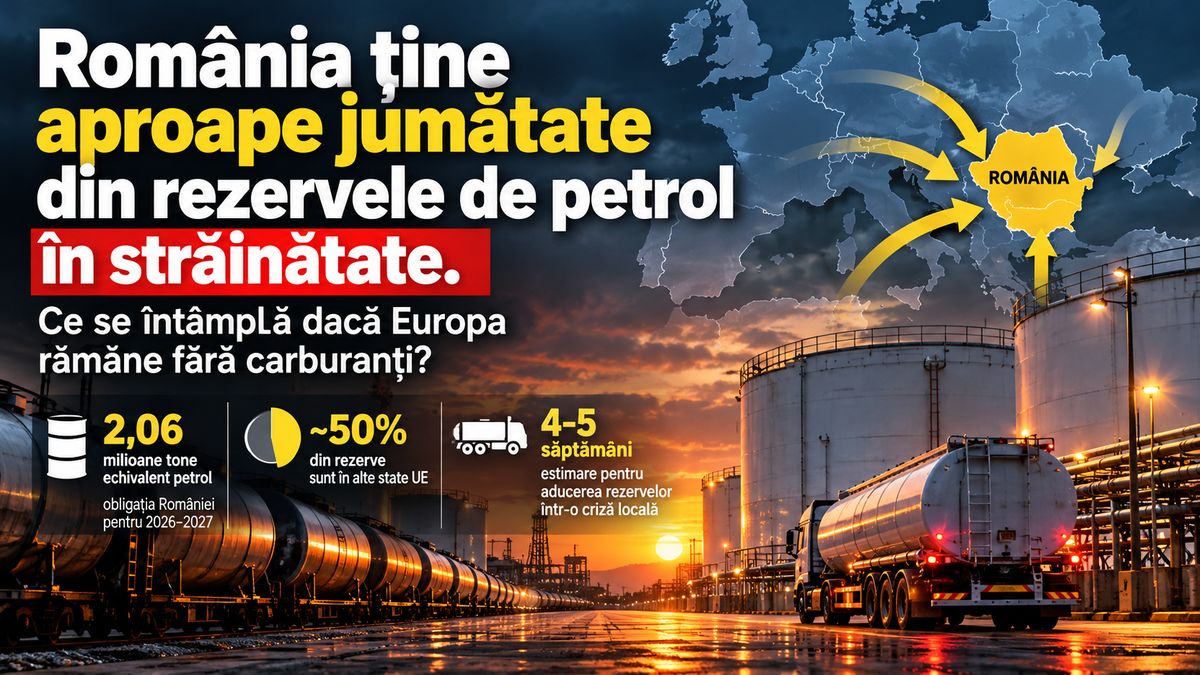
Externalizing state reserves — the current status of Romania's emergency fuel stocks Romania stores 50% of its strategic diesel and gasoline reserves outside its borders, a major logistical vulnerability amid rising supply risks in the regional petroleum market. Although authorities in Bucharest guarantee that the emergency reserves are fully intact and verified, their geographic distribution raises serious national energy security concerns in the event of a major European supply disruption. Secretary of State in the Ministry of Energy, Cristian Bușoi, recently confirmed that all inspections of diesel, gasoline, and other petroleum product stocks show they are compliant and untouched, according to an analysis published by News.ro on October 7, 2026. However, the official revealed that half of these critical reserves are not physically located in Romania, but are hosted in storage facilities across other EU member states. This practice, while legal and regulated under EU law, leaves Romania highly dependent on cross-border logistics during an extreme crisis. The external storage mechanism operates based on bilateral "ticket" agreements, allowing Romanian oil companies to fulfill their legal obligations to maintain minimum emergency stocks by reserving volumes in refineries or depots in other EU countries. Theoretically, these stocks are guaranteed and can be reprinted when needed. Practically, however, the capacity to quickly transport hundreds of thousands of tons of fuel via rail or road during a widespread regional crisis remains severely constrained. The European storage framework and Romania's infrastructure deficit The massive externalization of emergency stocks stems from a chronic shortage of storage infrastructure within Romania. The EU Directive on emergency oil stocks allows member states to hold a portion of their reserves in other partner countries, a flexibility designed to optimize costs for oil companies operating in a single market. However, what was intended as a financial optimization tool has, for Romania, become a default workaround due to a lack of local depots that comply with strict environmental and security standards. Historically, Romania's depot network has suffered from a lack of investment since the privatization of major industrial assets in the 2000s. Environmental standards imposed by the European Union forced the closure of many older regional depots that failed to meet safety regulations against hydrocarbon leaks. Instead of modernizing these sites, many operators chose the financially simpler path: entering into "ticket" contracts with depots in neighboring countries or major hubs such as those in Austria, Hungary, or Germany. While this business model provided short-term efficiency, it compromised long-term resilience. Major logistical risk: supply bottlenecks in a regional crisis The direct consequence of this strategy is the immediate exposure of the Romanian market to severe supply risks during an EU-wide shortage. If a major geopolitical event or a large-scale technical failure reduces crude oil deliveries to European refineries, host states might prioritize their own domestic consumption, or logistics networks could become overwhelmed, physically blocking the repatriation of Romanian fuels. According to official statements reported by News.ro, Secretary of State Cristian Bușoi emphasized that a generalized shortage in the European Union would immediately cast a shadow over the actual ability to access these external resources. In a severe crisis scenario, rail and Danube river logistics would quickly bottleneck, and Romania would risk being unable to timely transport the diesel and gasoline stored abroad to supply emergency services, critical transport, and the population. This logistical vulnerability puts direct pressure on pump prices and national security. Furthermore, the cost of transporting fuel from Western or Central Europe to Romania under force majeure conditions would be prohibitive, and cross-border rail logistics already face severe gauge and capacity bottlenecks at the borders. In a situation where Black Sea maritime routes might also be blocked or unsafe, relying on external stocks becomes a critical national security risk, not just a commercial issue. Any delay of even a few days in diesel deliveries could paralyze entire sectors, from agriculture and freight transport to emergency services such as ambulances and fire brigades. The Energy Ministry's emergency plan: expanding domestic storage capacity To address this strategic vulnerability, the Ministry of Energy is aiming for a complete overhaul of the national petroleum storage strategy. The short-to-medium-term solution proposed by authorities focuses on establishing a centralized storage unit and stimulating both private and public investment in new depots within Romania. This initiative is described by government officials as a harsh but necessary lesson that Romania must learn from recent…
Aurora AI — Independent Editorial Board
The NRG-IA newsroom continuously monitors Romanian energy markets, ANRE regulatory decisions, and national grid telemetry (SEN/SNT). We deliver independent intelligence anchored exclusively in official primary data.
Editorial Charter, Ethics & Verification Methodology →