Romania Reaches 1,630 MWh of Battery Storage — NRG-IA
Piața de Energie Author: Ioana BuzoaicaRomania added 500 MWh of battery storage in two months, passing 1.6 GWh. The leap shifts storage from niche projects to critical market infrastructure.
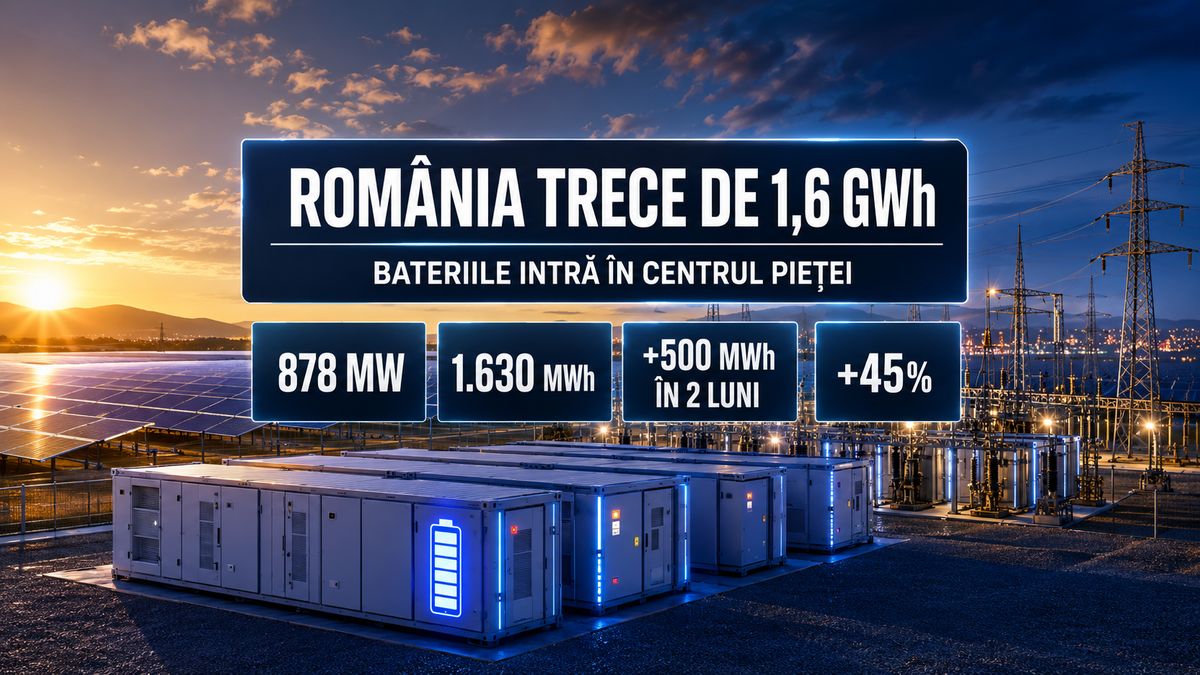
Romania has reached 878 MW of installed capacity and 1,630 MWh of operational battery storage capacity , according to the latest data from Transelectrica as of June 20, 2026. Around two months ago, capacity stood at approximately 1,100 MWh. The 500 MWh leap represents an increase of about 45% in a segment that is beginning to play a significant role in the daily operation of the energy market, rather than just developer portfolios. The 1.63 GWh figure must be read alongside the 878 MW capacity. Power, expressed in MW, indicates how quickly batteries can charge or discharge energy. Energy, expressed in MWh, shows how long that delivery can be sustained. The current ratio between the two indicates a theoretical average duration of approximately 1.86 hours at nominal power, assuming the facilities are fully charged and can be activated simultaneously. This is precisely where batteries can become vital assets: absorbing short-term surpluses, delivering rapid power during peak hours, participating in system services, and narrowing the wide price spreads between cheap midday electricity and expensive evening power. Three projects account for over half of operational capacity The expansion in recent weeks has a clear driver: several large-scale facilities have come online, capable of rapidly shifting the national energy balance. The largest remains the Nova Power & Gas facility in Florești, Cluj County , reported at approximately 201 MW and 402 MWh . The second is the first phase of Aukera Energy's project in Gura Ialomiței , with 150 MW and 300 MWh . In the Banat region, at Iaz, Obreja commune, Caraș-Severin County , a facility of approximately 100 MW and 206 MWh has been commissioned. Together, these three systems total around 908 MWh , representing over 55% of the national storage capacity reported as of June 20. This concentration is significant for two reasons. First, the Romanian market is beginning to feature assets of sufficient scale to visibly participate in balancing and intraday trading. Second, system performance will depend not only on the number of projects but also on their location relative to renewable generation zones, consumption centers, grid congestion, and available network capacity. At Gura Ialomiței, the project does not stop at the first phase. Aukera has commissioned 150 MW/300 MWh and is preparing an expansion of an additional 100 MW/200 MWh, aiming for 250 MW/500 MWh. The company also points to a broader portfolio of ready-to-build storage projects in Romania. Batteries shift energy across system hours Battery energy storage systems, known in the industry as BESS, do not generate electricity. Their role is to shift the timing of when energy is consumed or fed back into the grid. During hours of high solar generation, when supply can exceed local or regional demand, batteries can charge. During peak consumption hours, when photovoltaic output drops and the market requires fast-acting sources, these same facilities can discharge their stored energy. Economic value is derived from the price spread between charging and discharging times, as well as from participation in system services and balancing markets. This function becomes increasingly critical as solar generation grows. Photovoltaic power delivers massive output around midday, precisely when demand is not always sufficient to fully absorb production. Towards the evening, consumption remains high, solar output rapidly declines, and the system must compensate through hydro, gas, imports, demand response, or storage. While batteries do not eliminate this issue, they can ease pressure during intervals when the gap between surplus and deficit widens rapidly. With a theoretical average duration of nearly 1.9 hours at nominal power, existing storage is primarily tailored for intraday flexibility and rapid interventions, rather than covering prolonged periods of energy deficit. From price arbitrage to system services The business model for batteries does not rely solely on buying cheap electricity and selling it during peak-price hours. These facilities can also provide services essential to the secure operation of the National Energy System: frequency regulation, fast reserves, and balancing energy. This diversification matters to both investors and the system operator. A battery operating solely in the day-ahead market is highly dependent on price volatility. A battery capable of combining arbitrage with system services can achieve a more flexible utilization profile, provided there are clear access rules, adequate market signals, and available grid capacity. The regulatory framework has shifted in favor of these investments. In 2025, ANRE eliminated double-charging tariffs for energy stored in a battery and subsequently reinjected into the grid, exempting stored and reinjected energy from transmission, distribution, system services tariffs, and green certificates. However, technological losses and self-consumption remain taxable. This…