Romania Tops 1 GW of Battery Storage, Reaching 2.31 GWh — NRG-IA
Energie Regenerabilă Author: Ioana BuzoaicaRomania tops 1 GW of battery capacity, reaching 2.31 GWh of storage and nearing its 2030 targets years ahead of schedule as investments accelerate.
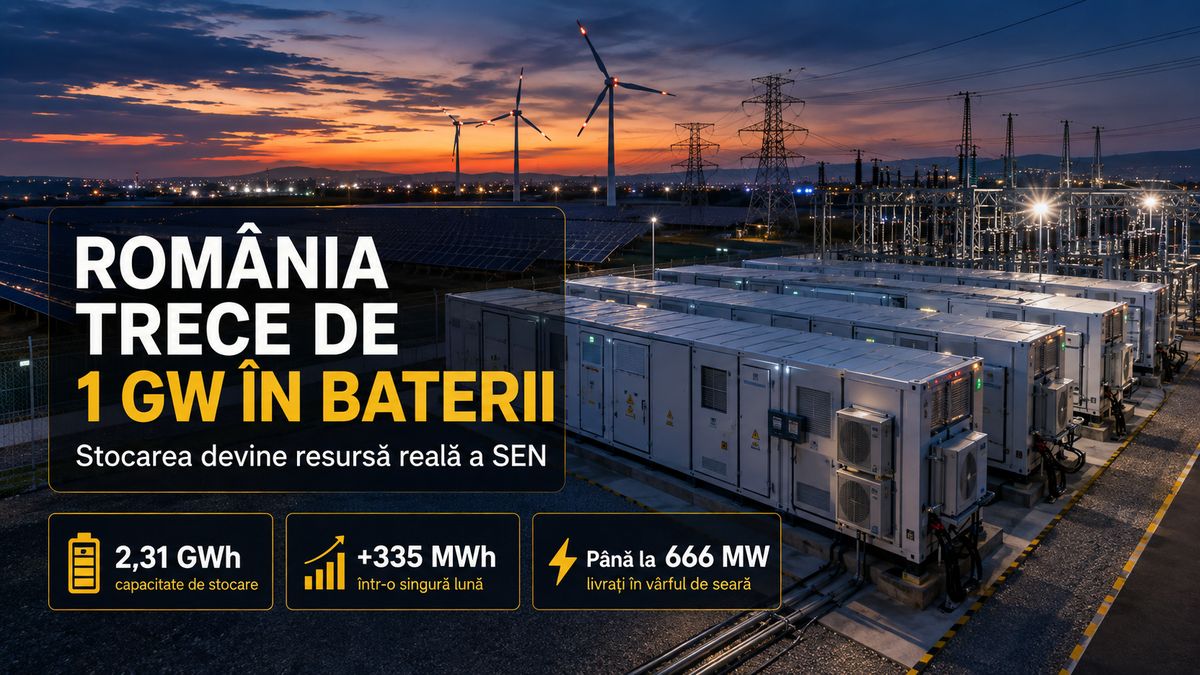
In a single summer, Romania transitioned from an expanding battery market to a storage infrastructure of systemic relevance for the National Power Grid (SEN). As of September 1, 2026, storage installations totaled over 1.08 GW of power capacity and approximately 2.31 GWh of energy storage capacity, according to Transelectrica data. Just a month earlier, on August 1, the system stood at 989.35 MW and 1,974.7 MWh. August thus saw the addition of approximately 335 MWh, representing a 17% increase in a single month. This leap becomes far more significant when compared to the beginning of the year. On January 1, 2026, Transelectrica reported 494 MW of installed power capacity in storage systems and 913.68 MWh of energy capacity. In eight months, power capacity more than doubled, while the energy batteries can store reached approximately 2.53 times the level recorded at the start of the year. Surpassing 1 GW Reshapes the Scale of the Romanian Storage Market Crossing the 1 GW threshold is significant because it marks the transition from isolated projects to a national portfolio capable of actively influencing grid operations. Megawatts indicate the rate at which batteries can absorb or inject electricity at any given moment, while megawatt-hours represent the volume of energy they can store for later use. Romania now boasts over 1.08 GW of the former and 2.31 GWh of the latter. When compared, these two values describe a storage fleet with an aggregate duration of just over two hours at nominal capacity. This is the profile of an infrastructure capable of absorbing energy during one period and shifting it to another, including from hours of high solar generation to the evening peak demand. The acceleration in August was driven by four new systems that account for virtually the entire monthly growth: 160.48 MWh at Glodeni, 99.37 MWh at Doicești, 60.48 MWh at Lugoj, and 15.048 MWh at Mihăilești. Together, these total approximately 335.4 MWh. The scale of these projects also signals a structural shift in the market. Growth is no longer driven solely by small-scale batteries of a few megawatt-hours, but by individual installations of tens or hundreds of MWh, capable of visibly shifting national totals immediately upon grid connection. Batteries Reached 666 MW Exactly When the Grid Needed Power The most compelling evidence that storage is beginning to matter beyond capacity statistics came in August. On August 13, between 9:00 PM and 10:00 PM, storage facilities injected an hourly average of 666 MW into the grid. During the same hour the following day, they delivered 644 MW , with other evening peak intervals recording values exceeding 500 MW. This is the mechanism that makes batteries vital for a system with growing solar generation. Electricity can be absorbed when there is high availability in the grid and reinjected a few hours later, when solar output drops and demand remains high. Batteries do not add primary energy generation, but they provide something increasingly valuable as the generation mix evolves: temporal flexibility . Transelectrica explicitly identifies storage as a key resource for enhancing grid flexibility and maximizing the integration of renewable energy. With hundreds of megawatts delivered simultaneously, this function is no longer marginal. Batteries are becoming a resource that can actively help manage tight grid hours and shift energy from one part of the day to another. Romania Is Already at 96% of Its 2030 Target The pace of investment is beginning to outrun official policy targets. According to the European Commission's assessment, Romania's National Integrated Energy and Climate Plan (NECP) sets a 2030 target of 1,200 MW or 2,400 MWh for battery storage. With 2,310 MWh online as of September 1, Romania has already reached 96.25% of its 2030 energy storage target . In terms of power capacity, the existing 1.08 GW represents over 90% of the 1.2 GW goal . The contrast with the beginning of the year is stark. On January 1, capacity stood at 913.68 MWh, representing about 38% of the 2,400 MWh target. Eight months later, the market has surpassed 96%. The 2030 threshold no longer appears as a distant milestone, but rather as a benchmark that current investment momentum will likely bypass well ahead of schedule. The Next Wave Could Nearly Double the Existing Battery Fleet The expansion does not stop with currently grid-connected capacities. Romania has a €150 million state aid scheme, funded through the Modernisation Fund, targeting investments in standalone utility-scale batteries, with the goal of installing at least an additional 2,174 MWh . This figure is nearly equivalent to Romania's entire current energy storage capacity. The 2,174 MWh target represents approximately 94% of the 2,310 MWh online as of September 1. If funded projects reach full planned capacity, this scheme alone could push storage capacity far beyond the current 2030 target. The market would rapidly scale from the two…
Ioana Buzoaica — Independent Editorial Board
The NRG-IA newsroom continuously monitors Romanian energy markets, ANRE regulatory decisions, and national grid telemetry (SEN/SNT). We deliver independent intelligence anchored exclusively in official primary data.
Editorial Charter, Ethics & Verification Methodology →