Romania Energy Storage: Hidroelectrica & Scornicesti BESS — NRG-IA
Energie Regenerabilă Author: Aurora AITwo signals shift Romania's storage landscape: the state eyes major battery targets at Hidroelectrica, while EBRD funds a large independent BESS.
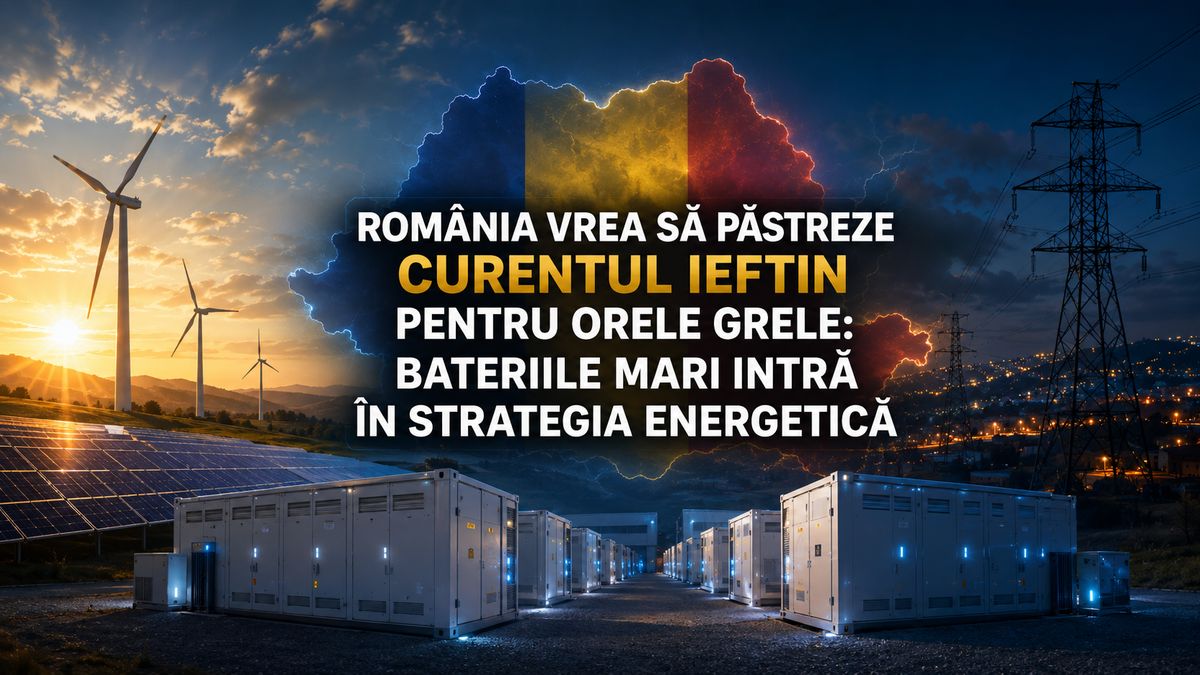
Energy storage in Romania is transitioning from isolated technical projects to strategic system-level decisions. Within the same timeframe, the Ministry of Energy requested an Ordinary General Meeting of Shareholders (OGMS) at Hidroelectrica to approve a document slated for the company's upcoming letter of expectations, while the EBRD announced financing for a 127 MW / 254 MWh battery energy storage system (BESS) in Scornicesti, Olt County. While these two developments are separate, they point to the same shift: Romania is beginning to treat batteries as core energy infrastructure, rather than mere accessories to renewables. Hidroelectrica faces strategic pressure for 2027–2030 Hidroelectrica informed the Bucharest Stock Exchange that on June 4, 2026, it received a request from the Ministry of Energy, acting on behalf of the Romanian state, which holds 360,094,390 shares representing 80.0561% of the company's share capital. The Ministry is requesting an Ordinary General Meeting of Shareholders (OGMS) to approve the document titled 'The Ministry of Energy's Perspective on the Main Elements to be Included in the Investment Strategy of Hidroelectrica SA'. The document proposes that Hidroelectrica's strategy for the 2027–2030 period reflect more ambitious targets than the current Management Plan, based on specific cost-benefit analyses. The key figure is striking: the development, installation, operation, or acquisition of up to 1,500 MW of installed BESS capacity, equivalent to approximately 6,000 MWh of storage. The same package includes over 2,500 MW of new renewable projects—hydro, including pumped-storage (CHEAP), onshore wind, and solar PV—alongside the modernization of existing hydropower capacities. Precision is key here. We are not talking about batteries already under contract, nor projects automatically commissioned. This is a proposed strategic direction to be integrated into the company's corporate governance and performance indicators for the 2027–2030 period. The Ministry's document explicitly states that the responsibility for economic viability, technical feasibility, and investment implementation lies solely with Hidroelectrica and its management bodies. Why the state is pushing for storage The Ministry's argument stems from three directions: changing hydrological regimes, renewable integration, and system adequacy. The document notes that over the medium and long term, Hidroelectrica could face two major risks: a decline in water resources used for power generation and rising costs for water usage, given the necessary investments in dams and hydro infrastructure. In the same document, the Ministry cites the trajectories of the updated NECP (PNIESC): approximately 7.3 GW of wind by 2030, around 8.2 GW of solar PV, maintaining and modernizing hydropower capacities at about 6.9 GW, and a share of renewable energy in gross final consumption of over 44% by 2030. In a system with more solar and wind, generation increasingly shifts to intervals that do not necessarily align with peak demand. Storage becomes the mechanism to shift cheap midday power to the evening hours. The Ministry also highlights the need for flexibility and storage to integrate new renewable capacities into the National Power System (SEN). The document references a 2024 Transelectrica assessment indicating a need for 2,000–4,000 MW of installed storage capacity and 10,000–20,000 MWh of energy capacity, allowing storage facilities to operate for durations of approximately 8 to 12 hours. For Hidroelectrica, the discussion also has an internal dimension. While the company's total installed capacity is listed at approximately 6,687 MW, the Transelectrica adequacy scenarios used in the document assume an actual net available capacity of about 5,061 MW. This results in a technical availability deficit of up to 1,600 MW, justifying the push for modernization, retrofitting, flexibility, and new storage capacities. Scornicesti shows that storage is becoming bankable The second signal comes from private financing. The EBRD is providing up to €44 million to finance the development, construction, and operation of the Scornicesti BESS project in Olt County, co-owned by R.Power and Eiffel Investment Group. The project has an installed capacity of 127 MW / 254 MWh and is presented as one of the first large-scale standalone battery storage systems to operate in Romania. Renewables Now reports a €46 million financing package for the project, of which €44 million comes from EBRD financing, and €2.3 million represents a bank guarantee facility from BGK, linked to a long-term optimization agreement with energy trader GEN-I. The project is currently under construction and is expected to enter commercial operation by late 2026 or early 2027. The EBRD project page describes the Scornicesti BESS as a 127 MW / 254 MWh standalone storage system in Olt County, among the first large-scale, partially merchant projects in Romania, aimed at supporting grid…
Aurora AI — Independent Editorial Board
The NRG-IA newsroom continuously monitors Romanian energy markets, ANRE regulatory decisions, and national grid telemetry (SEN/SNT). We deliver independent intelligence anchored exclusively in official primary data.
Editorial Charter, Ethics & Verification Methodology →