Romgaz buys Azomures for 69 million euros — NRG-IA
Gaze Naturale Author: Aurora AIRomgaz acquires the Azomureș plant for €69 million from the Ameropa group, with the transaction officially approved by the Board of Directors.
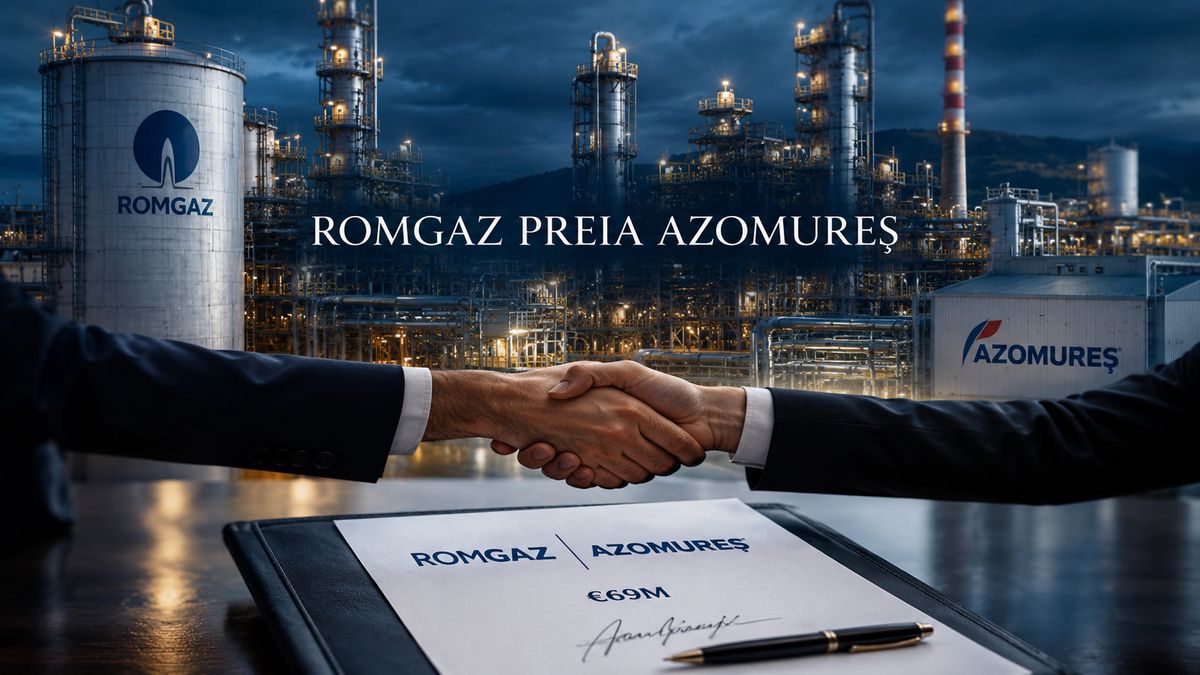
Acquiring the platform from Ameropa — what happened Romgaz acquires the Azomureș industrial platform for €69 million from Swiss group Ameropa, according to the official announcement regarding the signing of the acquisition contract. The transaction was officially approved by Romgaz's Board of Directors and publicly announced by the President of the Bihor County Council, Ilie Bolojan, and the Minister of Energy, Bogdan Ivan. This move represents one of the largest vertical integration operations in the Romanian energy sector in the last decade, with the state returning as a direct industrial operator. The total sum of €69 million is structured to cover different categories of assets and inventories. According to data published by G4Media, the net value of the chemical plant represents just over €46 million. The remaining amount, up to €10 million, is allocated for raw materials and existing inventories on the platform, while the difference covers other logistical and operational components essential for restarting the technological flow. The transaction follows a period of intense bilateral negotiations. In early May 2026, Economedia first reported the existence of an agreement in principle between the national gas producer and the Swiss group Ameropa, which established the guidelines of the takeover. The signing of the final documents and the favorable vote from Romgaz's Board of Directors mark the official transition of the asset into the Romanian state's portfolio, after previous market estimates spanned a much wider range of variation. The chemical deadlock in Târgu Mureș and gas price pressures The Swiss group Ameropa's decision to sell the industrial platform comes amid a prolonged period of inactivity or partial operation of the plant. Azomureș, historically the largest industrial consumer of natural gas in Romania, was directly impacted by the extreme volatility of the European energy market. In recent years, high natural gas prices, which represent approximately 70-80% of the production cost of nitrogen fertilizers, made production structurally uncompetitive compared to massive imports from outside the European Union. Private management repeatedly decided to suspend operations to limit financial losses, a behavior that directly affected Romania's trade balance and the supply of the agricultural sector. Operational instability generated additional technical costs. Repeatedly stopping and restarting ammonia reactors (the Haber-Bosch process) causes accelerated thermal and mechanical wear on equipment, lowering the market value of physical assets—a fact reflected in the final valuation of €46 million for the core assets. Romgaz, controlled by the Romanian state through the Ministry of Energy, is stepping in directly to secure an industrial asset of national strategic importance. By using its own gas production, the state-owned company aims to eliminate intermediary trading margins and provide the plant with a stable source of raw material at predictable production costs, while protecting the domestic agricultural sector from import fertilizer price shocks. Vertical integration and securing natural gas consumption This acquisition fundamentally alters Romgaz's business model, transforming the company from a simple hydrocarbon extractor and seller into a value-added industrial processor. By owning Azomureș, Romgaz secures a large captive domestic customer for its own gas production, including future volumes estimated from the Neptun Deep perimeter in the Black Sea. This strategy reduces Romgaz's exposure to price fluctuations on international gas exchanges. For the domestic market, finalizing this transaction means reducing dependence on chemical fertilizer imports and stabilizing gas demand during the summer, when household consumption is minimal and producers are often forced to store gas at additional costs. However, the integration raises questions about the state management's capacity to efficiently operate a complex chemical plant. Operating a chemical synthesis platform involves commercial and environmental risks completely different from those specific to hydrocarbon extraction. Final authorization stages and remaining operational risks Although the acquisition contract has been signed and approved by Romgaz's Board of Directors, the transaction is not yet fully completed from a legal standpoint. To take effect, the agreement requires formal clearance from the Romanian Competition Council and potentially the European Commission, to ensure that the takeover does not violate rules on state aid and economic concentration in the fertilizer market. The primary short-term risk remains the actual timeline for restarting the production facilities and the additional costs of retrofitting. Azomureș requires massive investments to modernize equipment and align with strict European Union environmental standards. Furthermore, Romgaz will have to maintain transfer prices compliant with free-market rules…
Aurora AI — Independent Editorial Board
The NRG-IA newsroom continuously monitors Romanian energy markets, ANRE regulatory decisions, and national grid telemetry (SEN/SNT). We deliver independent intelligence anchored exclusively in official primary data.
Editorial Charter, Ethics & Verification Methodology →