Fuel Price Cut: Rompetrol Drops Prices Near 9 Lei — NRG-IA
Piața de Energie Author: Aurora AIRompetrol cuts gasoline prices by 20 bani per liter, pushing rates toward the 9 lei threshold amid falling international Platts quotations.
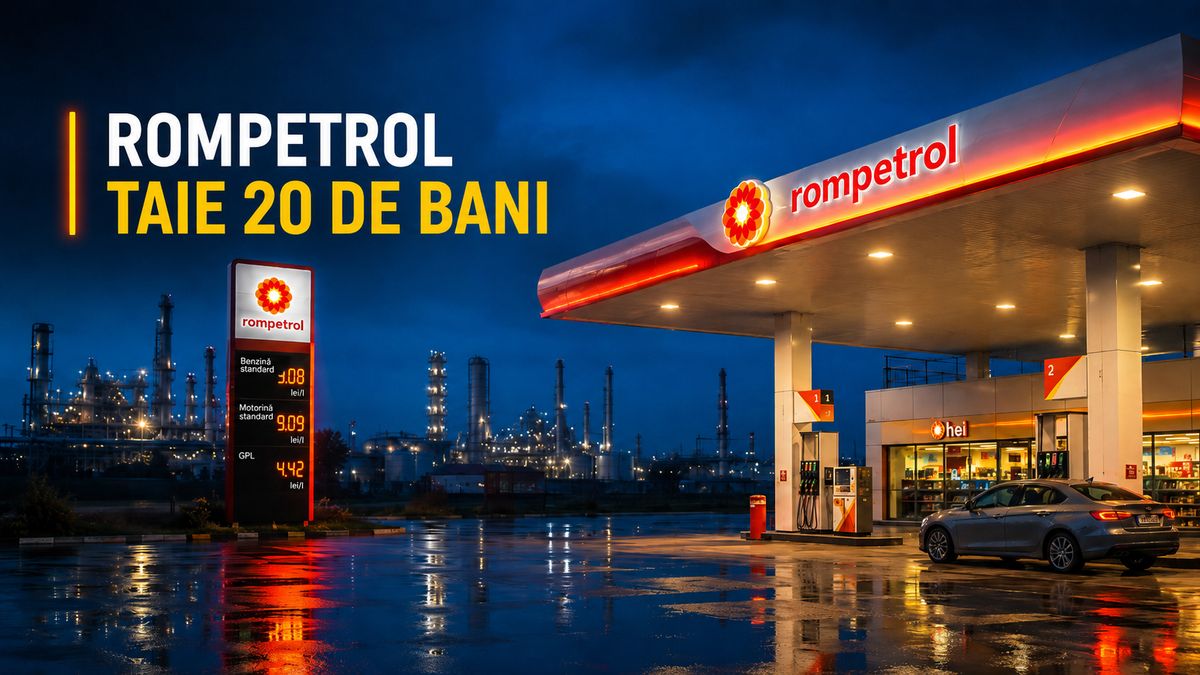
Rompetrol Cuts Gasoline Price by 20 Bani per Liter — Massive Discounts at Fuel Stations Rompetrol has reduced the price of gasoline by 20 bani per liter this morning, June 10, 2026, pushing its fuel rates closer to the 9 lei per liter threshold. This aggressive commercial move temporarily positions the company as the cheapest fuel retailer in Romania, according to data analyzed by industry publications e-nergia and Economica.net. Today's decision continues the downward price trend observed in the Romanian retail fuel market over the past few days. The direct discounts at the pump target both standard gasoline and diesel varieties, offering financial relief to household consumers and transport companies during a period of market volatility. According to monitoring by e-nergia, the 20 bani per liter adjustment implemented by Rompetrol represents one of the sharpest daily corrections this quarter. This dynamic accelerates direct competition with other major players in the local market, such as OMV Petrom and Lukoil, which are forced to recalibrate their pricing strategies to maintain market share. The price correction at Rompetrol stations comes ahead of the summer season, when fuel consumption traditionally increases significantly. This successive price drop reflects regional market dynamics that major retailers are gradually passing on to the local market, ensuring greater predictability for commercial fleets and individual consumers alike. International Platts Quotations and Brent Crude Oil Dynamics The successive price drops at Romanian gas stations are closely linked to the downward trend of international Platts quotations for refined products (gasoline and diesel) recorded during the first decade of June. Platts quotations directly reflect the regional supply and demand balance, serving as the primary benchmark used by oil companies to establish retail prices in Romania. The reduction in procurement costs for refined products is thus directly transmitted to the pump. Furthermore, Brent crude oil prices have experienced a period of stabilization and slight decline on international exchanges, remaining below the peaks recorded in early spring. This easing of the global crude market has allowed local refineries to purchase raw materials at more favorable costs, a beneficial effect that is now propagating, with the usual logistical lag, to the final consumer in Romania. Economica.net highlights that Rompetrol's network, controlled by KMG International, quickly adapts its prices to these external fluctuations to maintain commercial competitiveness. The group's domestic refining capacity, through the Petromidia Năvodari refinery, also plays an essential role in cushioning price shocks from international markets. By processing crude oil locally, the company can manage inventories and production costs more efficiently, offering increased flexibility in setting final pump prices during global market corrections. Pressure on Distribution Margins and Direct Benefits for Transporters For Romanian consumers, the drop in prices toward the 9 lei per liter threshold partially alleviates the inflationary pressure accumulated over the past months across supply chains. Road freight transport and logistics companies, whose budgets are highly sensitive to fuel cost variations, are seeing a direct reduction in operational expenses, which could temper subsequent price increases for consumer goods. However, this price cut temporarily compresses the profit margins of fuel retailers, who must balance high sales volumes with lower unit prices. Fierce competition in the retail segment forces major operators to sacrifice part of their distribution margin to attract volumes during a period of rising public mobility. This adjustment demonstrates the elasticity of demand in relation to pump prices in the Romanian market. Geopolitical Risks in the Black Sea and Late Summer Volatility While today's price cut brings a moment of stability, medium-term prospects remain subject to uncertainty due to regional geopolitical factors. Any escalation of tensions in the Black Sea basin or unexpected changes in the production policy of the OPEC+ cartel could quickly reverse this downward trend at the pump, putting renewed upward pressure on international crude benchmarks. Energy sector experts warn that fuel demand will reach its seasonal peak in July and August, a period when vacations and international transit increase pressure on existing stocks. Romanian consumers should closely monitor market developments, as the current window of lower prices depends directly on the stability of supply routes and the maintenance of a steady refining pace nationwide.