Vostok Oil Starts Arctic Exports, Targets 30M Tons — NRG-IA
Geopolitică & Energie Author: Ioana BuzoaicaVostok Oil has launched its first Arctic cargo, targeting 30M tons by late 2027 as Russia seeks to bypass traditional routes to reach Asia.
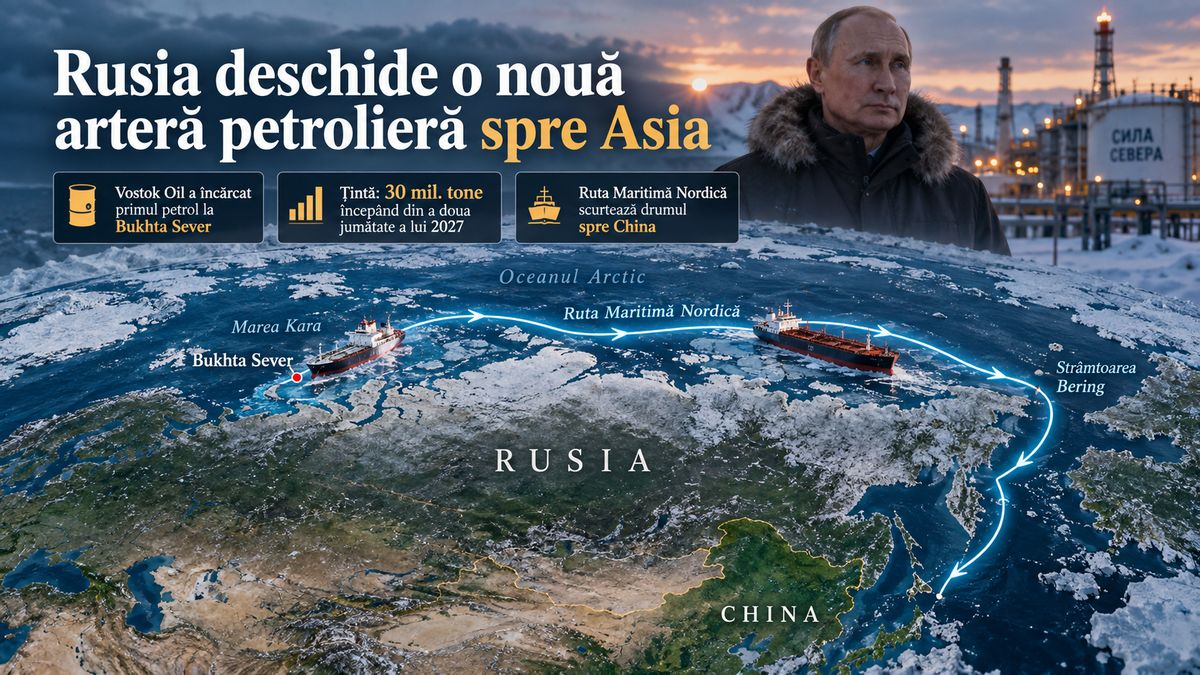
Russia has commissioned one of the most significant oil infrastructures built in the Arctic in recent decades. On September 6, Rosneft began the first oil loading from the Vostok Oil project onto the Arctic tanker Valentin Pikul at the new Bukhta Sever terminal on the Kara Sea. Simultaneously, the Vankor–Payakha–Bukhta Sever pipeline entered service, spanning 790 kilometers and designed for a maximum capacity of 100 million tons of oil per year . For Moscow, this infrastructure opens up more than just a new oil field. Vostok Oil connects the vast resources of northern Siberia directly to the Northern Sea Route, the Arctic corridor that enables oil shipments to Asia without transiting the Suez Canal or relying on major European trade routes. Rosneft estimates that the project will be able to deliver 30 million tons of oil starting in the second half of 2027 , with volumes potentially reaching 50 million tons by 2030 . The company states that further development could allow up to 100 million tons per year, but explicitly links this target to market demand and favorable economic conditions. A 790 km Pipeline Carries Oil Directly to the Arctic Ocean The scale of the constructed infrastructure underscores the project's ambition. The main pipeline crosses the Taymyr Peninsula to Bukhta Sever, with 414 kilometers of the route built as a twin-line system. A six-kilometer segment passes beneath the Yenisei River bed. The new terminal currently features one oil loading berth, two cargo berths, a port fleet berth, and 14 storage tanks of 30,000 tons each . Upon full development, Rosneft plans for 102 tanks. The port is designed to accommodate Arctic tankers with a deadweight of approximately 120,000 tons and includes a specialized ice-protection structure. Rosneft claims a resource base of 7 billion tons of low-sulfur oil for Vostok Oil. This figure represents the resource base reported by the company, rather than 7 billion tons of proven reserves under international classification standards. The economic scale is equally massive. Rosneft states that investments made in the integrated project have reached 4 trillion rubles . The figure of approximately $135–137 billion frequently associated with the project stems from much older estimates when the total cost was valued at over 10 trillion rubles; it does not represent the value of investments actually realized up to 2026. The Route to China Can Shorten Transit by About Two Weeks The strategic advantage of Vostok Oil lies in its positioning along the Northern Sea Route. Russian oil shipments to Asia via the Arctic had already been rising prior to the project's launch. By August 11, seven tankers had transported approximately 6 million barrels of crude oil via this route, nearly half the volume shipped during the entire 2025 season. China was the primary destination. For certain voyages to China, the Arctic route can reduce travel time by about two weeks compared to the Suez Canal route. At the same time, transit takes place along the Russian coastline, reducing vessels' exposure to some of the checkpoints and restrictions encountered on European routes. Total traffic on the Northern Sea Route reached 37.02 million tons in 2025 , of which approximately 5.4 million tons represented trade between Russian and Chinese ports. Rosatom estimates a traffic increase of about 14% for 2026. Compared to these figures, Vostok Oil's target is enormous. The 30 million tons that Rosneft aims to deliver starting in the second half of 2027 alone is close to the entire current annual traffic of the Northern Sea Route. The Weak Link Is the Ice-Class Fleet The pipeline and terminal can handle far larger volumes than Arctic maritime logistics can support today. S&P Global identifies the shortage of ice-class tankers as the project's primary immediate constraint. The first loading was carried out by the Valentin Pikul, a vessel purpose-built for Arctic operations, but scaling up from initial cargoes to tens of millions of tons annually requires a much larger fleet. The route is highly seasonal for conventional vessels. In 2026, commercial oil shipments via the NSR began in the summer, and the navigation window without heavy icebreaker support narrows rapidly as the ice returns. This highlights the project's most significant contrast: Russia has built a pipeline capable of transporting 100 million tons per year , but reaching such a scale depends on the availability of vessels, icebreakers, and the logistical infrastructure required to consistently move that oil out of the Arctic. In any case, Rosneft conditions the 100-million-ton target on market and economic factors. As an order of magnitude, such a volume would equate to approximately 2 million barrels per day , depending on crude density—enough to turn Vostok Oil into a globally significant flow. Western Sanctions Directly Target Vostok Oil The new infrastructure is being built in a commercial environment vastly different from the one in…