Russia Imports Indian Gasoline Amid Refinery Crisis — NRG-IA
Geopolitică & Energie Author: Ioana BuzoaicaOne of the world's top oil powers faces fuel shortages due to refining bottlenecks, forcing Russia to import gasoline from India and Belarus.
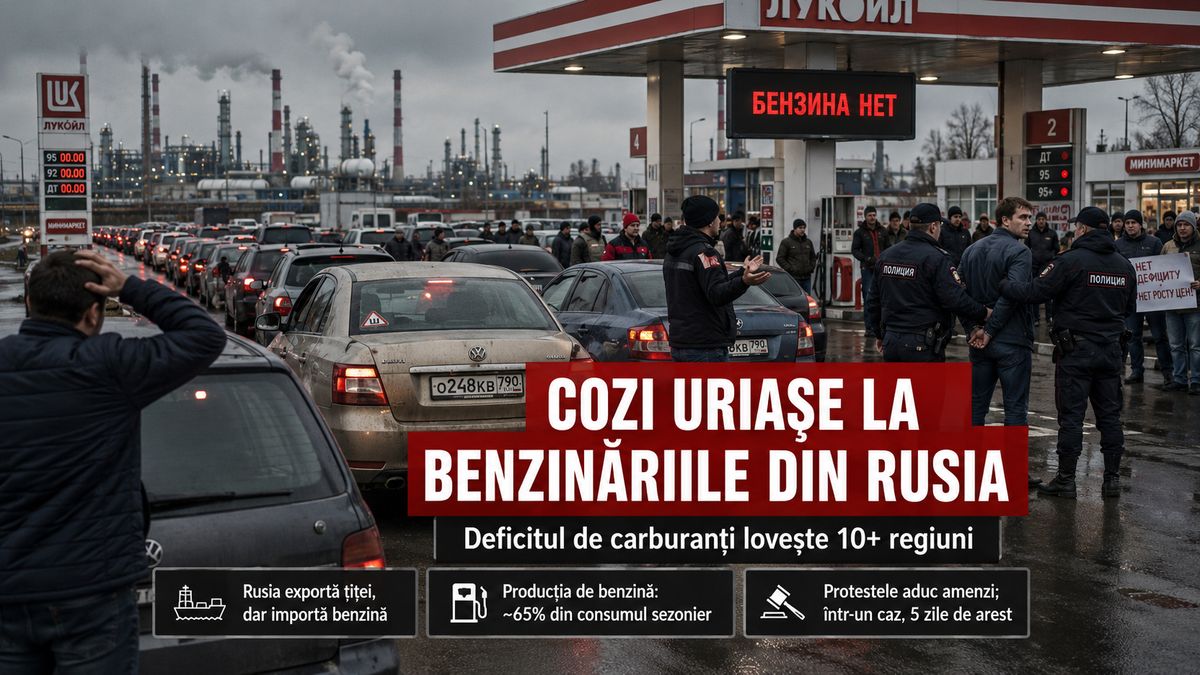
Russia is experiencing its second wave of fuel crises this summer, making the gap between its oil prowess and its ability to put gasoline in its own drivers' tanks increasingly visible. In August, authorities in at least ten regions reintroduced fuel sales restrictions, and Reuters again found gas stations running dry, including in the Moscow region. On the St. Petersburg International Commodity Exchange, gasoline sales volumes fell by an average of 20% since the beginning of August compared to the second half of July. The issue is not a lack of oil in Russia's ground. In July, Russian crude and condensate production rose by approximately 100,000 barrels per day to over 9 million barrels per day, supported by strong exports. Higher crude volumes were planned for August through western ports, with one explanation being the additional availability of oil that can no longer be processed in affected refineries. Russia's Bottleneck Has Shifted from Oil to Refining A refinery converts crude oil into gasoline, diesel, jet fuel, and other products. If a facility shuts down, crude oil remains available and can be exported, while the domestic market is left short of finished products. This distinction explains the apparent Russian paradox: more crude available for export can emerge precisely when domestic fuel production drops. The scale of the imbalance became clear in early July. According to industry sources and Reuters calculations, Russian gasoline production had fallen to a level equivalent to roughly 65% of average seasonal consumption . This indicator does not represent the percentage of destroyed refineries or a 35% loss of installed capacity, but rather the ratio between the actual volume produced and seasonal gasoline demand. The crisis had been brewing since May, following the intensification of Ukrainian attacks on oil infrastructure, and was amplified by high summer demand. By late July, export bans, imports, and inter-regional fuel redistribution had partially stabilized the situation. However, fresh attacks in late July and early August brought back restrictions and shortages. The Russian government acknowledged supply difficulties in regions such as Orenburg, Lipetsk, Tver, Krasnodar, Zabaikal, Primorye, Krasnoyarsk, Oryol, Tuva, and Khakassia. India and Belarus Supply the Market of a Major Oil Power Moscow responded with an unusual combination of measures for one of the world's top oil producers: fuel export restrictions, easing certain quality standards, redistributing available production, and increasing imports. On August 17, Reuters confirmed the entry into the Russian domestic market of a cargo of approximately 68,000 tons of gasoline from India , shipped to the Arctic port of Vitino and subsequently transferred for rail distribution. LSEG data indicated that at least two more gasoline cargoes from India were expected in the following two weeks. In parallel, Russia was importing fuel by rail from Belarus and Kazakhstan. Belarus reached record monthly volumes in July. Rail deliveries of gasoline to Russia rose by 13% compared to June, reaching 212,000 tons , while diesel shipments doubled to 162,000 tons . In the first seven months of 2026, Belarus delivered nearly 665,000 tons of gasoline to Russia, 25 times more than in the comparable period of 2025. During this period, Russia also turned to gasoline from Kazakhstan and Morocco. These imports show how profoundly the economics of Russian refining have changed: the availability of crude oil no longer guarantees the availability of fuel where and when it is needed. Orsk Illustrates the Difficulty of Repairing Lost Capacity One of the most severe recent blows hit the Orsk refinery in the Orenburg region. A Ukrainian drone attack on August 11 forced a complete shutdown of the facility, which can process approximately 6 million tons of crude oil per year . Regional Governor Evgeny Solntsev warned that repairs could take up to six months, partly because some of the damaged equipment is imported and difficult to replace under sanctions. The impact was felt immediately at the pump. Only about 80% of the region's 287 gas stations were operational, with emergency and specialized vehicles receiving priority. Traffic police and volunteers were mobilized to manage the flow of cars searching for fuel. The situation in Orsk illustrates a vulnerability that goes beyond the temporary loss of a single facility. A refinery can be knocked offline in a minutes-long attack, while equipment replacement, repairs, and restarting operations can take months. Refined Product Exports Are Contracting The impact does not stop at Russia's borders. Russian seaborne exports of refined products fell in July to 3.93 million tons , down 33.3% from June and 54.7% compared to July 2025, according to industry data and Reuters calculations. Attacks on refineries have reduced processing and the production of fuels available for both the domestic market and export. This contraction…
Ioana Buzoaica — Independent Editorial Board
The NRG-IA newsroom continuously monitors Romanian energy markets, ANRE regulatory decisions, and national grid telemetry (SEN/SNT). We deliver independent intelligence anchored exclusively in official primary data.
Editorial Charter, Ethics & Verification Methodology →