PPC's 0 RON/kWh Offer Shifts Demand to Solar Hours — NRG-IA
Piața de Energie Author: Ioana BuzoiacaPPC offers a 6-hour window of 0 RON/kWh active energy to test shifting household demand to solar hours, when wholesale market prices are lowest.
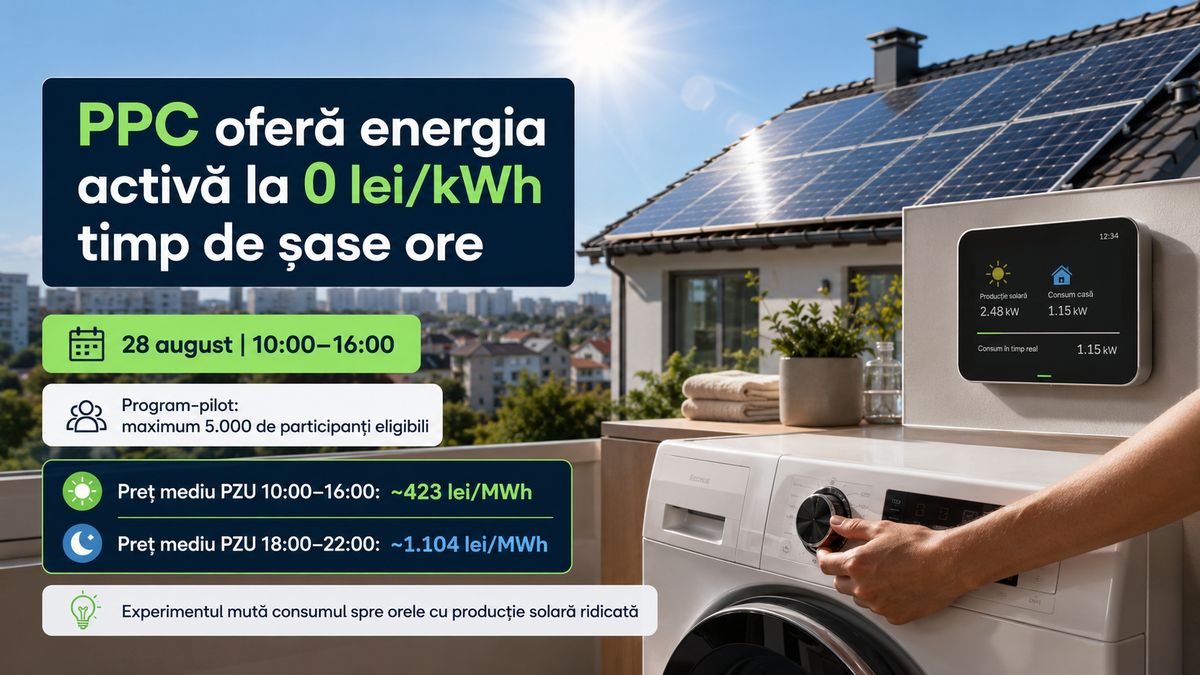
Today, between 10:00 and 16:00, approximately 5,000 eligible PPC Energie customers have a new window in which the active electricity component of their consumption is fully offset, down to the equivalent of 0 RON/kWh . The program does not make the entire bill free. Electricity is initially billed according to the contract, and PPC subsequently issues a commercial bonus equal to the value of the active energy component for consumption during the eligible intervals. Network tariffs, taxes, and other bill components remain due. However, far more interesting than the one-off benefit for the 5,000 participants is the mechanism PPC is testing. The free window is scheduled precisely during the hours when solar generation is high and wholesale electricity tends to be much cheaper than in the evening. Instead of simply encouraging lower consumption, the supplier is testing whether it can prompt households to consume at the right time . Today's market data shows just how significant this difference can be. Between 10:00 and 16:00, electricity today is approximately 2.6 times cheaper than in the evening For the delivery day of August 28, OPCOM indicates an average price of 805.30 RON/MWh on the Day-Ahead Market (DAM), but the daily average hides massive hourly variations. Calculated from the 15-minute intervals published by OPCOM, the average for the 10:00–16:00 period—the exact window of today's PPC program—is around 423 RON/MWh . Between 18:00 and 22:00 , as solar generation progressively fades and household consumption remains high, the average of the same quotes reaches approximately 1,104 RON/MWh . Thus, during the evening peak, electricity traded on the DAM is approximately 2.6 times more expensive than during the six hours chosen by PPC for today's bonus. This comparison does not mean that PPC buys every kWh supplied to customers at the spot price of that moment. Suppliers secure their energy through portfolios that may include contracts with various terms and structures. However, DAM prices clearly illustrate the varying value that electricity can have in the system depending on the hour it is consumed. And today, that difference is massive. Solar power is changing the value of consumption hours The expansion of solar generation is reshaping the electricity market profile. At midday, solar panels simultaneously feed large volumes of power into the grid. If demand does not rise sufficiently during these hours, wholesale prices are pushed down. In the late afternoon, the reverse occurs. Solar output drops rapidly, while consumption remains high or even increases as people return home. The system must quickly replace solar generation with hydropower, gas-fired plants, coal, imports, stored energy, or other available sources. PPC explicitly states that the "Zero Active Electricity" pilot aims to capitalize on solar generation when it is available, encouraging participants to schedule shiftable consumption during these windows. A washing machine, an electric water heater, air conditioning, or charging an electric vehicle consumes the same amount of energy whether run at 13:00 or 19:00. For the power system, however, these two moments can have radically different economic values. This is the shift that the pilot is trying to translate into visible consumer behavior. Initial results show that consumers respond to price signals The program has been running since June, and initial data shows that the financial incentive has altered the behavior of a large majority of participants. After the first six free intervals in June, the 5,000 customers in the pilot had consumed a total of approximately 71 MWh during the windows with active energy at 0 RON/kWh. At 4,193 consumption sites , representing over 83% of the total , consumption during the incentivized intervals increased. The volume of electricity used during these windows was 28.6% higher than the consumption of the same customers during comparable intervals and days in May. For the first half of June, PPC awarded cumulative commercial bonuses of approximately 61,000 RON . The data shows that a simple, easy-to-understand financial benefit can quickly shift the hours when households choose to run certain appliances. However, it does not allow for an exact measurement of the volume shifted away from evening hours: the 28.6% increase may include both load shifted from other times and additional consumption. The key takeaway is the behavioral response. Most participants used more energy when the supplier provided a clear financial incentive to do so. In August, the program reaches 72 hours of zero-priced active energy Today's window is not an isolated event. The calendar published by PPC for August includes free intervals on August 1, 2, 3, 8, 9, 13, 15, 16, 18, 22, 23, and 28. Each window lasts six hours. Therefore, after today's interval concludes, participants will have had 72 hours this month in which the active energy component of their consumption was offset to…
Ioana Buzoiaca — Independent Editorial Board
The NRG-IA newsroom continuously monitors Romanian energy markets, ANRE regulatory decisions, and national grid telemetry (SEN/SNT). We deliver independent intelligence anchored exclusively in official primary data.
Editorial Charter, Ethics & Verification Methodology →