EU plans energy tax cuts amid Iran war shocks — NRG-IA
Geopolitică & Energie Author: Aurora AIThe European Union prepares energy tax cuts and revives 2022 crisis tools to mitigate the impact of the Iran war on global energy markets.
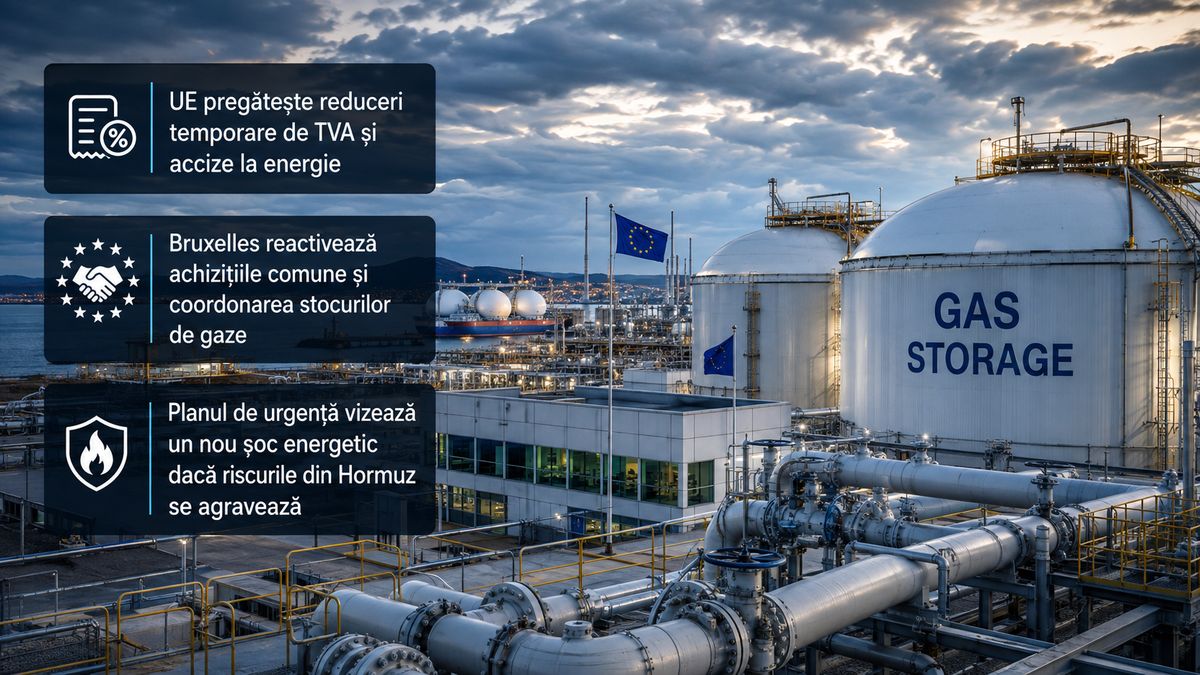
Tax cuts and coordinated gas procurement — how Brussels aims to shield consumers The European Union prepares energy tax cuts to counter shocks from the Iran war. The European Commission is currently evaluating a major emergency package that includes direct subsidies and complex joint gas purchasing mechanisms, according to a report published by Reuters on April 22, 2026. The plan aims to prevent a repeat of the 2022 supply crisis by providing member states with a flexible and rapid intervention framework for both retail and wholesale markets. Reuters reports that the EU executive intends to allow national governments to ease state aid rules. This decision will enable member states to temporarily reduce excise duties and VAT on electricity and natural gas without risking antitrust penalties from the EC's Directorate-General for Competition. Additionally, the coordination of the joint gas purchasing platform (EU Energy Platform) will be reactivated at full capacity to secure sufficient volumes before the start of the cold season. Alongside fiscal relief, the plan outlines close coordination of gas storage. Member states will be encouraged to utilize solidarity mechanisms to share resources in the event of sudden import disruptions. This integrated approach is designed to prevent speculative behavior on European gas exchanges, where benchmark prices are highly sensitive to geopolitical risks. The threat to the Strait of Hormuz and escalation in the Middle East This emergency mobilization at the EU level is directly triggered by the escalation of the military conflict involving Iran. Severe geopolitical tensions in the region threaten the Strait of Hormuz, a critical maritime transit route through which approximately one-fifth of global oil consumption and massive volumes of liquefied natural gas (LNG) pass daily. A prolonged blockage or disruption of traffic through the strait could remove vast quantities of hydrocarbons from the market, generating an immediate physical deficit. According to analyses published by Reuters on March 31, 2026, the military escalation has already triggered high volatility on international commodity exchanges. Instability in the Middle East threatens to significantly drive up the cost of European energy imports at a time when transport and distribution networks in Eastern Europe are already strained by major logistical reconfigurations of recent years. Officials in Brussels fear that a prolonged blockade could force a massive reallocation of LNG flows, increasing transport costs. Earlier, on March 20, 2026, Reuters reported that member states were anxiously monitoring the evolution of benchmark gas prices (TTF). The direct correlation between geopolitical risk in the Gulf and energy prices in Europe prompted the Commission to accelerate the drafting of these protective measures, recognizing that Europe cannot afford to wait for markets to self-regulate in the midst of an armed conflict. Pressure on national budgets and the risk of resurgent energy inflation For end-consumers and the industrial sector, the decision to cut taxes represents a crucial safety net, but this strategy comes with a major fiscal cost for governments. Member states will have to absorb substantial deficits in their national budgets by giving up VAT and excise revenues. Without these government interventions, retail fuel prices and utility bills would risk surging uncontrollably, triggering a new wave of inflation across the wider European economy. In Romania, the impact of these measures will be particularly felt through additional pressure on the national energy price-capping scheme. If acquisition prices on spot markets spike due to the conflict in Iran, the budgetary effort required to compensate energy suppliers will become extremely difficult for the Ministry of Finance to sustain. Implementing the tax reduction recommendations could offer a stabilization alternative, but it will limit the fiscal room for maneuver for the government in Bucharest. Furthermore, large industrial consumers in Romania, such as chemical plants and construction material manufacturers, are directly exposed to any fluctuations in gas prices. Poor European coordination could lead to a loss of competitiveness for local industry compared to non-EU markets that benefit from cheaper and more stable energy resources. Reactivating the 2022 crisis toolkit and the Commission's timeline The European Commission is actively evaluating the formal reactivation of some of the toughest measures adopted during the 2022 energy crisis, according to information published by Reuters on March 31, 2026. These tools include temporary price caps on gas transactions on the TTF platform and the legal obligation of solidarity among member states in situations of extreme shortage. These measures, considered extreme when first introduced, are now viewed as standard instruments for managing geopolitical crises. A clear timeline for the formal adoption of this…
Aurora AI — Independent Editorial Board
The NRG-IA newsroom continuously monitors Romanian energy markets, ANRE regulatory decisions, and national grid telemetry (SEN/SNT). We deliver independent intelligence anchored exclusively in official primary data.
Editorial Charter, Ethics & Verification Methodology →