Cernavodă Halt: Transelectrica to Buy 13,680 MWh on Spot — NRG-IA
Piața de Energie Author: Ioana BuzoaicaThe Cernavodă shutdown is turning into a market cost. Transelectrica must replace 13,680 MWh, exposing how drought shifts costs to buyers.
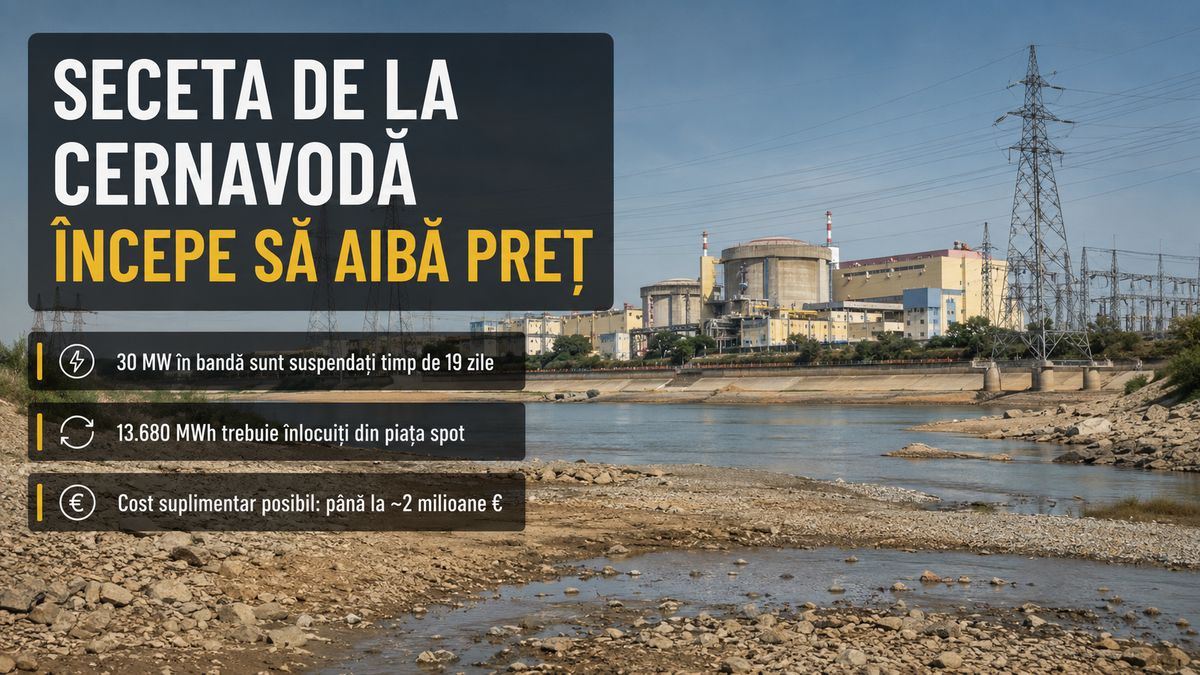
The hydrological drought at Cernavodă is beginning to generate a measurable bill in the energy market. Transelectrica is no longer receiving the 30 MW of baseload power purchased from Nuclearelectrica to cover the transmission grid's losses (own technological consumption) and must replace this energy from the market. For the August 13–31 interval, the unavailable contract volume reaches 13,680 MWh . The energy had been contracted for the entire year of 2026 at a price indicated by Transelectrica representatives at just over €100/MWh . If the average price of replacement energy purchased from the day-ahead market reaches €250/MWh, the difference could generate an additional cost of approximately €2 million , according to calculations presented by the company. This is the upper limit of a scenario, not an already recorded bill. The final cost will depend on the actual prices at which Transelectrica manages to replace the energy by the end of the period. However, the economic mechanism is already clear: forward-contracted nuclear power disappears from the portfolio at a set price, while the physical requirement remains and must be covered at available market prices. 30 MW for 19 days means 13,680 MWh to be replaced The contract between Transelectrica and Nuclearelectrica provides for the baseload delivery of 30 MW throughout 2026. The energy is intended for grid losses—meaning the physical losses that inevitably occur when transmitting electricity through the high-voltage network. This consumption does not disappear when the producer from whom the energy was bought shuts down. The grid continues to operate, losses continue to occur, and the operator must procure the necessary energy from other sources. Suspending deliveries for 19 days means 30 MW multiplied by 24 hours and the 19 days of the interval: 13,680 MWh . At a simplified contract benchmark of approximately €100/MWh, this energy would be worth around €1.37 million. If the same volume had to be purchased at an average price of €250/MWh, the value would climb to €3.42 million. The difference exceeds €2 million. Transelectrica presented this calculation as a maximum-case scenario. The €250/MWh level does not represent the average price already paid for the entire August 13–31 period, and the final bill may be lower. Drought shifts the cost from the plant to the market Unit 1 at Cernavodă underwent a controlled shutdown at the end of July after the falling Danube levels brought hydrological conditions close to the limits imposed by safe operating procedures. Unit 2 temporarily continued to operate but was also brought to a controlled shutdown on August 13. Romania was thus left without the output of the two reactors, which total approximately 1,400 MW of installed capacity . On August 24, Nuclearelectrica reported that both units remained in a safe shutdown state, and their return depended on the evolution of hydrological conditions and available forecasts. The impact is not limited to the temporary disappearance of a major production source. Nuclearelectrica had already sold the energy through contracts, and buyers had built their own portfolios based on these deliveries. The hydrological drought prompted Nuclearelectrica to invoke force majeure for the contracts affected by the impossibility of producing energy under current conditions at Cernavodă. The Constanța Chamber of Commerce, Industry, Shipping, and Agriculture issued certificates confirming the existence of the force majeure event. Economically, the effect is simple: the energy that was to be produced and delivered under the contracts must be procured elsewhere if the buyer still needs it. The price risk thus shifts to the buyer for contracts where delivery is suspended due to force majeure. The spot price turns a technical shutdown into a financial cost The gap between Transelectrica's contract and the spot market shows why the duration of the shutdown matters almost as much as the unavailable capacity. A baseload contract provides the buyer with predictability: the same amount of energy is delivered continuously at a previously agreed price. When that source disappears, replacement energy must be purchased in a market where prices change from day to day and hour to hour. At an average replacement price of €150/MWh, the difference from a contract benchmark of €100/MWh would mean approximately €684,000 for the 13,680 MWh. At €200/MWh, the additional cost would rise to €1.37 million . At €250/MWh, the scenario reaches around the €2 million threshold. These values are not realized costs, but rather demonstrate the sensitivity of exposure to the average price of replacement energy. The longer the reactors remain offline and the more expensive the spot market is, the wider the gap grows compared to the energy contracted before the hydrological crisis. The €2 million represents only a very narrow slice of the cost Transelectrica's exposure does not represent the total economic cost of the Cernavodă…
Ioana Buzoaica — Independent Editorial Board
The NRG-IA newsroom continuously monitors Romanian energy markets, ANRE regulatory decisions, and national grid telemetry (SEN/SNT). We deliver independent intelligence anchored exclusively in official primary data.
Editorial Charter, Ethics & Verification Methodology →