Poland Loses 1.3 GW of Coal to Drought: Romania Impact — NRG-IA
Piața de Energie Author: Ioana BuzoaicaPoland warns Romania: coal is dispatchable but not drought-proof. Low Vistula levels cut 1.3 GW as Romania debates keeping lignite for adequacy.
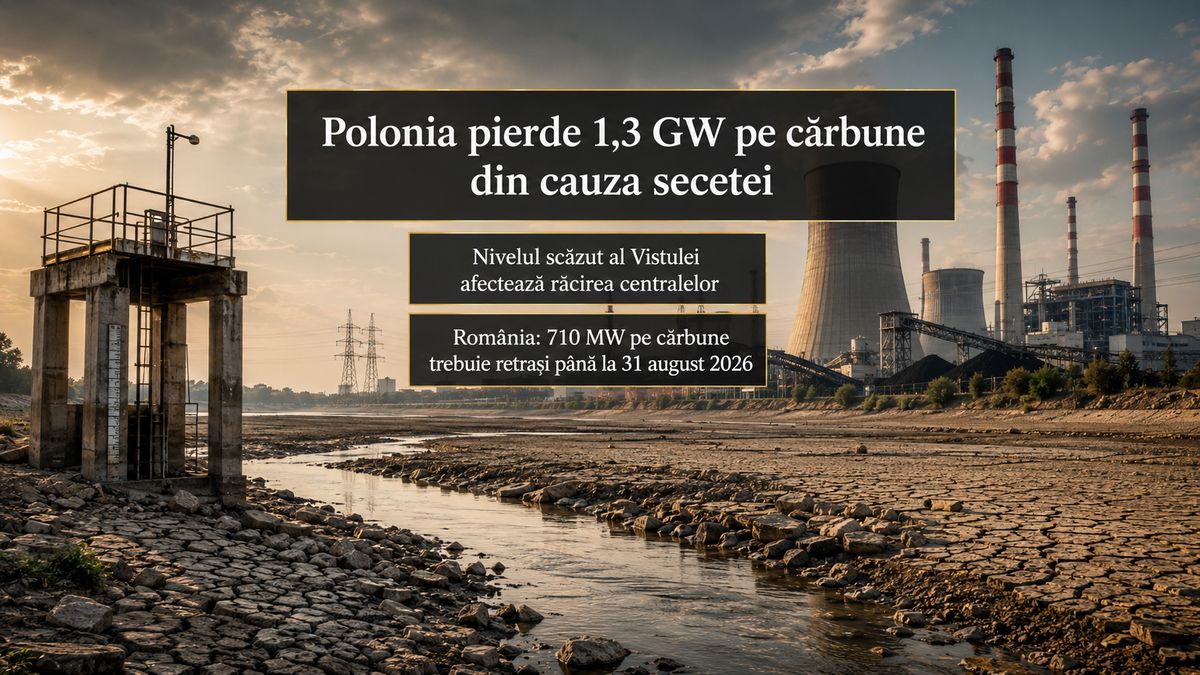
Poland has lost approximately 1.3 GW of coal-fired generation capacity after critical levels on the Vistula River restricted the cooling water required for the Kozienice and Połaniec power plants. In terms of scale, the sidelined capacity is nearly double the output of a single reactor at Cernavodă, shifting the debate on energy droughts into territory that directly concerns Romania: even coal-fired plants are not entirely independent of hydrological conditions. The Guardian reported on August 7 that Polish authorities were forced to shut down units at the two major power plants after the Vistula dropped to levels insufficient for normal cooling, with the cumulative impact on the grid reaching around 1.3 GW. This figure does not represent the total capacity of the two sites, but rather the capacity rendered unavailable during the current episode. For Romania, this event comes at a sensitive time. The shutdown of a unit at Cernavodă and diminished hydropower output have revived public arguments that the grid needs controllable capacity—available when water is scarce, the sun is not shining, and wind does not cover consumption. In this equation, lignite from Complexul Energetic Oltenia is once again being framed as a resource that should not be phased out before new capacities are actually online. However, Poland demonstrates the limits of this conclusion: coal eliminates dependence on sun and wind, but it does not automatically eliminate dependence on water. 1.3 GW lost in a heavily coal-reliant system Kozienice and Połaniec are not marginal plants. They are two of Poland's major thermal generation hubs, in a country where coal continues to play a far more significant role in electricity generation than in Romania. The issue on the Vistula is not a lack of fuel. Coal may be stockpiled, the power unit may be technically available, and the turbine ready to run. However, if the plant cannot safely discharge the necessary amount of heat, generation must be curtailed or halted. Documents from Enea, the group operating Kozienice and Połaniec, confirm that most units at the two plants use once-through (open-loop) cooling systems, directly dependent on river water. The company identifies water availability as one of the key dependencies for its electricity generation. In such a system, water is drawn from the river, passes through cooling installations and condensers, and allows the steam that has passed through the turbine to condense back into water. Waste heat must be continuously discharged for the thermodynamic cycle to continue. When river flow drops too low, water intake can hit technical limits. If the water is also very warm, its capacity to absorb heat decreases, and discharging the heated water back into the river can run up against environmental limits. The fuel differs, but the physical challenge remains. A nuclear reactor generates heat through fission. A lignite or hard coal plant generates it by burning fuel. In both cases, an essential part of the facility must reject massive amounts of heat after the steam passes through the turbine. Poland loses almost the equivalent of two Cernavodă reactors A comparison with Romania illustrates the scale of the event. A single reactor at Cernavodă delivers approximately 700 MW. The roughly 1.3 GW sidelined in Poland represents, in terms of capacity, nearly the equivalent of two such units. Romania has already felt the severe impact of losing a single nuclear unit during this drought period. In Poland, the restriction linked to the Vistula withdrew a significantly larger thermal capacity in a single event. This difference is important precisely because one of the natural reactions to Romania's situation was to question whether the accelerated phase-out of coal-fired generation leaves the grid without sufficient controllable capacity. The Polish answer is not that coal plants are no longer useful to the system. Under certain conditions, they remain an important source of dispatchable power. However, the episode shows that "dispatchable" does not mean "invulnerable" . Romania must retire another 710 MW of coal capacity by August 31 The tension is particularly high as Romania approaches a critical deadline. Emergency Ordinance No. 20/2026 maintains the obligation to decommission another 710 MW of lignite and hard coal capacity by August 31, 2026 , following the retirement of 1,045 MW by the end of 2025. The schedule is part of the commitments made under the National Recovery and Resilience Plan (NRRP) and was negotiated with the European Commission. The legislative act explicitly states that the measures aim to ensure the irreversibility of the decarbonization process. At the same time, it allows certain units to continue operating until August 31, 2026, and others until the end of 2030, in accordance with the revised schedule negotiated with Brussels. Romania's problem is that the new capacities meant to gradually replace coal have not all entered service…
Ioana Buzoaica — Independent Editorial Board
The NRG-IA newsroom continuously monitors Romanian energy markets, ANRE regulatory decisions, and national grid telemetry (SEN/SNT). We deliver independent intelligence anchored exclusively in official primary data.
Editorial Charter, Ethics & Verification Methodology →