Drought Shuts Down 4.2 GW of French Nuclear Power — NRG-IA
Piața de Energie Author: Ioana BuzoaicaDrought hits two major French nuclear plants. Chooz is limited by a bilateral treaty on the Meuse, while Cattenom must manage its dedicated reserves.
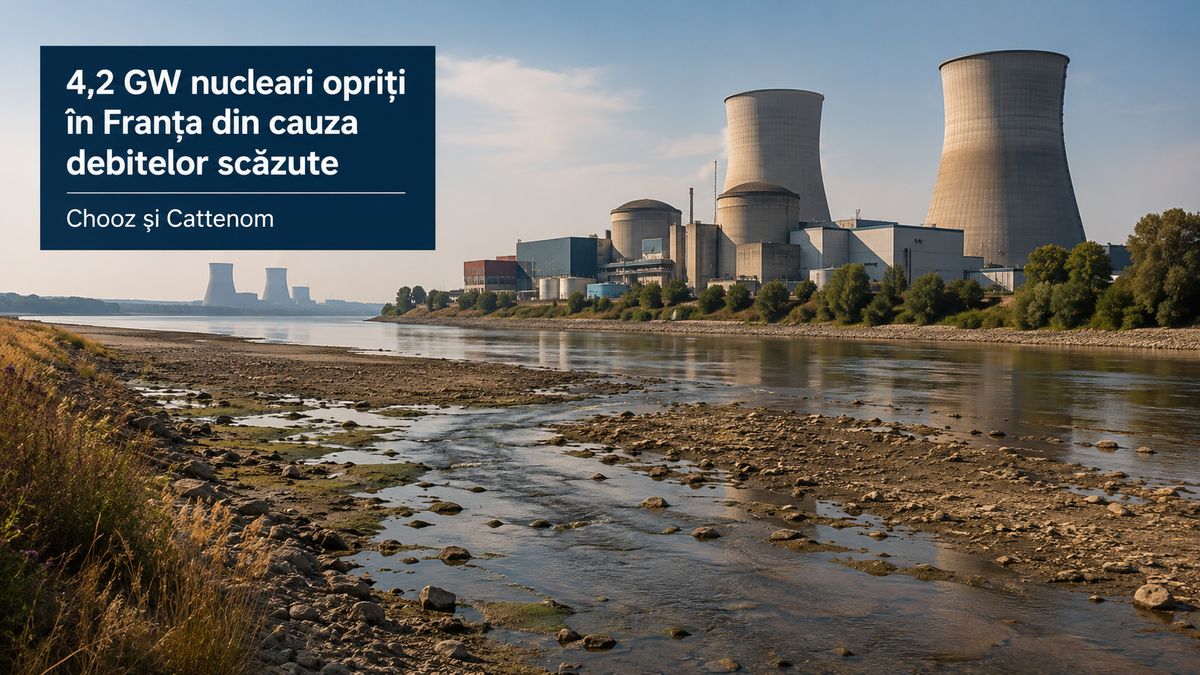
Three French nuclear reactors with a combined installed capacity of 4,200 MW have been shut down due to extremely low flow rates on the Meuse and Moselle rivers. Both 1,450 MW units at the Chooz plant are offline, and EDF has also preemptively shut down the 1,300 MW Unit 1 at Cattenom. The situation is exacerbated by overlapping scheduled maintenance. Cattenom 2 and Cattenom 4, each with a capacity of 1,300 MW, were already offline for planned works. Of the six reactors at Chooz and Cattenom, only Cattenom 3 is currently generating electricity. The two sites have a combined installed capacity of approximately 8,100 MW , with around 6,800 MW currently unavailable . This represents about 84% of their combined capacity. Of this outage, 4,200 MW is linked to hydrological conditions, while 2,600 MW is due to scheduled maintenance shutdowns. However, the drought has not created the same technical issue at both plants. At Chooz, nuclear generation conflicts with France's obligation to preserve the flow of the Meuse for downstream users and Belgium. At Cattenom, the cooling system includes dedicated reservoirs, but the drop in the Moselle limits the volume of water that can be used under environmental permits. Chooz is shut down due to the Meuse flow regime, not a technical inability to cool the reactors Chooz Unit 2 was shut down preemptively on July 11 at 00:08, following a drop in the flow of the Meuse. That morning, EDF measured a flow rate of 21.3 cubic meters per second . The company explicitly stated that this level did not pose a nuclear safety issue. According to EDF, approximately 6.3 cubic meters per second are required to ensure cooling for the Chooz reactors. The shutdown was triggered by a different constraint: compliance with the agreement between France and Belgium dated September 8, 1998, regarding the use of the Meuse river flow. The agreement establishes progressively more restrictive rules as the river's flow declines. If the average daily flow, calculated downstream of the nuclear site over 12 consecutive days, falls between 20 and 22 cubic meters per second , the amount of water evaporated by the plant must be limited. If this same average drops below 20 cubic meters per second , evaporative consumption must be eliminated. This is a fundamental difference from the notion that the river "can no longer cool the reactor." According to EDF, water remains sufficient for the technical cooling function, but the plant cannot use it without limits in a river basin shared with Belgium and other consumers. On August 2, EDF reported a Meuse flow rate of just 18.6 cubic meters per second , down from 21.3 cubic meters per second on July 11. The instantaneous value had thus fallen below the 20 cubic meters per second threshold set in the agreement, even though the formal application of the rule is based on the 12-day average. In this context, Chooz Unit 1 was also shut down, rendering the entire plant, with a total installed capacity of 2,900 MW , unavailable. Water regulations have shut down Chooz in the past The site's sensitivity is not new. Chooz's annual environmental report for 2025 shows that the 12-day average flow of the Meuse reached 19.98 cubic meters per second back then, triggering the shutdown of Unit 2 on August 30, 2025. The output of the same unit had also been curtailed on August 27 and 28. This vulnerability is also highlighted in French institutional assessments. The Court of Auditors identified Chooz as one of the nuclear sites most sensitive to flow constraints, precisely because of the cross-border agreement on the Meuse. As early as 2023, the institution warned that nuclear outages associated with global warming could become three to four times more frequent by 2050 , depending on climate trends and the specific site. For Chooz, the risk is therefore not limited to high water temperatures. The available volume and the obligation to preserve river flow can themselves become factors that curtail generation. Cattenom uses a different system and two water reserves The situation at Cattenom is different. The plant in Lorraine has four 1,300 MW pressurized water reactors, totaling 5,200 MW of capacity. Unlike plants that use a fully open-loop cooling system, Cattenom features cooling towers and recirculates a large portion of its water. However, the Moselle remains essential to compensate for water lost through evaporation and to operate the facility under the conditions set by environmental permits. During low-flow periods, the plant's infrastructure is supported by two major reservoirs: Mirgenbach , with approximately 7.2 million cubic meters, and Vieux-Pré/Pierre-Percée , with around 61 million cubic meters. Vieux-Pré was built specifically to support the flow of the Moselle during droughts and to provide the supply necessary for the plant's operation. Hydrological pressure was visible long before the shutdown of Unit 1. At the end of June, EDF restricted public access to the Mirgenbach…