Doicești SMR: Cost Estimate Reaches $6.5B, Slips to 2034 — NRG-IA
Energie Regenerabilă Author: Ioana BuzoaicaDoicești SMR cost estimate hit $6.5B in Dec 2025, up $3.8B from baseline, with the 462 MWe plant delayed to 2034. The full report raises wider stakes.
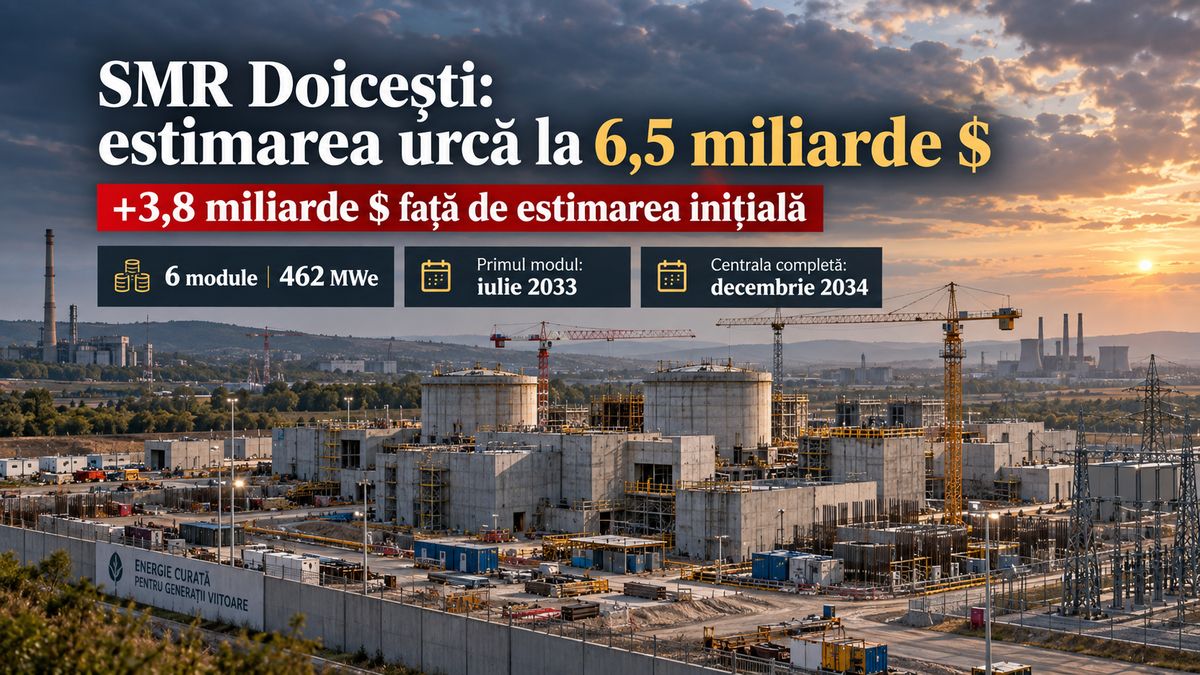
The small modular reactor (SMR) project at Doicești looks fundamentally different today than the one outlined in the 2022 strategy. By December 2025, the cost estimate had reached $6.5 billion , approximately $3.8 billion above the initial estimate , while the timeline for the complete plant has shifted from around 2030 to December 2034 . These figures appear in the full report of the Prime Minister's Control Body on the SMR project, published by Nuclearelectrica on September 11. The document brings together the cost, delays, financing, and governance of an investment designed to bring Romania six NuScale modules of 77 MWe each, totaling 462 MWe of nuclear capacity. However, the report does not establish a final price tag of $6.5 billion for the plant. This figure represents the project estimate as of December 2025. The Pre-EPC phase must refine costs to a Class 2 estimate and clarify the contractual architecture, contractors, and commercial terms of the project. Yet, the gap from the starting point remains massive. If the December 2025 estimate is roughly $3.8 billion above the initial baseline, this implies a starting level of approximately $2.7 billion . The project's estimate has thus reached about 2.4 times its initial value , even before entering the phase meant to produce a much more mature technical budget. From a 2030 Horizon to a Complete Plant in 2034 Cost is not the only parameter that has changed. The 2022 strategy envisioned a much faster path: construction was slated to take place between May 2026 and March 2029, commissioning between March and August 2029, and full commercial operation was projected by January 2030. FEED 2, the front-end engineering and design phase originally scheduled for completion by April 30, 2024, concluded in December 2025. The Control Body characterizes this difference as a delay of 20 months . Nuclearelectrica disputes that this delay is attributable to its actions, pointing out that the dates in the initial strategy were estimates rather than binding contractual deadlines. The company cites the complexity of a first-of-a-kind nuclear project, the licensing process, and the need to structure international financing. However, the calendar dates remain clear: FEED 2 concluded in December 2025, not April 2024, and the scenario approved alongside the final investment decision now pushes the first module to July 2033 and the entire plant to December 2034 . The shift is not just about the schedule. The project is being restructured so that the first 77 MWe module demonstrates operation before the acquisition and payment of the other five modules. This model reduces exposure to the technological risk of a solution that has not yet been commercially deployed at this scale, but simultaneously pushes back the moment when Romania would benefit from the full 462 MWe capacity. Over €200 Million Equivalent Already Drawn from SNN Financing The report also highlights the financial commitments already made. The two shareholders of RoPower Nuclear—Nuclearelectrica and Nova Power & Gas—contributed share capital, and SNN additionally provided the project company with a loan facility of $243 million . According to the Control Body, amounts equivalent to approximately €204 million had been drawn from this facility. This sum does not represent damages or the cost of constructing the plant; rather, these are funds loaned to the project company for SMR development. The dispute raised by the report concerns how the use of these funds is monitored. The Control Body states that it did not identify a sufficiently detailed, dedicated system at Nuclearelectrica to monitor RoPower's expenditures from these loans, pointing out that shareholder agreements allowed for direct audits and verifications. Nuclearelectrica rejects the conclusion that there was a lack of control, arguing that supporting documents, expenditure eligibility, and contractual caps were verified prior to funding. The company also asserts that the analyzed decisions did not cause any quantifiable damage to SNN's assets. Site Acquisition Opens a Second Front in the Report Doicești was one of nine sites analyzed for the project and ranked second in the Sargent & Lundy evaluation, scoring 1,091 points compared to 1,099 for the top-ranked site. The Control Body criticizes the lack of a sufficiently explicit technical-economic comparative analysis between the recommended sites. Nuclearelectrica responds that legislation did not require such a document in a specific format and that the advantages of the brownfield site, including existing infrastructure, were taken into account. However, the site transaction has become one of the most sensitive parts of the report. On June 5, 2025, RoPower Nuclear purchased the land and buildings at Doicești for €24.344 million . Separately, on the same day, the company entered into a reinvoicing agreement for €19.492 million excluding VAT , representing costs previously incurred by Nova Power & Gas.…