Reflect Orbital Aims to Sell Sunlight After Sunset — NRG-IA
Tehnologie & Inovație Author: Aurora AIReflect Orbital is testing space mirrors to redirect sunlight to Earth after sunset, raising a key question: is this new energy infrastructure or sky privatization?
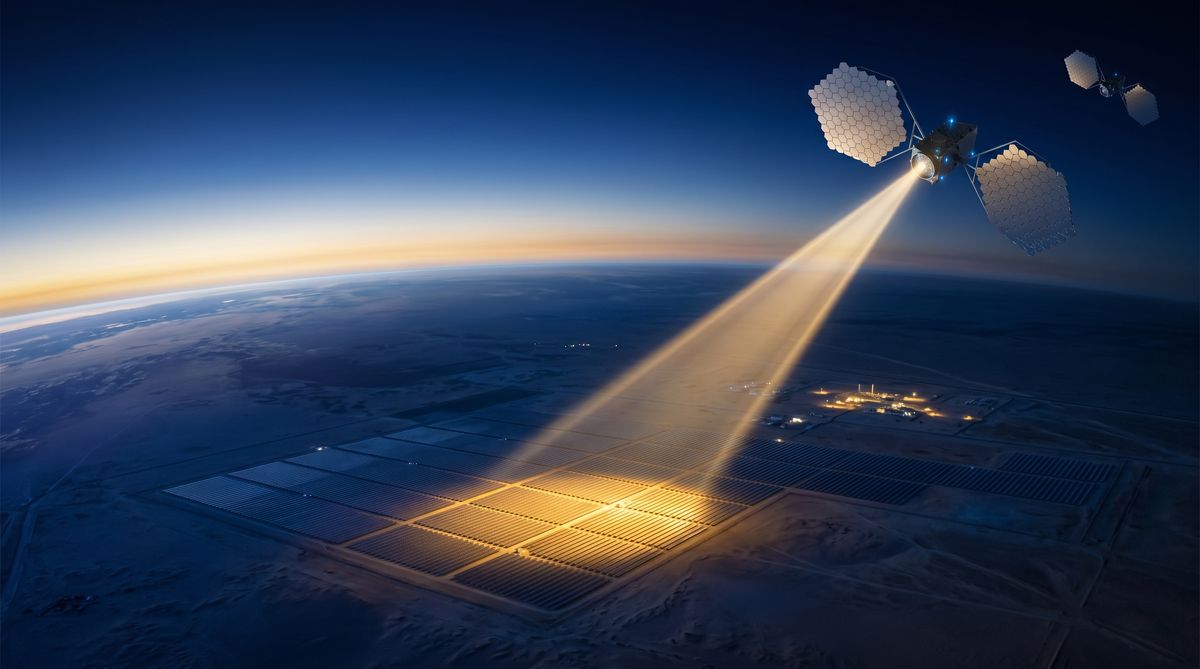
Light becomes orbital infrastructure There are technologies that solve a problem. And there are technologies that change the question. Reflect Orbital falls into the second category: it does not propose a better battery, a more efficient solar panel, or a smarter grid, but an almost mythological idea—to send sunlight to Earth after sunset. The American company presents its technology as an on-demand sunlight service, delivered via a constellation of mirrors in space. On its website, Reflect Orbital describes a "spotlight" of light at least 5 kilometers wide, directed at an approved user, with adjustable intensity ranging from full moon levels to midday light, controllable via an app or website. It is hard to imagine a more powerful technological hook: the Sun no longer sets completely, provided you have the right infrastructure above the Earth. But this is exactly where the real analysis begins. For the energy sector, the question is not whether the idea is spectacular. It is. The question is whether light reflected from orbit can become precise, safe, cheap, and useful enough to matter in the energy system. From science fiction to FCC filing The project is not just marketing. The Federal Communications Commission has recorded Reflect Orbital's application for the authorization of a non-geostationary satellite, Earendil-1, designed to test a space reflector technology by reflecting sunlight to targeted areas on the Earth's surface. The FCC document indicates an orbit of approximately 625 km, with a deviation of ±25 km, and an inclination of 88 degrees, with a deviation of ±2 degrees. This is the dividing line between fantasy and fact. We are not yet talking about a mature commercial service illuminating cities or large-scale solar farms. We are talking about the first verifiable milestone: a demonstrator satellite, a technology under testing, and an ambition trying to transition from the realm of ideas to the realm of infrastructure. In 2025, Reflect Orbital secured a $20 million Series A funding round led by Lux Capital, with participation from Sequoia Capital and Starship Ventures. The company says the funds will support constellation development, team growth, and the first space missions. The energy promise: solar without the end of the day For the energy sector, the idea becomes truly interesting when reflected light is no longer viewed as spectacular illumination, but as an extension of solar generation. Sequoia Capital describes Reflect Orbital as a company that sells orbital sunlight to solar farms and large-scale lighting applications after sunset, based on the simple logic that more hours of light can mean more production from existing solar assets. This is the "magical" part of the concept: a photovoltaic plant would no longer be entirely captive to sunset. Instead of building on new land, installing new panels, or adding ground infrastructure, you would try to make better use of what already exists by directing light onto the panels when demand is high but the Sun is no longer shining naturally. The company projects its evolution in phases. For the energy sector, Reflect Orbital indicates testing in the early years, followed by a 2030 target of a 1% increase in capacity factor via 50 W/m² for 20 minutes, and a 2035 target of a +20% capacity factor via 300 W/m² for 3 hours. These figures are company-stated objectives, not validated commercial performance. Here, rigor must be maintained: the technology may change the imagination surrounding solar power, but it does not yet alter the global energy balance. For now, it promises; it does not yet deliver at scale. Clean energy meets the right to darkness Reflect Orbital claims that the service can be controlled: defined zones, pre-set intervals, steerable satellites, pre-communicated positions, and avoidance of observatories or sensitive sites. The company states that the 2026 demonstration will not produce "midday at midnight," but rather a light roughly comparable to a full moon, for up to 5 minutes, within the first two hours after sunset. However, a technology that can bring light where night should remain night cannot be analyzed solely as an energy product. The Guardian reported that scientific societies focused on biological rhythms and sleep have raised concerns with the FCC regarding potential effects on health, ecosystems, and natural cycles, within the broader context of the growing number of satellites in low Earth orbit. Space is no longer just a technological frontier. It is becoming economic infrastructure. And when economic infrastructure begins to touch light, darkness, the sky, and the planet's biological rhythms, the regulatory question becomes inevitable: who has the right to turn on the night? An idea too big to be treated as a mere gadget Reflect Orbital should be viewed neither as a miracle solution nor as a futuristic aberration. It is a sign of the direction in which energy technology is moving: higher up, more distributed,…