US, Israel Plan Iran Energy Strikes; Tanker Hit Near Hormuz — NRG-IA
Geopolitică & Energie Author: B0gd@nEnergy risks in the Iran conflict rise on land and sea. The US and Israel plan potential strikes on energy targets, while a tanker is hit near Hormuz.
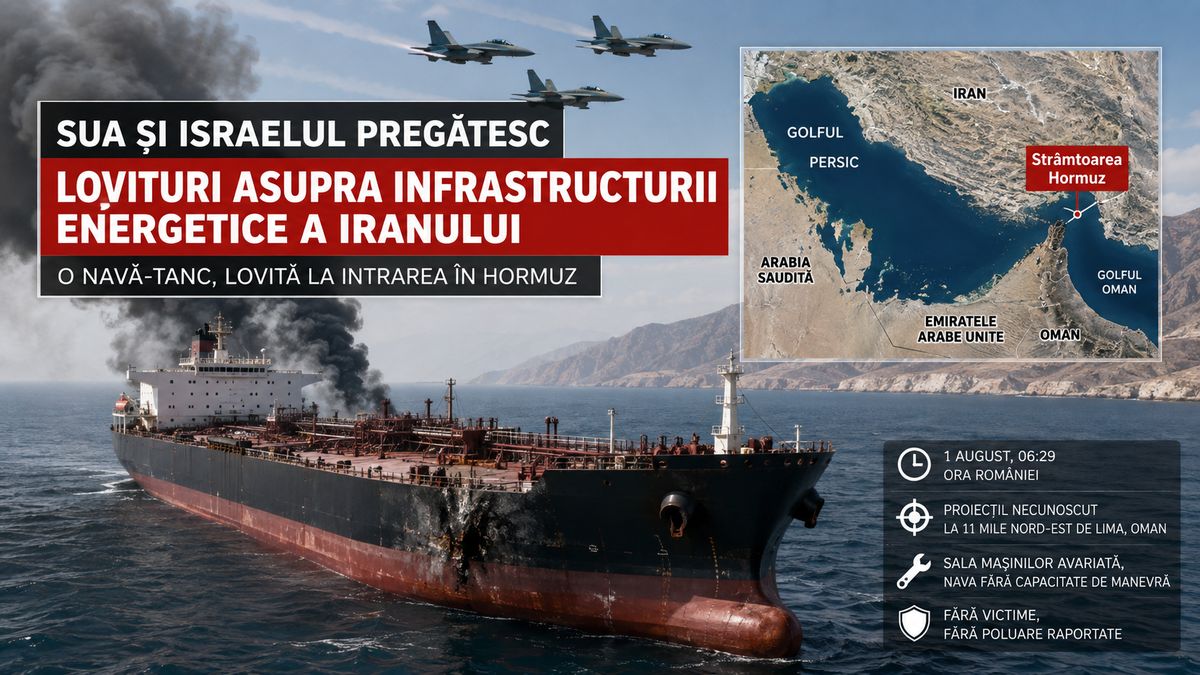
The United States and Israel are preparing a potential bombing campaign against targets within Iran's energy infrastructure, with strikes that could occur this weekend, according to CBS News, as cited by Reuters. However, US President Donald Trump had not yet granted final approval for the operation at the time the information was published. Just hours after this report emerged, a tanker was struck by an unknown projectile near Oman's Musandam Peninsula, right at the entrance to the Strait of Hormuz. The two developments have no proven causal link. The perpetrator of the tanker attack has not been identified, and the potential US-Israeli strikes against Iranian infrastructure have not yet been approved. Together, however, they increase pressure on the same regional energy system: onshore production and infrastructure on one hand, and transit through the Persian Gulf's primary oil chokepoint on the other. Iranian energy infrastructure enters military planning Reuters reported on July 31, citing CBS, that the United States and Israel are preparing a campaign against energy targets in Iran and that the strikes could take place over the weekend. CBS sources specified that Donald Trump had not yet given final approval. According to the same report, if launched, the campaign would be one of the harshest operations to date against Iranian energy infrastructure. Sources cited by CBS also indicated that there were discussions about concluding the strikes before financial markets open on Monday. This discussion does not represent a confirmed military timeline, nor is it a guarantee that the operation will take place. As of the morning of August 1, there is no verified public list of the targets slated for attack. Consequently, it cannot be determined whether any potential strikes would target production, refining, export, power facilities, or other components of Iran's energy infrastructure. This distinction is essential for assessing the economic impact. A strike on a production or export facility would have a different effect than an attack on power infrastructure, and the scale of the consequences would depend on the targets actually selected, the duration of the operations, and Iran's reaction. Trump also keeps the negotiation option open The military planning reported by CBS comes at a time when Washington has not completely closed the diplomatic channel. On July 31, Trump declared that he still saw the possibility of a deal with Iran, while simultaneously stating that he was losing confidence in the Iranian side and that military pressure would continue. The situation thus remains fluid: the US administration is discussing negotiations but keeps a new military escalation on the table. Energy infrastructure becomes relevant precisely because an attack on it would shift a larger share of the conflict's cost from the strictly military sphere to the functioning of the Iranian economy and regional energy markets. A projectile strikes a vessel at the entrance to Hormuz On August 1, at 03:29 UTC (equivalent to 06:29 Romanian time), the United Kingdom Maritime Trade Operations reported that a tanker was struck by an unknown projectile approximately 11 nautical miles northeast of Limah, Oman. The projectile damaged the engine room, leaving the vessel "not under command"—a maritime term indicating an inability to maneuver normally. British authorities stated that no casualties or environmental impacts were reported. Limah is located on the Musandam Peninsula, at the entrance to the Strait of Hormuz. The location of the incident gives it greater significance than an attack in a secondary shipping lane: the vessel was hit right next to the corridor through which tankers and other commercial ships enter and exit the Persian Gulf. In the information published by the maritime authority and Reuters, there is no attribution for the attack. The exact type of projectile has not been publicly established. Therefore, the incident cannot be presented as an Iranian attack, nor as a consequence of US-Israeli plans. Hormuz remains partially open, but traffic is heavily disrupted The incident on the morning of August 1 follows a further deterioration of the maritime situation. The day before, Iran's Revolutionary Guard claimed they had struck two vessels and forced four others to turn back. Reuters noted that these claims could not be independently verified. At the same time, data from monitoring firm Kpler showed that two large tankers, loaded with oil in the Gulf, crossed the strait alongside two other commercial vessels. However, tracking systems do not capture all transits, as some vessels sail with their transponders turned off. Traffic through Hormuz is therefore not completely halted. However, it is much more restricted and unpredictable than under normal conditions. Reuters reports that Iran has blocked most transit through the strait since the beginning of the conflict, though some vessels have managed to negotiate passage.…