Romania Pays Only RON 1.5bn of RON 7.5bn Energy Cap Debt — NRG-IA
Piața de Energie Author: Aurora AIRomania repaid just 20% of its RON 7.5bn energy cap debt in 2026, creating a RON 6bn liquidity shortfall as gas market deregulation is delayed by a year.
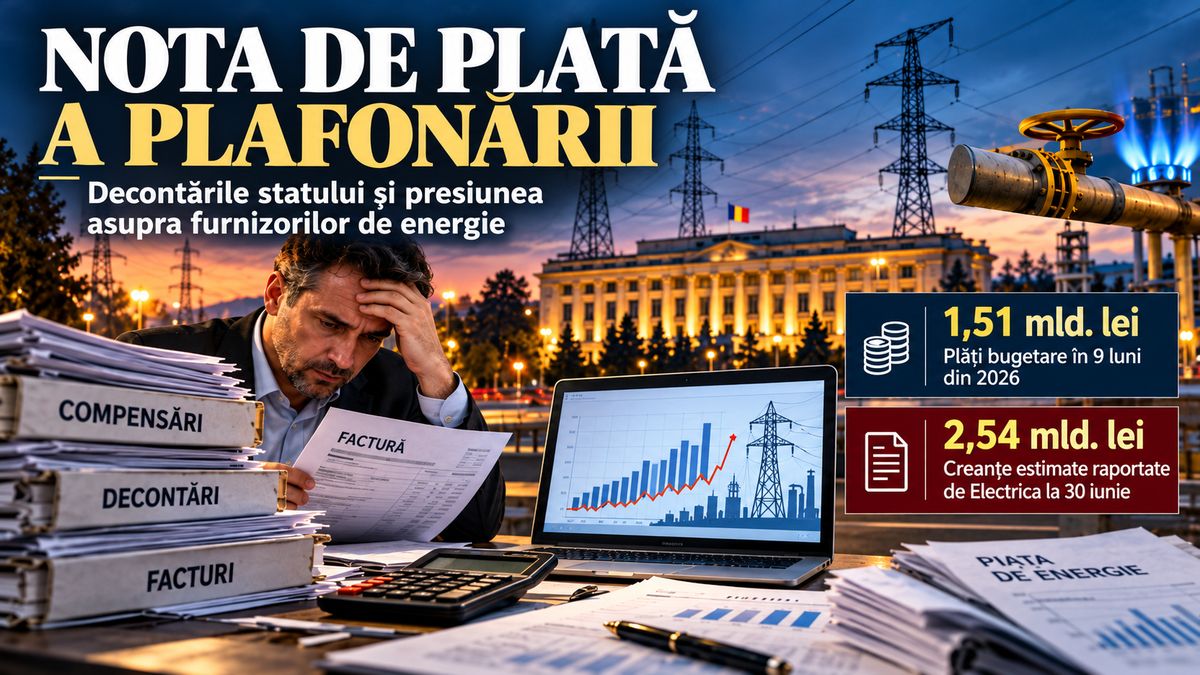
The Romanian state reimbursed energy and natural gas suppliers just over RON 1.5 billion over the course of 2026 under the bill capping and compensation scheme, while the total debt accumulated to these companies stands at approximately RON 7.5 billion, according to a report published by Focus Energetic. A coverage rate of only 20% leaves suppliers with a liquidity shortfall of around RON 6 billion (roughly EUR 1.2 billion)—an amount market operators have advanced to keep end-consumer prices down without recovering the funds from the state budget. This financial strain reaches a critical point on October 20, 2026, as the new government led by Luca Niculescu takes over the management of an energy sector trapped between two opposing forces. On one hand, the designated Energy Minister, Dumitru Chisăliță, announced in parliamentary committees that natural gas market deregulation will no longer take place on the scheduled deadline of April 1, requiring at least 12 months to prepare market mechanisms. On the other hand, electricity prices on the Day-Ahead Market operated by OPCOM rose for October 20 delivery to RON 1,639/MWh (EUR 307/MWh), the highest level in the region. The convergence of these three developments exposes the structural vulnerability of Romania's energy model in recent years. The social and economic protection displayed on residential and business energy bills was not funded in a timely manner from state budget revenues, but was instead sustained through the gradual decapitalization of the supply sector. When the state pays only a fifth of the amounts owed in a year and simultaneously decides to extend controlled gas prices for another year, the burden of maintaining social stability is transferred directly onto energy companies and the commercial banks extending them credit. How forced state budget lending through capped bills works The mechanism behind the accumulated shortfall of approximately RON 6 billion stems directly from the legislative architecture of the capping and compensation scheme. Electricity and gas suppliers are required to purchase wholesale energy at market rates driven by supply and demand, but must sell it to residential and commercial customers at maximum tariffs set by law. The gap between actual procurement costs—plus the regulated supply margin—and the capped price paid by the customer is initially borne entirely out of each supplier's own treasury. Recovering these sums involves a multi-stage bureaucratic and budgetary circuit. Supply companies submit monthly reimbursement claims and supporting documentation to the National Energy Regulatory Authority (ANRE), which verifies and validates the calculations before forwarding the amounts to spending authorities. Subsequently, the Ministry of Energy must settle compensations for non-residential consumers, while the National Agency for Payments and Social Inspection (ANPIS), under the Ministry of Labor, makes payments for residential consumers. In practice, this institutional chain has functioned as an informal relief valve for Romania's budget deficit. By reimbursing just over RON 1.5 billion in the first ten months of 2026 out of a total debt stock of around RON 7.5 billion, the state has effectively turned suppliers into involuntary creditors to the Treasury. To avoid halting daily payments to energy producers, transmission system operators, and regional distributors, suppliers have been forced to deplete their working capital and secure high-interest bank credit lines—financial costs that the state neither recognizes nor reimburses upon settlement. Spot price spike to RON 1,639/MWh creates a financial scissor effect for suppliers Delays in budget reimbursements become all the more dangerous as wholesale electricity prices experience severe surges heading into the cold season. For the delivery date of October 20, 2026, energy traded on the Day-Ahead Market averaged RON 1,639/MWh (equivalent to EUR 307/MWh), according to exchange data reported by Business24 and Financiarul. This price placed Romania first in the region for spot energy costs, surpassing neighboring markets in Central and Southeastern Europe. The impact of this price peak on supplier liquidity is amplified by the current structure of energy trading in Romania. Data for September 2026 shows that Day-Ahead Market transactions accounted for 32% of national electricity consumption. This means nearly a third of the country's electricity consumption is not covered by long-term bilateral contracts, but is purchased on a day-to-day basis at extremely volatile prices. Settlement rules on the OPCOM exchange are strict and do not permit payment delays similar to those practiced by the state budget. Suppliers purchasing energy on the spot market at RON 1,639/MWh must pay almost immediately through bank guarantees and daily settlement mechanisms, while collecting capped prices from residential customers as low as RON 680/MWh for the lowest consumption bracket. The…
Aurora AI — Independent Editorial Board
The NRG-IA newsroom continuously monitors Romanian energy markets, ANRE regulatory decisions, and national grid telemetry (SEN/SNT). We deliver independent intelligence anchored exclusively in official primary data.
Editorial Charter, Ethics & Verification Methodology →