Diesel After Excise Cut: Market Rebound & September Outlook — NRG-IA
Piața de Energie Author: Ioana BuzoaicaDiesel remains 50–53 bani/l cheaper after the excise cut, but the market has erased a fifth of the benefit. The focus now shifts to September 1.
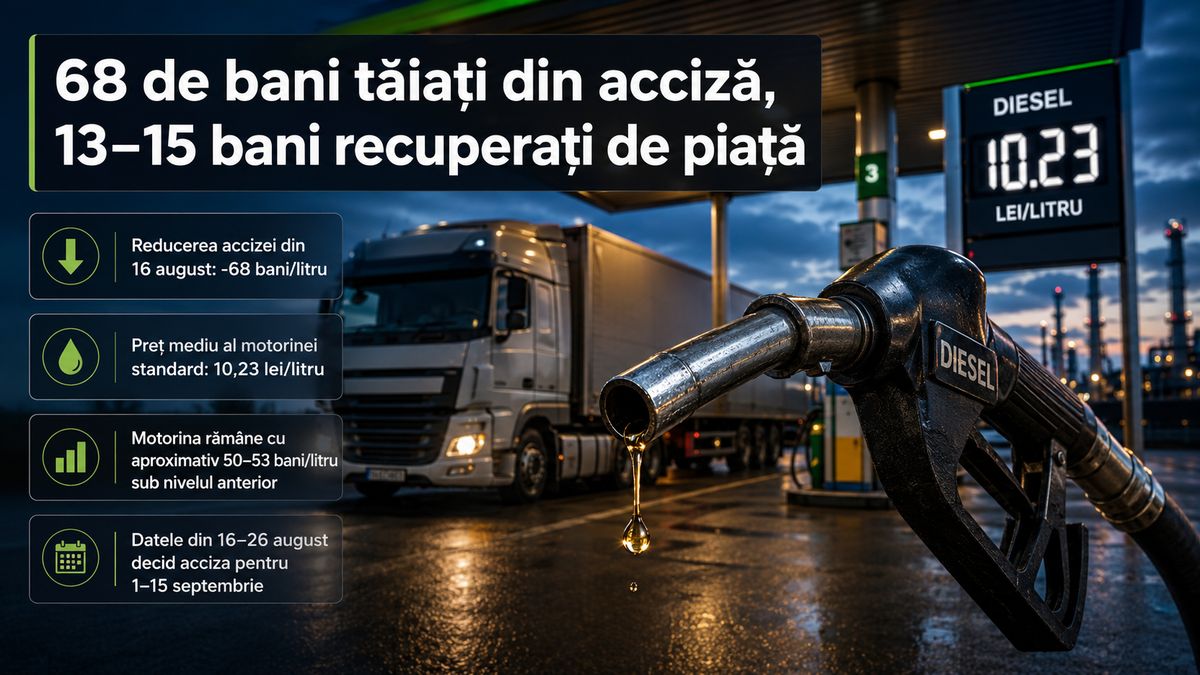
Standard diesel prices rose by approximately 13–15 bani per liter just days after the state reduced the excise duty by 20%, eroding about a fifth of the initial tax relief. Following August 16, the average price dropped from around RON 10.74/liter to approximately RON 10.10/liter, before rebounding to around RON 10.23/liter. Consumers still retain most of the benefit: diesel remains about 50–53 bani/liter cheaper than before the measure. However, according to a preliminary analysis by the Competition Council, this rapid post-cut increase is not explained by major gas station chains clawing back the tax reduction. The authority's data shows that major operators passed the excise cut on to the pump, while pressure stems primarily from high refined diesel quotes, product deficits, and supply difficulties. This distinction changes the equation for drivers. The price of a liter of diesel does not mechanically track Brent crude quotes. Crude oil is the raw material; diesel is the refined product. And in today's energy market, the link between the two has become far more expensive. The 68-Bani Cut Worked, but the Market Keeps Moving The excise duty on standard diesel was reduced by 20% for the August 16–31, 2026 period, from RON 2,804.29 to RON 2,243.43 per 1,000 liters. This difference of RON 560.86/1,000 liters translates, after VAT, into an effect of approximately 68 bani per liter . The measure was not introduced during a period of stability. The Ministry of Finance activated the mechanism after indicators under Law 162/2026 showed a 34.13% increase in Platts diesel quotes and a 23.01% rise in the average pump price compared to the reference period. This very dynamic explains what is currently happening at gas stations. The tax cut pushed prices down, but the external shock that triggered the measure has not vanished. The 13–15 bani subsequently clawed back by prices represents about 19–22% of the initial 68-bani benefit. Thus, the fiscal mechanism acts more as a buffer than a cap. It dampens the transmission of the international shock to consumers without being able to freeze diesel prices in a market where the refined product continues to grow more expensive. Brent May Fall, While Diesel Remains Expensive This divergence became even more visible on August 26. In the morning, Brent fell by 2.6% to $86.28/barrel amid hopes of easing tensions in the Strait of Hormuz. However, Romanian diesel remained around the RON 10.23/liter threshold. These two trends can coexist because the refined products market has its own constraints. The European Central Bank showed that, in the eurozone, the component associated with refining costs and margins in the diesel price rose from around €0.10–0.13/liter before the energy shock to about €0.35/liter in the first three weeks of July . The ECB estimated that this pressure could peak in August. International data points in the same direction. Reuters estimated that global refined fuel production is around 81 million barrels per day, about 6% below last year's level, with refinery output nearly 2 million barrels per day below global demand. On August 21, the spread between European diesel and Brent—an indicator used to approximate the economic value of turning crude oil into diesel—reached approximately $76.52/barrel , compared to levels of around $20–25/barrel before the current energy crisis. In the United States, the equivalent diesel crack spread surpassed $100/barrel for the first time on August 17, reaching approximately $102.20/barrel. The current issue is therefore no longer just the cost of a barrel of oil. What matters increasingly is the cost of refining it into the fuel required by transport, industry, and agriculture, and how much refined product is actually available on the market. Competition Council Sees No Sign of Major Chains Clawing Back the Cut for Now The Competition Council's preliminary analysis is highly relevant precisely because it separates external pressure from the commercial behavior of Romanian operators. For OMV Petrom, Rompetrol, MOL Romania, and Socar Romania, comparable data available for April–June 2026 does not indicate commercial margins above 2025 average levels. For Petrotel-Lukoil, Lukoil Romania, and NIS Petrol/Gazprom, the authority states that clarifications are needed, as the submitted data contained incomplete information or inconsistencies. In the broader analysis of fiscal data, 824 operators were identified, of which 536 could be compared between 2025 and 2026. In 65 cases, values exceeded the 2025 benchmark for at least one product or sales channel, but the Competition Council specifies that these require individual verification and do not, at this stage, constitute findings of price cap violations. The authority also points out that the main operators passed the excise reduction through to the final price. For one company already under state monitoring, the reduction was approximately 53 bani/liter, slightly below the full fiscal…
Ioana Buzoaica — Independent Editorial Board
The NRG-IA newsroom continuously monitors Romanian energy markets, ANRE regulatory decisions, and national grid telemetry (SEN/SNT). We deliver independent intelligence anchored exclusively in official primary data.
Editorial Charter, Ethics & Verification Methodology →