PET Bottles as Battery Graphite: Penn State Research — NRG-IA
Tehnologie & Inovație Author: Ioana BuzoaicaDiscarded PET bottles could become raw material for EV batteries. Researchers made synthetic graphite from waste plastic, but industrial tests are needed.
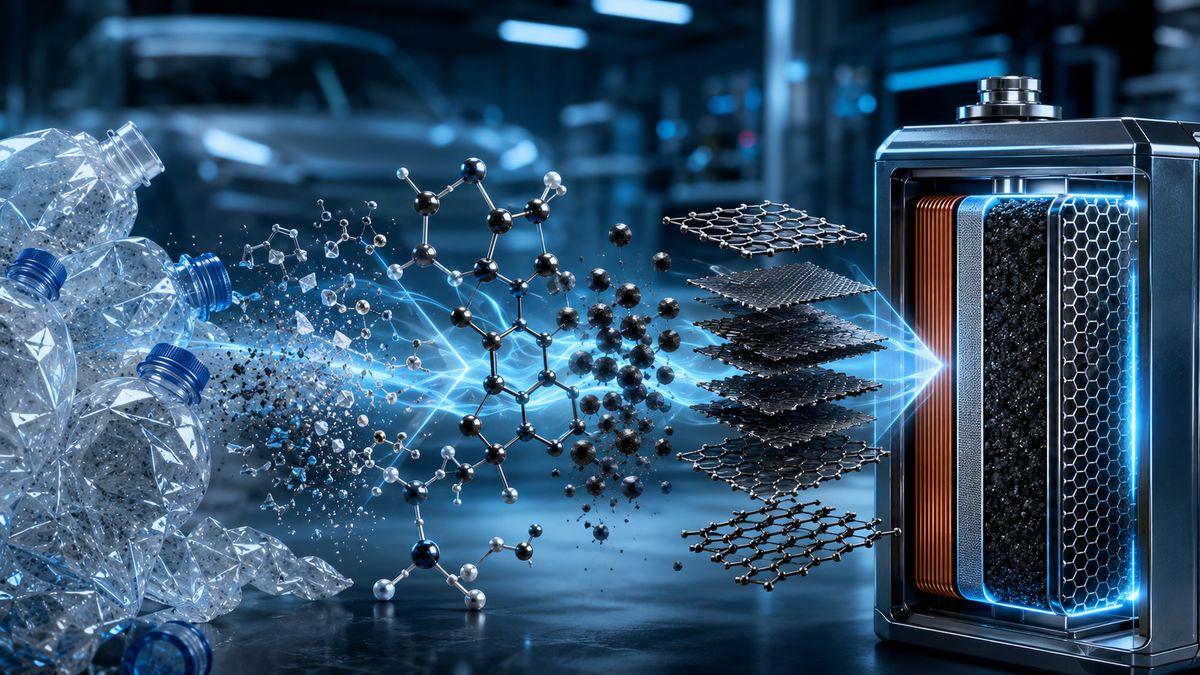
PET bottles could have a second life far more valuable than that of recycled packaging or textile fibers. A team of researchers at Penn State has demonstrated that the plastic used in bottles can be converted into synthetic graphite, a material found inside most lithium-ion batteries used today in electric vehicles, phones, laptops, and energy storage systems. This is not about inserting a bottle directly into a battery, nor is it a technology ready for immediate factory deployment. In the lab, researchers obtained a carbon material with a highly ordered structure, close to what the industry seeks for the battery component that receives and releases energy during charging and discharging. The result opens up a new direction: waste plastic would no longer be just a collection and recycling challenge, but could become a raw material for the battery economy. A Plastic Bottle Viewed as an Energy Resource PET is one of the most common types of plastic in the world. It is the material used to produce many water bottles, soft drinks, and other beverage packaging. Even though some of this packaging ends up in collection systems, not all plastic can be recycled back into products of the same quality. Some is downcycled into cheaper products, some degrades in the recycling chain, and some ends up in landfills or incineration. The Penn State researchers started with a simple question: can this plastic be transformed into a material more valuable than the packaging it came from? Their answer is promising. Through a controlled thermal process and by using a small amount of graphene oxide, the team succeeded in reorganizing the carbon in PET into a form of synthetic graphite. While the general public does not need to follow every laboratory step, the key takeaway is that the resulting material had a more ordered structure than the commercial natural graphite sample used by the researchers as a benchmark. In simple terms, the PET bottle is no longer treated merely as waste. It becomes a potential carbon source for a material that batteries increasingly require. Graphite Is One of the Hidden Raw Materials of the Energy Transition When discussing batteries, public attention almost automatically shifts to lithium. However, graphite remains one of the essential materials in a lithium-ion battery, as it is typically used in the anode—the component that stores and releases energy during operation. Without graphite, the expansion of electric vehicles and large-scale grid batteries would become far more difficult. Global demand for graphite, cobalt, nickel, and rare earths grew by 6–8% in 2024, primarily driven by batteries, electric vehicles, grids, and clean energy technologies. This demand is rising at a time when supply chains are concentrated in just a few countries. The IEA points out that between 2020 and 2024, most of the global growth in refined graphite production was concentrated in China, and reliance on a handful of suppliers remains one of the battery industry's major vulnerabilities. Therefore, any technology that can produce graphite from sources other than traditional mining attracts industry attention. This is not because it can immediately replace existing mines or factories, but because it can create new material sources in a market where security of supply is becoming just as important as the price of the battery itself. From Recycling to Industrial Raw Material The most interesting aspect of this research is not just the conversion of plastic into graphite; it is the shift in perspective. Until now, most discussions about PET have focused on recycling: how many bottles are collected, how much plastic ends up in nature, and how much material can be reused in packaging or textiles. The Penn State research suggests a different direction: PET that can no longer efficiently re-enter the traditional recycling loop could become a raw material for higher-value products. This could represent a major shift for the industry. Instead of waste plastic being sold cheaply, transported, recycled multiple times, and gradually degraded, a portion of it could enter a new supply chain linked to batteries, electric mobility, and energy storage. The material obtained in the study is not presented as an instant replacement for natural graphite. The researchers explicitly state that further testing in real batteries and evaluations of large-scale production are still required. This is the boundary separating a laboratory result from industrial change. A material may look excellent in analysis, but it must prove that it can endure over time, perform stably during charging and discharging, be produced uniformly, and remain price-competitive. The Big Question: Can Plastic Become Graphite Without Consuming Too Much Energy? The fact that PET is cheap and readily available does not automatically guarantee that the graphite derived from it will be inexpensive. The process must be analyzed beyond just the raw material. Bottles must be…
Ioana Buzoaica — Independent Editorial Board
The NRG-IA newsroom continuously monitors Romanian energy markets, ANRE regulatory decisions, and national grid telemetry (SEN/SNT). We deliver independent intelligence anchored exclusively in official primary data.
Editorial Charter, Ethics & Verification Methodology →