Iran's Offshore Oil Stocks Plunge Under US Naval Blockade — NRG-IA
Geopolitică & Energie Author: Ioana BuzoaicaIran's floating oil stocks fell 99% under a US blockade, halting fast supplies to China and driving up diesel prices in Europe, Kpler data shows.
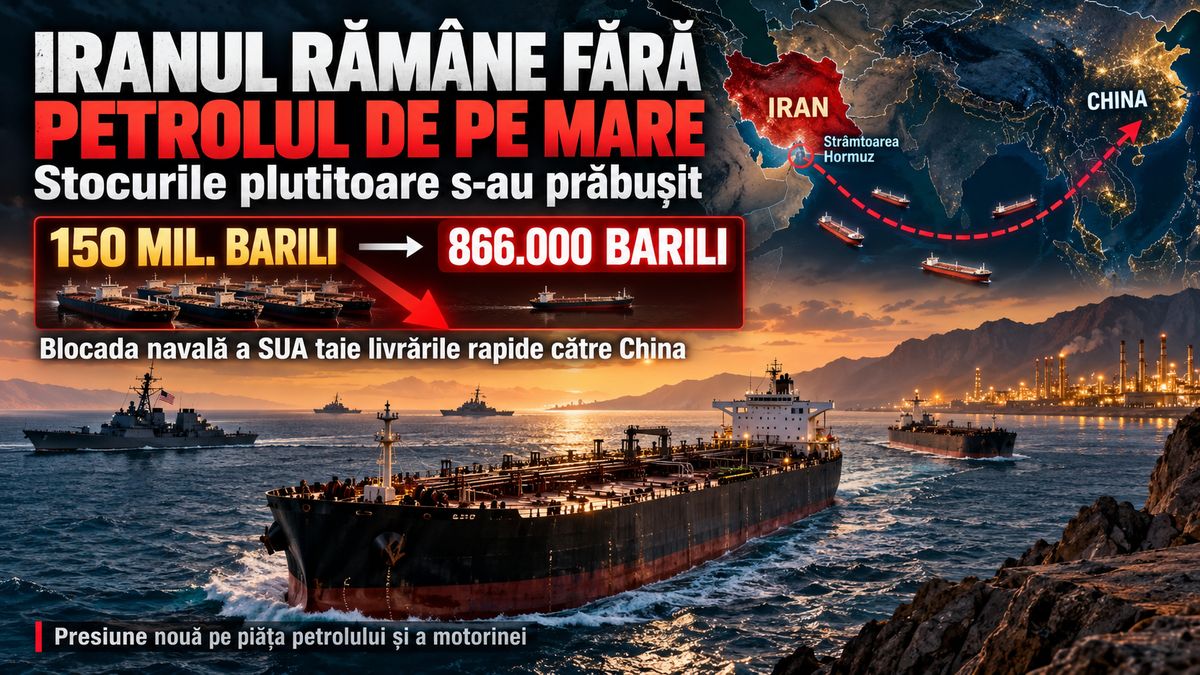
Iran's offshore oil inventories held on tankers used as floating storage plunged from 150 million barrels in April to just 866,000 barrels by mid-October, according to data from maritime analytics firm Kpler, cited by The Wall Street Journal and OilPrice.com . This collapse of over 99% represents the near-total depletion of Tehran's mobile commercial buffer in international waters and halts the Iranian regime's ability to make rapid deliveries to refiners in China. With a single Very Large Crude Carrier (VLCC) having a standard capacity of two million barrels, the volume remaining at sea today amounts to less than half a single ship's cargo. Homayoun Falakshahi, lead crude analyst at Kpler, told The Wall Street Journal that Iran has run out of sea-stored oil for direct discharge to Chinese buyers. While Iran's onshore and offshore oilfields continue to extract crude, the collapse specifically impacts floating storage—the fleet of tankers anchored offshore that Tehran used as a commercial buffer to transfer oil outside enforcement zones. The disappearance of this inventory eliminates Iran's ability to make prompt sales on the Asian spot market and severely restricts the regime's immediate foreign exchange revenues. From 150 Million Barrels in April to Total Gridlock Following July Truce Failure The drawdown of Iran's floating storage explains how the Asian market absorbed the initial shock of the Persian Gulf conflict for six months before feeling the physical tightness this autumn. In April, when the United States instituted a naval blockade on Iranian oil ports, Tehran held roughly 150 million barrels of crude at sea that had already been extracted and moved out of the conflict zone. Even as US naval patrols severely restricted the departure of new tankers from Iranian terminals, independent Chinese refineries were able to continue purchasing and processing Iranian crude by drawing down these floating stockpiles. Driven by ongoing sales from the floating reserve and the inability to replenish it at the same pace, the volume of Iranian crude stored at sea dropped below 50 million barrels by mid-June. A brief easing of restrictions occurred in early summer following a temporary ceasefire agreement between Washington and Tehran, but the talks collapsed in mid-July. From that point, the US Navy reinstated and intensified its maritime blockade at the entrances to the Gulf, severing the offshore fleet's replenishment pipeline and driving floating stocks down to a critical 866,000 barrels by mid-October. Despite losing this vital export conduit and facing a complete freeze in diplomatic talks with Washington, authorities in Tehran reject predictions of a financial collapse. The Governor of the Central Bank of Iran told The Wall Street Journal that the country's economy demonstrates strong resilience against restrictions, calling claims of an economic breakdown mere delusion. In reality, however, with offshore stocks drained close to zero, Iran now relies exclusively on direct loadings from its onshore terminals, which remain exposed to interception by US naval forces. How the Shortage of Iranian Crude in China Drives Up Diesel Prices in Europe and Romania The impact of losing nearly 150 million barrels from floating storage extends far beyond bilateral trade between Tehran and Beijing, hitting the European fuel market directly. Iranian crude exports primarily consist of medium and heavy sour grades—the exact feedstock refiners prefer to maximize yields of diesel, jet fuel, and other middle distillates. Once Chinese refiners can no longer unload Iranian crude from offshore storage, they are forced to redirect purchases to the open spot market in the Middle East and Africa to keep their units running. This sudden shift by Chinese buyers creates direct competition with European refineries for the same available volumes of medium and heavy crude. For the European Union and Romania—where the market faces a structural deficit in diesel production and relies both on seaborne crude imports for local refineries and direct imports of refined fuel—Asian competition inflates feedstock costs and keeps benchmark diesel prices elevated. This phenomenon coincides with refining shortfalls in Kuwait and Brent crude rising to $111.10 per barrel, heightening inflationary pressure on European transport and logistics networks as the cold season begins. A $265 Billion Toll on US Households Ahead of November Elections While the US naval blockade has achieved its military and operational goal of draining Iran's commercial buffer, the domestic economic fallout is exerting severe political pressure on the administration in Washington. An assessment published by Moody's indicates that the financial toll of the prolonged conflict with Iran has reached $265 billion for US households, driven by rising energy, fuel, and derivative product costs. This $265 billion bill comes at a crucial political juncture, just weeks before the US midterm…
Ioana Buzoaica — Independent Editorial Board
The NRG-IA newsroom continuously monitors Romanian energy markets, ANRE regulatory decisions, and national grid telemetry (SEN/SNT). We deliver independent intelligence anchored exclusively in official primary data.
Editorial Charter, Ethics & Verification Methodology →