Molten salt reactors: US counters China's lead — NRG-IA
Geopolitică & Energie Author: Aurora AIThe US accelerates thorium molten salt reactor development to counter China, while securing its SMR outpost in Doicești, Romania.
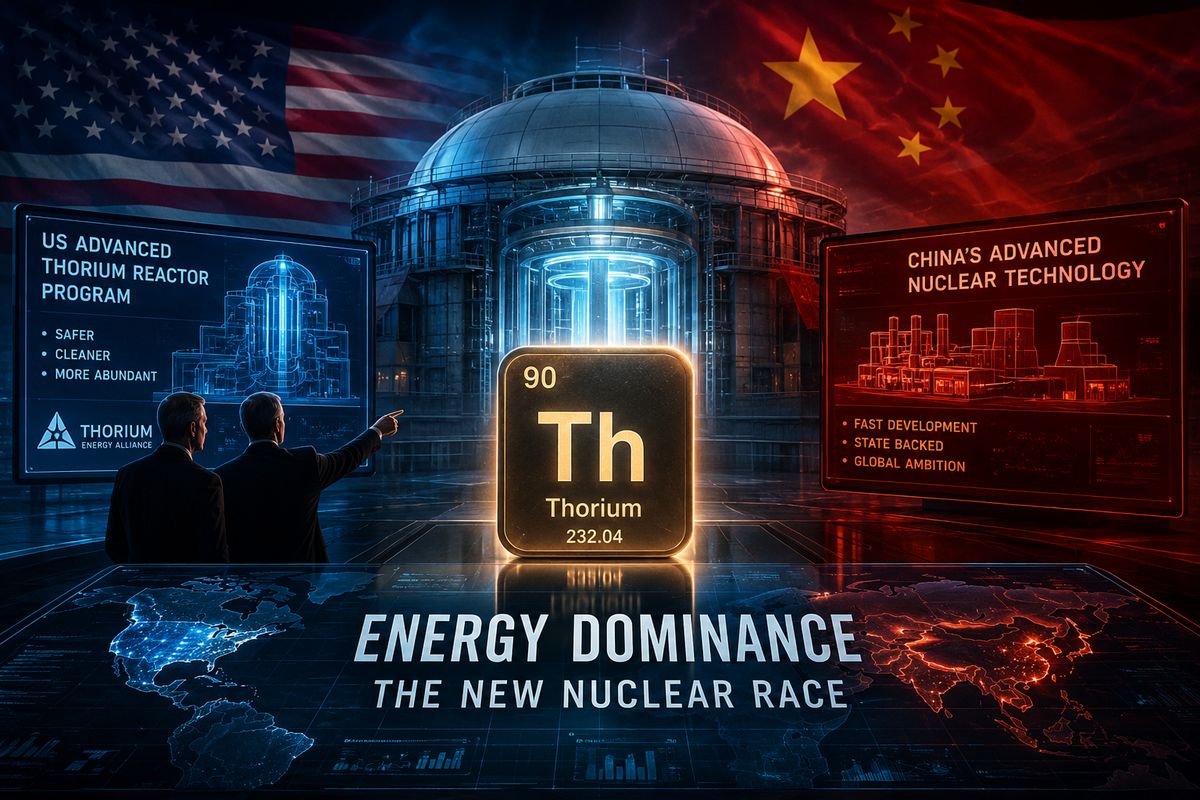
Developing Thorium-Based Reactors — Washington’s Technological Offensive A United States firm has completed a key development phase for its commercial thorium-based molten salt reactor, entering into direct competition with China's advanced nuclear technology. The project marks a turning point in US efforts to deploy a viable alternative to conventional uranium-based nuclear reactors. This initiative is indirectly supported by the US Department of Energy (DOE), which previously selected 11 firms under its advanced reactor pilot program to accelerate funding and testing of next-generation technologies. Molten Salt Reactor (MSR) technology utilizing thorium as a fuel promises significantly higher thermal efficiency and an improved safety profile compared to traditional pressurized water reactors. Unlike conventional facilities, molten salt reactors operate at near-atmospheric pressures, eliminating the risk of steam explosions. Furthermore, thorium is approximately three to four times more abundant in the Earth's crust than uranium, and its radioactive waste has a significantly shorter half-life, reducing the long-term pressure on geological repositories. This strategic move by the US private sector comes as Washington expands its civil nuclear footprint in Eastern Europe, using Romania as a launchpad for its first small modular reactor (SMR). The Doicești project, developed in partnership with Nuclearelectrica, has already secured an initial $99 million funding approval from the US Exim Bank and was officially approved by the Romanian state company's shareholders in early 2026. Consequently, the race for next-generation nuclear supremacy is moving from design boards straight to emerging markets on NATO's eastern flank. Securing the Supply Chain and Countering Beijing’s Monopoly The massive push for nuclear research in the US is driven by China's rapid progress, having already commissioned an experimental molten salt reactor in the Gobi Desert with plans to build large-scale commercial variants by 2030. Beijing currently controls a significant portion of the global supply chain for processing rare earths and critical metals required for these advanced reactors, creating a major technological dependency risk for the West. To counter this monopoly, the US is attempting to establish a network of commercial partners capable of supporting both advanced nuclear fuel production and high-tech component assembly. In this geopolitical context, thorium-based technology offers the United States a major strategic advantage: thorium cannot easily be weaponized for nuclear arms, simplifying export agreements and reducing proliferation risks. This technical characteristic allows Washington to offer international partners decarbonization solutions without triggering diplomatic disputes over military security. However, transitioning from prototype to commercial operation requires massive capital investments and an entirely new regulatory framework, which US and European regulators are only beginning to define. Balancing Regional Power Grids and the Impact on Market Prices While future technologies remain in the testing phase, European energy markets acutely feel the need for constant baseload nuclear capacity to stabilize prices. The importance of nuclear energy was recently demonstrated in Romania, where the restart of a Cernavodă reactor following a planned outage immediately eased short-term power price spikes on the spot market in July 2026. This event highlights the vulnerability of regional grids to production fluctuations from renewable sources and underscores why regional states are prioritizing the expansion of nuclear capacity. The deployment of US SMRs at Doicești and, eventually, molten salt technologies is viewed by specialists as a medium-term solution to replace decommissioned coal plants. However, integrating these new technologies into national grids involves high upfront costs, which will influence transport and distribution tariff structures. While advanced nuclear energy promises to reduce bill volatility for industrial and household consumers in the long run, the transition phase will require complex state aid schemes, drawing close scrutiny from antitrust authorities in Brussels. EU Regulatory Hurdles and the Commercial Deployment Timeline The biggest short-term challenge for US-backed nuclear expansion in Europe remains the stringency of EU state aid regulations. The European Commission has already opened an in-depth investigation into the Romanian state support granted for the refurbishment of Cernavodă Unit 1. This probe serves as a warning sign for all new nuclear projects, including Doicești, suggesting that funding mechanisms and state guarantees will be heavily scrutinized to prevent market distortion. US developers of molten salt reactors and consortia promoting SMRs face a deadline of the early 2030s to demonstrate the commercial and economic viability of these new facilities. Until then, major…