US Strategic Petroleum Reserve Hits 1982 Low Below 283M Barrels — NRG-IA
Geopolitică & Energie Author: Ioana BuzoaicaUS Strategic Petroleum Reserve falls below 283 million barrels to a 44-year low as Brent tops $110/bbl, straining Washington's intervention capacity.
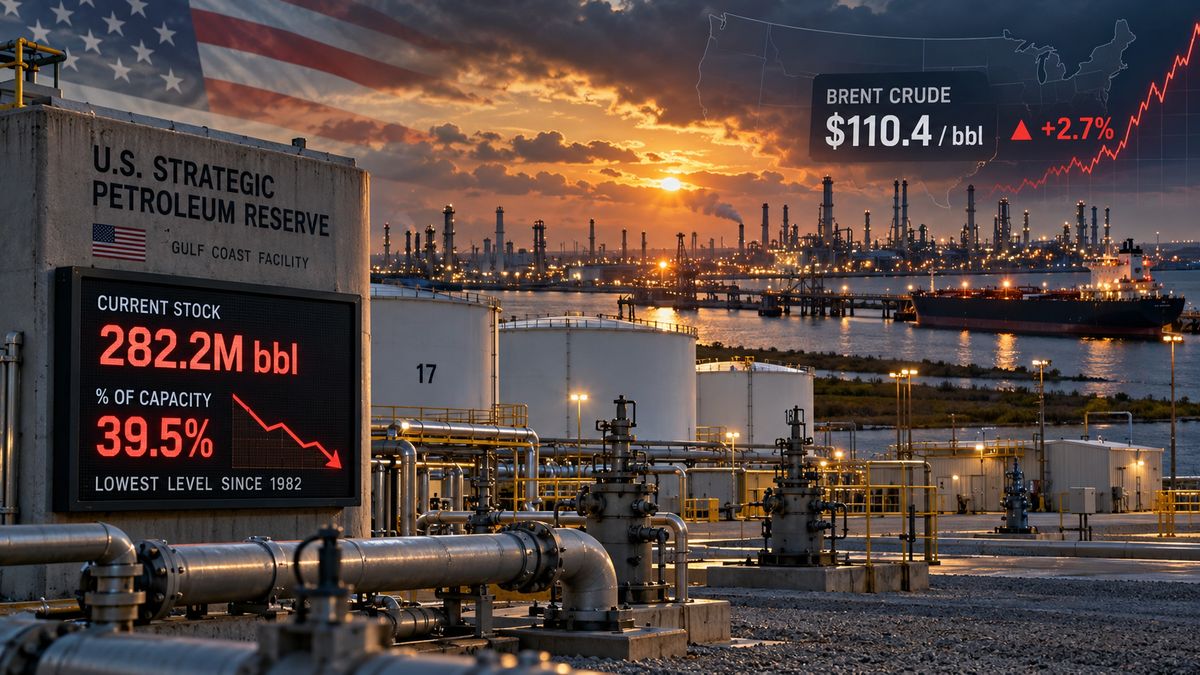
The United States has reached its lowest Strategic Petroleum Reserve level since October 1982, at a time when the global market is facing supply disruptions and Brent crude oil prices exceed $110 per barrel. Data published by Reuters on October 19, 2026, indicates a stockpile of 282.7 million barrels following successive oil releases used to support international markets. Direct reporting from the US Department of Energy shows 282.2 million barrels as of October 16, confirming that the federal inventory has fallen below the 283 million mark. The scale of the reduction is substantial. The US Strategic Petroleum Reserve (SPR) has an authorized storage capacity of 714 million barrels, meaning that only approximately 39.5% of this capacity remains filled. Compared to the historical peak of 726.6 million barrels reached in December 2009, the volume currently available represents less than two-fifths of the amount stored at that time. The decline occurs during a major US drawdown program coordinated with the International Energy Agency. In March 2026, IEA member countries agreed to a collective emergency release of 400 million barrels, the largest in the history of the international emergency response mechanism. The announced US contribution stands at 172 million barrels. Concurrently, a federal audit published in 2026 reveals that the infrastructure of the US reserve suffers from modernization delays that constrain drawdown and refilling capabilities. US Reserve Decreased by Nearly 129 Million Barrels Since Late 2025 As of December 31, 2025, the US strategic reserve held approximately 411 million barrels. Compared to the official inventory of 282.2 million barrels on October 16, 2026, the decline amounts to nearly 128.8 million barrels, equivalent to a 31.3% drop in stocks existing at the end of last year. This reduction reflects the intensive drawdowns during the first ten months of the year aimed at offsetting oil market disruptions. The crude oil is stored across four underground sites in Texas and Louisiana, within salt caverns. According to Department of Energy data for October 16, approximately 138 million barrels were stored at Bryan Mound, 89.1 million at Big Hill, 31.4 million at Bayou Choctaw, and 23.7 million at West Hackberry. These four sites comprise the federal system designed to rapidly inject significant volumes of crude oil into the market during severe supply disruptions. The current decline comes on top of releases in prior years. In 2022, the US administration authorized the release of 180 million barrels in response to market disruptions triggered by Russia's invasion of Ukraine. Over time, inventories have also been drawn down through congressionally mandated sales, including for budgetary purposes and to finance system modernization. The October 2026 level is comparable to that recorded 44 years ago, when the US reserve was still being built up. The difference today is that the US operates a storage system designed for far larger volumes, but with a substantially diminished inventory following decades of use and two major release programs. Washington Continues Oil Releases Under 172 Million Barrel Program The current intervention was launched in March 2026 following the escalation of the conflict in Iran and the disruption of Middle Eastern oil flows. The 32 member countries of the International Energy Agency agreed to release 400 million barrels of crude oil and petroleum products from their emergency reserves. The US contribution of 172 million barrels constitutes the largest single share of the initiative. As of October 16, approximately 132.5 million barrels had already been drawn down from the US reserve as part of the intervention, according to data cited by Reuters. The Department of Energy has continued organizing competitive tender procedures for the remaining volumes, including a new solicitation released on October 16 for exchange bids involving up to 17 million barrels. A key feature of the 2026 program is the use of crude oil exchange mechanisms. Participating companies temporarily receive crude oil from the strategic reserve and commit to returning the volumes later, alongside an additional contractually agreed volume. Through this approach, the administration aims to boost immediate market supply while securing the subsequent replenishment of federal inventories via premium return volumes. However, this mechanism creates a significant temporal disconnect between current supply needs and future stock replenishment. Crude is delivered to the market during a period of supply tightness, while payback deliveries are scheduled over subsequent years—some extending through late 2028. Actual refilling capability will depend on contract compliance, facility availability, and operational conditions for receiving crude. The US intervention aims to bolster supply at a time when energy markets are vulnerable to production, transit, and infrastructure risks. In trading on October 20,…
Ioana Buzoaica — Independent Editorial Board
The NRG-IA newsroom continuously monitors Romanian energy markets, ANRE regulatory decisions, and national grid telemetry (SEN/SNT). We deliver independent intelligence anchored exclusively in official primary data.
Editorial Charter, Ethics & Verification Methodology →